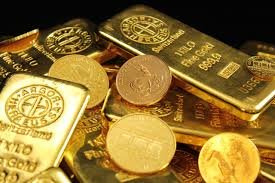
Gold prices have taken a massive surge and jumped over 2% as a weakening US dollar and the evolving expectations of Federal Reserve policy gave the precious metal a strong tailwind. The surge is an indication of a larger market shift of sentiment as investors respond to new economic data and geopolitical events that have all led to the reduction of the immediate fear of increased interest rates.
Spot gold improved significantly to hit about $4,587.09 per ounce, and the US gold futures contracts with an even greater lead of 4.2 per cent. settled at around $4,586.10 both for April delivery. This rebound is one of the best daily performances of the yellow metal in several months, an indicator of a new interest in safe-haven assets in an increasingly complicated global economic environment.
Primary catalyst and inflation sentiment
The major driving force behind the gains of the day was the visible drop in the index of the US dollar, which went down by about 0.17% to 97.68. The price of gold has an inverse relationship with the strength of the greenback in the world of global commodities.
Since gold is traded in US dollars in the world markets, a weaker dollar will ensure that the metal will be much cheaper and much more accessible to other currency holders. This demand due to currency is usually a pillar to support prices during volatile times.
The current low in the dollar is a result of a series of continuing trade uncertainties and the legal events in the United States. As an element that has exerted a downward pressure on the currency, analysts have cited the repercussions of the US Supreme Court invalidating some of the high tariffs that had been placed previously on imports.
Although the White House talks of the possibility of raising uniform tariffs, the currency markets have reacted immediately to the proposal, with a rush toward consolidation, enabling the bullion currency, which is covered by the greenback, to shine again. This has prompted international investors to return to the gold market, where they are seizing the opportunity to hedge their exposure against broader market risks, given the favorable exchange rate.
In addition to the currency price changes, the gold rush was strongly backed by a shift in the attitude towards the Federal Reserve interest rate direction. Inflation trends and other economic indicators have started pointing to the fact that the period of violent rate increases might be coming to an end, further alleviating the competition that the central bank would continue its restrictive monetary policy further than expected.
The opportunity cost of holding the non-yielding assets, such as gold, declines when the chance of an increase in interest rates is lost. These higher precious metals are a more attractive substitute compared to other interest-bearing instruments like government bonds, where yields usually decline in case rate-cut expectations are renewed.
Market participants are also paying much attention to soft inflation data to indicate that the Fed might be more capable of maneuvering in the next few months. Fears of rate hikes were appeasing, and the result has been a stampede into gold as a hedge against economic stagnation that might be coming.
According to Christopher Wong, a strategist at OCBC, the market environment is currently very sensitive to the expectations of the Federal Reserve policy. With the market turning away from fear that there will be more tightening to look forward to, and as a possible easing begins to be considered, gold is once again emerging as a major beneficiary of this structural change in monetary mood.
Geopolitical developments and sustained institutional demand
Geopolitics has also been critical in the 2% increase in the price of gold. The continued tension between the United States and Iran, in addition to doubt surrounding the global trade discussions, has strengthened the historical use of gold as a “safe-haven” asset.
When there is instability in international relations or a conflict between countries, investors normally rush to the safety of gold. The prolongation of the nuclear talks in Geneva with no evident improvement, as well as the new threats between the largest world powers, has maintained the risk premium on gold at high levels.
The activity of the central bank remains a strong price floor. It has been reported that large institutions, including the People’s Bank of China (PBOC), have kept on with their steady purchase of gold, with fifteen months of accumulation as of early 2026.
This institutional need, coupled with structural supply limitations in the silver and gold business, indicates that the overall uptrend does not appear to be impaired. Strong support areas of gold have been noted by the analysts at around the ₹1,58,800 level on the MCX, and resistance has been witnessed to come to the close at the ₹1,61,400 level and above.
Conclusion
The increase in gold prices to a level of more than 2% is a complex reaction to a friendlier macroeconomic climate. The convergence of a weaker US dollar that reduced the entry point of foreign investors and the weakening of the fear about increased interest rates have rejuvenated the attractiveness of the metal. Although geopolitical tensions and trade uncertainties offer the safe-haven demand required, the long-term changes in monetary policy expectations in the sector are the most notable.
With the market still digesting the incoming information on both inflation and central bank messages, the future of gold is structurally bullish. Investors will probably be immune to the changing equation of the economic growth and inflationary pressures, but at least in the short term, the least path of resistance of the yellow metal looks upwards.