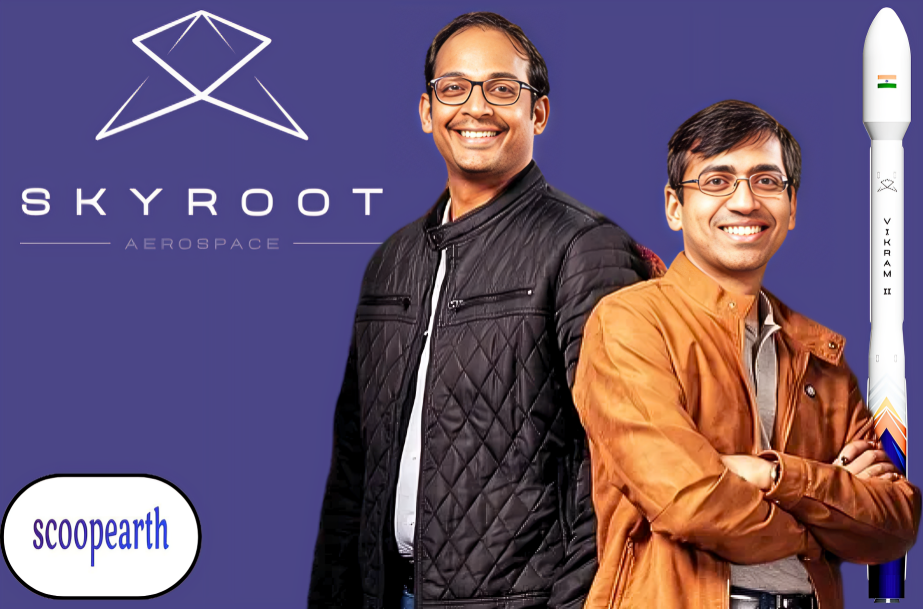
The private space technology industry in India is going through a significant operational milestone, with key companies moving from research and development to monetizing. Skyroot Aerospace, the space tech startup based out of Hyderabad, has achieved its maiden crossing of the ₹100 crore revenue milestone for FY26, provisional financial statements reviewed by Entrackr.
The milestone represents the first time the company is generating meaningful revenue since it was founded, and it is an active reflection of the company’s corporate lifecycle. The release follows the company’s becoming India’s first ‘spacetech unicorn’ after a $60 million fundraising round, which valued the company at around $1.1 billion.
Provisional operating revenue
Skyroot Aerospace has recorded provisional operating income of ₹100.6 crores in FY26. This achievement holds relevance because the company was able to accomplish this without undertaking any commercial launch of rockets. All of this newfound revenue comes directly from the commercialization of its Space Systems business, since the maiden launch of its flagship Vikram-I rocket has yet to be executed.
It marks a complete shift from the previous year (FY25), when the company was still a completely pre-revenue entity without any net operating income. The vertical for space systems devotes significant attention to the production and provision of highly sophisticated sub-assemblies for space systems and satellites.
The startup creates a wide variety of specialized components such as composite satellite structures, payload adaptors, propulsion systems, composite motor cases, actuators, nozzles, and other ancillary and miscellaneous products found in space vehicles and satellites. With these hardware capabilities monetized in FY26, Skyroot was able to maintain a consistent stream of revenue as well as simultaneously maintain the capital-intensive process of development and qualification of its core shell-mount and precursor-to-SLV orbital launch vehicles.
Expansion and commercial pipeline
The business achieved higher sales, but the net result is a financial profile that is characteristic of a deep-tech aerospace startup with heavy capital costs and high overheads. For FY26, Skyroot posted a net operating loss of ₹130.3 crore, which is a negative Earnings Before Interest, Taxes, Depreciation, and Amortization (EBITDA) figure.
The losses are increased from the previous financial year, when the company reported a negative EBITDA of ₹107.7 crore. The larger deficit is being driven mainly by a corresponding surge in internal costs driven by scaling up the manufacturing, engineering, and manpower capacity of the company.
One of the primary drivers of this spending was an explosive growth in investments in human resources. The employee benefit expenses also increased from ₹35.9 crore in FY25 to ₹95.5 crore in FY26.
In addition to salary costs, the firm has also invested heavily in research and development, establishing specialized test laboratories and maintaining growing operational requirements. Under industry standards, these investments are considered critical to the safe, reliable and accurate production of aerospace equipment prior to use.
Skyroot Aerospace has presented an ambitious long-term financial plan that aligns with its planned launch schedule. According to the internal documents, the company is projecting its annual revenue to continue to rise at an exponential rate and is set to reach a whopping net worth of ₹13,205 crore in the fiscal year 2032 (FY32).
This high ascent curve is largely dependent on the successful transition of its core rockets, Vikram-I and Vikram-II launch vehicles, as well as their upcoming Reusable Launch Vehicle (RLV) programme into full commercial use with high frequency launches. Commercial pipeline forward visibility with substantial financial investments from global satellite operators.
According to the financial results posted on its website so far, by March 2026, Skyroot had received advanced customer payments of more than ₹252 crore. The robust backlog suggests strong interest on the part of both domestic and international clients regarding guaranteeing orbital slot access for future missions, providing the enterprise with a clear timetable to forge its multi-year business strategy.
Conclusion
The interim report for FY26 released by Skyroot Aerospace indicates a healthy development of the Indian private space tech industry, where private platforms are able to generate considerable commercial income without undertaking primary orbital missions. The company’s growing losses of EBITDA will serve as an indication of the price of building in-house aerospace platforms, but the availability of a strong backlog of sales and multi-billion dollar targets illustrates the evident commercial viability of the company.
The operational costs of scaling space systems manufacturing and the success in executing missions will govern whether the startup will achieve its ambitious target of ₹13,205 crore by FY32.