

Introduction
The United Kingdom is one of the world’s leading fintech markets. London, in particular, has become a major centre for digital banking, payments, lending, wealth management, and financial technology. UK fintech companies have changed how people send money, manage bank accounts, make payments, invest, borrow, and run businesses.
The growth of smartphones, open banking, cloud computing, artificial intelligence, and digital payments has helped fintech companies compete with traditional banks and financial institutions. Companies such as Revolut, Monzo, Wise, and Starling have made digital banking more convenient, while businesses such as Checkout.com and GoCardless have built technology that helps companies accept and move payments.
The UK fintech sector also has a strong global presence. Many companies founded in Britain now operate across Europe, North America, Asia, and other international markets.
This article highlights the Top 10 Fintech Companies in the UK, based on a combination of revenue, valuation, customer base, transaction volume, assets managed or administered, profitability, international presence, and overall influence in the financial technology industry. Because many leading UK fintech companies are privately owned, their valuations are based on the latest disclosed funding or secondary-market transactions rather than daily stock-market values.
Revolut

Image Courtesy: Revolut / Official Website
| Founded | 2015 |
| Headquarters | London, England |
| Latest reported valuation | US$115 billion |
| 2025 Revenue | Approximately £4.5 billion |
| CEO | Nik Storonsky |
Revolut is one of the UK’s most successful fintech companies and has grown into a global digital banking platform.
The company started with a focus on low-cost foreign exchange and international money transfers. It has since expanded into personal banking, business accounts, cards, savings, investments, lending, insurance, payments, and wealth management.
Revolut reported revenue of approximately £4.5 billion in 2025, an increase of 46% from the previous year. Profit before tax reached about £1.7 billion, while its retail customer base reached 68.3 million by the end of 2025.
In July 2026, a secondary share transaction valued Revolut at approximately US$115 billion, making it the most valuable fintech company in Europe.
Revolut’s expansion into banking, wealth management, business services, and AI-powered financial products makes it one of the most important fintech companies in the UK.
Wise

Image Courtesy: Wise / Official Website
| Founded | 2011 |
| Headquarters | London, England |
| FY2026 Net Revenue | Approximately US$2.5 billion |
| CEO | Kristo Käärmann |
Wise is best known for making international money transfers faster, simpler, and cheaper.
The company originally focused on reducing the high fees associated with international transfers. It has now developed into a broader financial platform offering international accounts, debit cards, business accounts, and financial infrastructure for banks and other companies.
For FY2026, Wise reported US$2.5 billion in net revenue, up 19% year over year. Its active customer base reached approximately 18.9 million, while cross-border transaction volume increased to US$243.5 billion. Customers were also holding about US$39 billion through Wise accounts and assets.
Wise also operates Wise Platform, which allows banks and other financial institutions to use its international payments infrastructure.
Its combination of low-cost transfers, global reach, and financial infrastructure has made Wise one of Britain’s most important fintech companies.
Monzo

Image Courtesy: Monzo / Official Website
| Founded | 2015 |
| Headquarters | London, England |
| FY2026 Net Revenue | Approximately £1.7 billion |
| CEO | Diana Layfield |
Monzo is one of the UK’s best-known digital banks. The company started with a simple mobile banking account and has gradually expanded into savings, investments, loans, pensions, insurance, business banking, subscriptions, and other financial products.
Monzo’s FY2026 results showed strong growth. Revenue increased by 39% to approximately £1.7 billion, while adjusted profit before tax reached £172.6 million. The company had 15.2 million customers and £25.7 billion in deposits. Monthly active users reached 10.4 million.
Monzo is also expanding outside the UK. The company launched in Ireland after receiving a banking licence from the Central Bank of Ireland.
Its strong mobile experience, simple pricing, budgeting tools, and growing product range have helped it become one of the UK’s leading digital banks.
Starling Bank

Image Courtesy: Starling Bank / Official Website
| Founded | 2015 |
| Headquarters | London, England |
| FY2026 Net Revenue | Approximately £887 million |
| CEO | Raman Bhatia |
Starling Bank is another major UK digital banking success story. Starling provides personal and business banking services through its mobile platform. Customers can manage current accounts, savings, payments, cards, and other financial services without relying on traditional branch banking.
For the financial year ending March 2026, Starling reported revenue of £887.4 million and profit before tax of £217.1 million. Platform accounts increased to 6.2 million, compared with 5.3 million in the previous year. Customer deposits reached £12.7 billion.
Starling has also developed Engine by Starling, a banking technology platform that allows other financial institutions to use Starling’s banking technology.
The company has remained profitable for five consecutive years, making it one of the strongest examples of a profitable digital bank in the UK.
Checkout.com

Image Courtesy: Checkout.com / Official Website
| Founded | 2009 |
| Headquarters | London, England |
| FY2026 Net Revenue | Approximately US$12 billion |
| CEO | Guillaume Pousaz |
Checkout.com is one of the UK’s biggest fintech companies focused on digital payments. Unlike consumer-focused fintechs such as Revolut and Monzo, Checkout.com mainly provides payment infrastructure for businesses. Its technology helps online companies accept payments, manage transactions, reduce fraud, and expand into international markets.
The company processed more than US$300 billion in total payment volume during 2025, representing a 64% increase from the previous year. It also worked with more than 1,000 enterprise merchants, including major global businesses.
Checkout.com was valued at approximately US$12 billion in a 2025 employee share buyback transaction.
Its payment infrastructure is particularly important for e-commerce, travel, digital services, marketplaces, and other businesses that need reliable global payment processing.
FNZ

Image Courtesy: FNZ / Official Website
| Founded | 2003 |
| Headquarters | London, England |
| FY2026 Net Revenue | approximately $1.4 billion |
| CEO | Adrian Durham |
FNZ is a major fintech company focused on wealth management technology.
FNZ provides technology infrastructure used by banks, wealth managers, insurers, and financial institutions. Its platform supports investment management, pensions, savings, trading, and other wealth-management services.
In 2025, FNZ reported that its platform supported more than US$1.7 trillion in assets under administration, serving more than 650 financial institutions and 12,000 wealth managers on behalf of over 24 million end investors. The company also secured US$500 million in additional equity funding from existing shareholders.
FNZ is important because its technology operates behind the scenes for many financial institutions. Rather than building a consumer banking brand, the company provides the infrastructure that helps financial businesses deliver digital investment services.
Funding Circle

Image Courtesy: Funding Circle / Official Website
| Founded | 2010 |
| Headquarters | London, England |
| FY2025 Net Revenue | £204.3 million |
| CEO | Lisa Jacobs |
Funding Circle is a leading UK fintech focused on small-business lending.The company uses technology and data to connect small and medium-sized businesses with financing. Its platform allows businesses to apply for funding digitally and receive decisions faster than through many traditional lending processes.
Funding Circle had a strong 2025. Revenue increased 28% to approximately £204.3 million, while credit extended increased to £2.45 billion. Assets under management reached approximately £2.96 billion. Profit before tax before exceptional items increased to £20.3 million.
The company is important to the UK fintech sector because small businesses often need faster and more flexible access to credit than traditional banks can provide.
GoCardless

Image Courtesy: GoCardless / Official Website
| Founded | 2011 |
| Headquarters | London, England |
| FY2025 Net Revenue | £160.9 million |
| CEO | Hiroki Takeuchi |
GoCardless is a leading UK fintech focused on bank payments and recurring payments. The company’s technology allows businesses to collect payments directly from customers’ bank accounts. This makes it particularly useful for subscriptions, memberships, software services, utilities, financial services, and other businesses that receive recurring payments.
For the year ending June 2025, GoCardless reported group revenue of approximately £160.9 million, up 22% from the previous year. The company processed around £79.2 billion in payments, helped in part by its acquisition of Nuapay.
GoCardless has expanded beyond traditional direct debit services and is investing in open banking and account-to-account payments.
Its infrastructure plays an important role in the move away from card-only payment systems toward direct bank payments.
Tide

Image Courtesy: Tide / Official Website
| Founded | 2015 |
| Headquarters | London, England |
| FY2025 Net Revenue | Approximately US$1.5 billion |
| CEO | Oliver Prill |
Tide is a fintech platform focused mainly on small businesses and entrepreneurs. Tide provides business bank accounts, expense management, invoicing, accounting tools, payments, credit, and other services through a digital platform.
The company raised more than US$120 million in primary and secondary investment from TPG in 2025, which valued Tide at approximately US$1.5 billion. The funding was intended to support international expansion and the development of additional financial products.
Tide is particularly important in the UK’s SME market because small businesses often need more than a traditional bank account. They also need tools for managing invoices, expenses, payments, taxes, and cash flow.
By bringing these services together in one platform, Tide is trying to become a broader financial operating system for small businesses.
Zilch

Image Courtesy: Zilch / Official Website
| Founded | 2018 |
| Headquarters | London, England |
| FY2025 Net Revenue | £110.3 million |
| CEO | Philip Belamant |
Zilch is one of the UK’s best-known fintech companies in the consumer payments and buy-now-pay-later sector. Zilch allows customers to spread payments and access flexible payment options through its digital platform. Unlike many traditional credit products, the company has focused heavily on mobile technology and a simpler customer experience.
The company has grown rapidly since its launch. Earlier reported figures showed more than 4.5 million customers and more than 10 million payments processed each month, while its revenue had reached tens of millions of pounds.
Zilch has continued investing in its technology and payments platform and has received recognition among leading UK and global fintech companies. Its financial statements for FY2025 are also publicly available through the company’s corporate financial information.
The company represents an important part of the UK fintech market because it combines payments, consumer credit, mobile technology, and retail commerce.
Financial Comparison of the Top Fintech Companies in the UK
The table below compares the latest available financial and operating figures. Since many UK fintech companies are privately owned, a conventional market-capitalization comparison is not possible for every company. For private companies, the table uses their latest publicly reported funding or secondary-market valuation where available.
| Company | Latest Revenue / Financial Figure | Valuation / Scale | Key Metric |
| Revolut | £4.5 billion | US$115 billion valuation | 68.3M retail customers |
| Wise | US$2.5 billion net revenue | £8.8 billion to £9.4 billion | 18.9M active customers |
| Monzo | £1.7 billion | Last reported private valuation £4.5B | 15.2M customers |
| Starling Bank | £887 million | $5.42 billion | 6.2M accounts |
| Checkout.com | US$12 billion | US$12 billion valuation | US$300B+ payment volume |
| FNZ | approx $1.4 billion | US$1.7T+ assets administered | 24M+ end investors |
| Funding Circle | £204.3 million | £662.62 million | £2.45B credit extended |
| GoCardless | £160.9 million | $2.1 billion | £79.2B payments processed |
| Tide | Approx US$1.5 billion | US$1.5 billion valuation | SME-focused platform |
| Zilch | £110.3 million | $2 billion. | 4.5M+ customers |
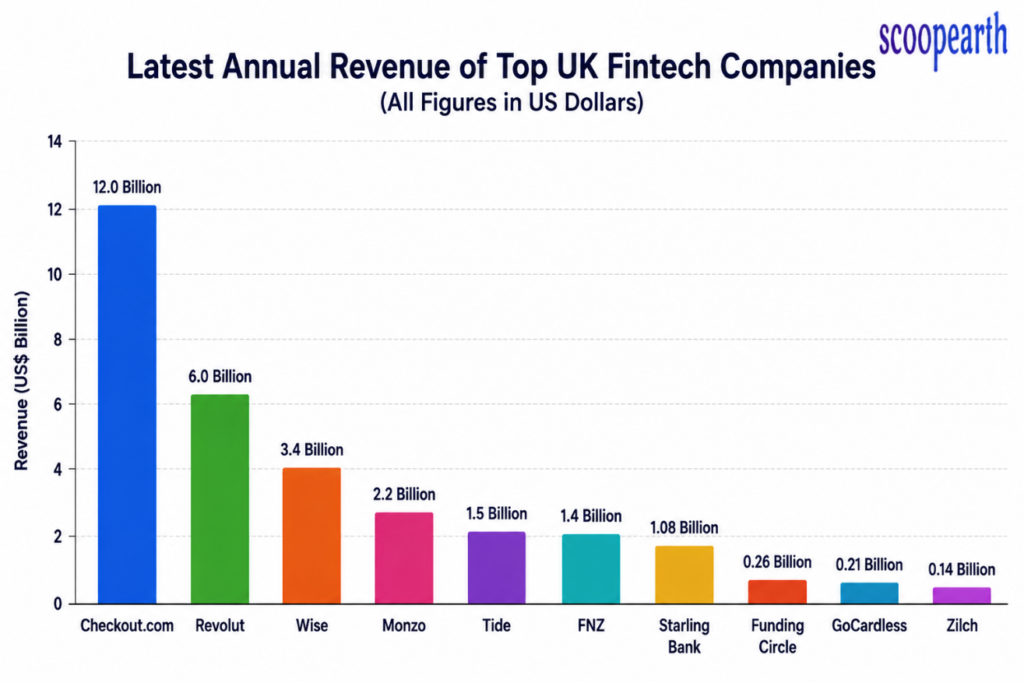
Figures represent the latest reported information available as of August 2026. Private-company valuations can change significantly between funding or secondary transactions.
Why These Fintech Companies Lead the UK Market
These companies have become leaders because they combine financial services with modern technology.
Digital Banking
Revolut, Monzo, and Starling have changed the traditional banking experience by allowing customers to manage most financial activities through mobile applications.
Global Payments
Wise, Checkout.com, and GoCardless help individuals and businesses move money across borders and between bank accounts more efficiently.
Business Financial Services
Funding Circle and Tide focus heavily on small businesses. Their platforms make borrowing, payments, accounting, and financial management easier for SMEs.
Wealth Technology
FNZ provides technology to banks and wealth managers managing large amounts of customer assets. Its scale shows how fintech is increasingly becoming part of the infrastructure of traditional financial services.
Strong Use of Data and Technology
Most leading fintech companies rely heavily on automation, data analytics, artificial intelligence, cloud infrastructure, and digital identity systems. These technologies allow them to offer faster services while controlling operating costs.
See also House of Chikankari secured ₹25 crore in a Series A funding round led by Cap Alpha Ventures
Future Outlook for UK Fintech
The UK fintech industry is expected to continue growing as financial services become increasingly digital.
Artificial intelligence will likely become one of the biggest areas of investment. Fintech companies are already using AI for fraud detection, customer support, credit decisions, financial advice, risk management, and personalized banking.
Open banking and account-to-account payments are also expected to become more important. These technologies can reduce dependence on traditional card networks and make direct bank payments easier for businesses and consumers.
Digital banking will continue expanding, but competition is also becoming stronger. Traditional banks are investing heavily in their own mobile applications, digital products, and AI systems. This means fintech companies will need to keep improving their products and maintaining customer trust.
Regulation will also remain important. Fintech companies handle sensitive financial information and customer money, so strong cybersecurity, fraud prevention, data protection, and financial controls will be essential for long-term growth.
The UK’s strong financial sector, large technology workforce, established regulatory system, and access to international markets should continue supporting fintech innovation.
Conclusion
The UK has developed one of the world’s strongest fintech ecosystems, with companies operating across digital banking, international payments, lending, wealth management, payment infrastructure, and consumer finance.
Revolut has emerged as Europe’s most valuable fintech, while Wise has built a major global money-transfer network. Monzo and Starling have changed digital banking in the UK, while Checkout.com and GoCardless provide important payment infrastructure for businesses.
FNZ has built technology for the global wealth-management industry, Funding Circle supports small-business lending, Tide focuses on business banking, and Zilch continues to develop digital consumer payments.
As artificial intelligence, open banking, digital payments, and financial automation continue to develop, these companies are likely to play an important role in the future of financial services.
The UK’s fintech sector is no longer limited to small startups challenging traditional banks. Many of its leading companies have grown into large international businesses with millions of customers, billions of pounds in revenue, and technology platforms used across the global financial system.
FAQs:
What is fintech?
Fintech means using technology to provide faster and easier financial services.
Which is the biggest fintech company in the UK?
Revolut is currently the UK’s most valuable fintech company.
What does Revolut do?
Revolut provides digital banking, payments, money transfers, investments, and other financial services.
Is Wise a UK fintech company?
Yes, Wise is a UK-founded fintech company specializing in international money transfers and payments.
What is Monzo known for?
Monzo is known for its mobile banking services and digital financial products.
What does Starling Bank offer?
Starling Bank provides digital banking services for individuals and businesses.
What does Checkout.com do?
Checkout.com provides online payment processing and payment technology for businesses.
What is FNZ?
FNZ provides technology platforms for wealth management and investment services.
What does Funding Circle do?
Funding Circle provides financing to small and medium-sized businesses.
What is GoCardless used for?
GoCardless helps businesses collect recurring and direct bank payments.
What does Tide offer?
Tide provides digital banking and financial tools for small businesses.
What is Zilch?
Zilch is a fintech company offering digital payment and buy-now-pay-later services.
Why is the UK strong in fintech?
The UK has strong financial institutions, technology talent, investment, and fintech-friendly infrastructure.
What technologies are driving UK fintech growth?
AI, open banking, cloud computing, automation, and digital payments are major growth drivers.
What is the future of UK fintech?
UK fintech is expected to keep growing through AI, digital payments, open banking, and financial automation.