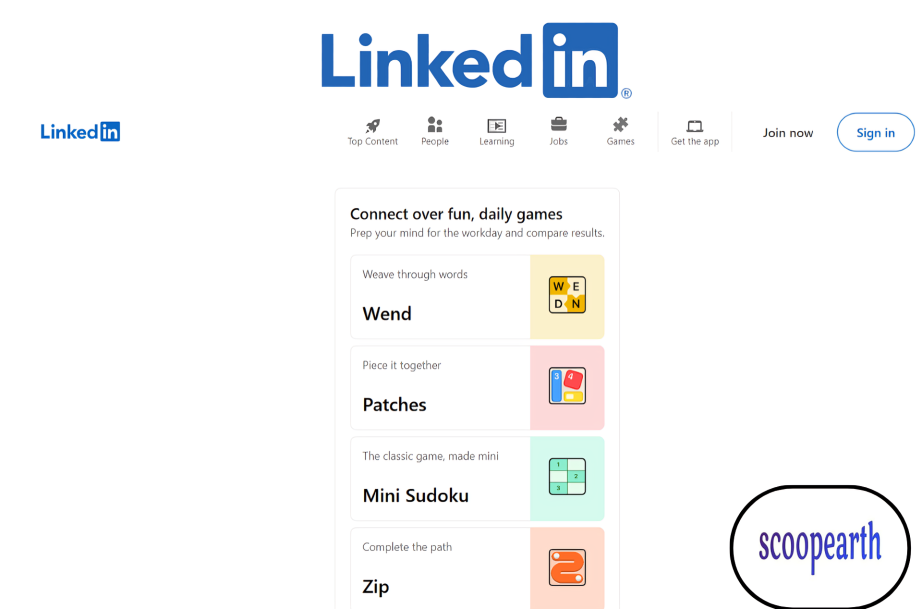
LinkedIn is widely known as a professional networking platform where people connect with colleagues, search for jobs, build professional profiles, and follow industry news. However, the platform also has a more casual feature that has become popular among users: LinkedIn Games.
LinkedIn Games are short daily puzzles designed to test skills such as vocabulary, logic, trivia, pattern recognition, and problem-solving. Unlike traditional games that can take hours to complete, these puzzles are designed to be solved within a few minutes.
The games also add a social element to LinkedIn. Users can compare their results with eligible connections, share scores, maintain streaks, and discuss the daily puzzles with other players.
LinkedIn Games at a Glance
Feature
Details
Platform
LinkedIn
Type
Daily puzzles and brain games
Main purpose
Entertainment, engagement and friendly competition
Games available
Pinpoint, Crossclimb, Queens, Tango, Zip, Mini Sudoku, Patches and Wend
New puzzles
Daily
Daily reset
Midnight Pacific Time
Availability
LinkedIn members and non-members
Cost
Free
Prizes
No prizes
Leaderboards
Available for eligible users
Main skills tested
Logic, vocabulary, pattern recognition and problem-solving
What Are LinkedIn Games?
LinkedIn Games are daily, thinking-oriented puzzles available through LinkedIn. They were introduced in 2024 as a way to encourage conversations and friendly competition among professionals on the platform.
The first three games launched by LinkedIn were Pinpoint, Queens, and Crossclimb. The platform later expanded its collection with additional puzzles, including Tango, Zip, Mini Sudoku, Patches, and Wend.
Each game has a different format, meaning users can choose between word-based challenges, logic puzzles, numerical puzzles and pattern-recognition games.
The games are free to play, and LinkedIn says both members and non-members can play them. New puzzles are released every day at midnight Pacific Time, while the previous day’s puzzles expire at that time.
LinkedIn Games List
The different LinkedIn Games are designed around different skills. Some focus on words, while others require players to use deduction or spatial reasoning.
Game Type of Puzzle Main Skill
Pinpoint Word association Vocabulary and pattern recognition
Crossclimb Word ladder and trivia Vocabulary and problem-solving
Queens Logic grid Deductive reasoning
Tango Symbol-based logic Logical thinking
Zip Path puzzle Spatial reasoning
Mini Sudoku Number puzzle Logic and deduction
Patches Visual pattern puzzle Pattern recognition
Wend Word/puzzle challenge Reasoning and pattern recognition
Pinpoint
Pinpoint is a word-association game.
Players are given up to five clues and must figure out the common category or theme connecting them. The challenge is to solve the puzzle using as few clues as possible.
The first clue is revealed initially. If the guess is incorrect, another clue is revealed, giving the player another opportunity to identify the category.
The fewer clues a player needs, the better the result.
Crossclimb
Crossclimb combines trivia and word ladders.
Players receive clues for several words and must find the correct answers. The words then need to be arranged in a sequence where each word differs from the next by exactly one letter.
Crossclimb Element What Players Need to Do
Clues Solve the given questions
Answers Find the correct words
Word ladder Arrange words in the correct sequence
Letter change Each neighboring word differs by one letter
Goal Complete the entire ladder
Important factor Accuracy and solving time
Crossclimb is timed, so knowing the answers is only part of the challenge.
Players also need to arrange the words efficiently.
The objective is to place one Queen in every row, every column, and every colored region. Queens cannot be placed in cells that are adjacent to one another, including diagonally.
Players can mark cells that cannot contain a Queen to help narrow down the possibilities. The puzzle rewards logical deduction rather than guessing.
Queens Rules
Rule Requirement
Rows One Queen in each row
Columns One Queen in each column
Colored regions One Queen in each region
Adjacent Queens Not allowed
Diagonal adjacency Not allowed
Guessing Logical deduction is preferred
Tango
Tango is another logic-based puzzle.
Players fill a grid with two symbols, represented by suns and moons. Every row and column must contain an equal number of each symbol.
There cannot be more than two identical symbols next to each other horizontally or vertically. Some cells are connected by “=” or “x” symbols, indicating whether connected cells must contain the same or different symbols.
Tango Rule Meaning
Equal symbols Rows and columns must contain equal numbers of each symbol Three identical symbols Not allowed consecutively
“=” sign Connected cells must contain the same symbol
“x” sign Connected cells must contain different symbols
Goal Complete the entire grid correctly
Zip
Zip is a path-based logic game.
Players must draw one continuous path through a grid, beginning with the numbered cells in sequence and filling every cell.
If the puzzle contains walls between cells, the path cannot cross those barriers.
Zip Feature Rule
Starting point Begin at the first numbered cell
Numbered cells Reach them in numerical order
Path Must be continuous
Grid Every cell must be filled
Walls Cannot be crossed
Objective Complete the entire path
Mini Sudoku
Mini Sudoku brings the familiar Sudoku concept to a smaller format.
Players solve a compact numerical grid using logic and elimination. Numbers already provided in the puzzle act as clues, and players must fill the remaining spaces while following the puzzle’s rules.
For players who already enjoy traditional Sudoku, Mini Sudoku can be a quicker version that fits LinkedIn’s short daily-game format.
Patches
Patches is a visual puzzle focused on pattern recognition and spatial reasoning.
Players have to recreate a particular arrangement of shapes on a grid. The challenge is to understand how different pieces fit together and reproduce the required pattern.
The game can also track factors such as solving time and redraws, depending on the puzzle.
Wend
Wend is another puzzle in LinkedIn’s collection of daily games. Like the other games, it is designed to be completed in a relatively short session while testing players’ ability to recognize patterns and solve structured challenges.
How to Play LinkedIn Games
Playing LinkedIn Games is relatively simple. Users can find the games through LinkedIn’s Games Hub. Games can also appear in the LinkedIn feed, notifications, My Network section, or LinkedIn News.
On the mobile application, users can access the games section through the LinkedIn interface.
After selecting a game, players can start the day’s puzzle. Each game has its own instructions, so the exact gameplay depends on the puzzle selected.
Pinpoint Identify the category connecting the clues
Crossclimb Solve clues and arrange answers into a word ladder
Queens Place Queens according to grid rules
Tango Complete the symbol grid
Zip Create a continuous path through the grid
Mini Sudoku Complete the numerical puzzle
Patches Recreate the required visual pattern
Wend Solve the daily puzzle according to its rules
LinkedIn Games Daily Puzzle Schedule
One of the main features of LinkedIn Games is the daily reset.
LinkedIn says a new puzzle for each game is released every day at midnight Pacific Time (PT). Once the new puzzle becomes available, the previous day’s puzzle expires and can no longer be played.
LinkedIn Games Schedule
Feature Details
New puzzle Every day
Reset time Midnight Pacific Time
Previous puzzle Expires after the daily reset
Streaks Can be maintained by playing regularly
Puzzle duration Generally designed for short sessions
For players outside the United States, the daily reset happens at a different local time depending on their time zone.
LinkedIn Games Rules
Although every game has different rules, some general principles apply across the platform.
Players should follow the instructions provided for each individual puzzle. Some games reward speed, while others focus more heavily on accuracy, deductions, or the number of clues used.
LinkedIn also provides features such as Hints, Undo, Clear, Auto-check, and other assistance tools, depending on the game.
Hints Provides assistance when a player is stuck
Feature Purpose
Undo Reverses a previous move
Clear Removes selected entries or moves
Auto-check Helps identify incorrect entries where available
Timer Tracks solving time in relevant games
How Are LinkedIn Games Scores Calculated?
Scores depend on the type of game. There is no single scoring formula used for every LinkedIn puzzle.
For some games, solving time is important. Other games can take into account factors such as clues revealed, mistakes, backtracks, or redraws.
Game Possible Performance Factors
Pinpoint Number of clues used
Crossclimb Solving time
Queens Solving time and correct placements
Tango Solving performance
Zip Solving time and backtracks
Mini Sudoku Solving time
Patches Solving time and redraws
Other games Depends on the specific puzzle
Can You Compare LinkedIn Games Scores?
Yes. LinkedIn allows players to compare certain game results and participate in leaderboards where eligible.
After completing a game, users can view their performance compared with averages for different groups. Depending on eligibility, leaderboards can also show how a company or school ranks.
Players can share their results with connections and participate in conversations about the daily games.
However, sharing scores is optional. LinkedIn says scores remain private unless users opt into the connections leaderboard or choose to share their score directly.
Tips to Improve at LinkedIn Games
Improving at LinkedIn Games mostly comes down to understanding the rules and practicing regularly.
Game Useful Strategy
Pinpoint Think about broad categories before guessing
Crossclimb Solve the easiest clues first
Queens Use elimination and mark impossible cells
Tango Look for rows or columns that are nearly complete
Zip Plan the path instead of moving randomly
Mini Sudoku Use elimination and existing numbers
Patches Focus on the overall pattern and shape placement
Wend Look for relationships and recurring patterns
Most importantly, players should not rush simply because a game has a timer. Understanding the puzzle rules is often more useful than making random moves quickly.
LinkedIn Games add a different type of content to a platform traditionally associated with careers and professional networking.
The puzzles are short, easy to access, and refreshed daily. Players can also compare their performance with connections, making them more social than many standalone puzzle games.
The format also encourages people to return to LinkedIn regularly. Instead of opening the platform only to check messages or professional updates, users can spend a few minutes solving a daily puzzle.
Frequently Asked Questions
Are LinkedIn Games free?
Yes. LinkedIn Games are available to LinkedIn members, and LinkedIn says non-members can also play the games.
How often do LinkedIn Games change?
A new puzzle for each game is released every day at midnight Pacific Time.
How many LinkedIn Games are there?
LinkedIn currently offers several games, including Pinpoint, Crossclimb, Queens, Tango, Zip, Mini Sudoku, Patches, and Wend.
Can I play LinkedIn Games on mobile?
Yes. LinkedIn Games can be accessed through the LinkedIn mobile application as well as on desktop.
Can my employer see my LinkedIn Games score?
Your score is private unless you choose to share it or participate in an eligible connections leaderboard.
Do LinkedIn Games give prizes?
No. LinkedIn says there are no prizes for solving its daily games.
Can I play yesterday’s LinkedIn puzzle?
No. Previous puzzles expire when the next daily puzzle is released.
Which LinkedIn Game is easiest?
There is no universally easiest game. Difficulty depends on the player’s skills and familiarity with different types of puzzles.
Can I share my LinkedIn Games score?
Yes. LinkedIn allows players to share their game results with connections.
Are LinkedIn Games useful for professionals?
They are primarily designed for entertainment, engagement, and conversation rather than professional qualifications. However, they provide another casual way for colleagues, classmates, and professional connections to interact.