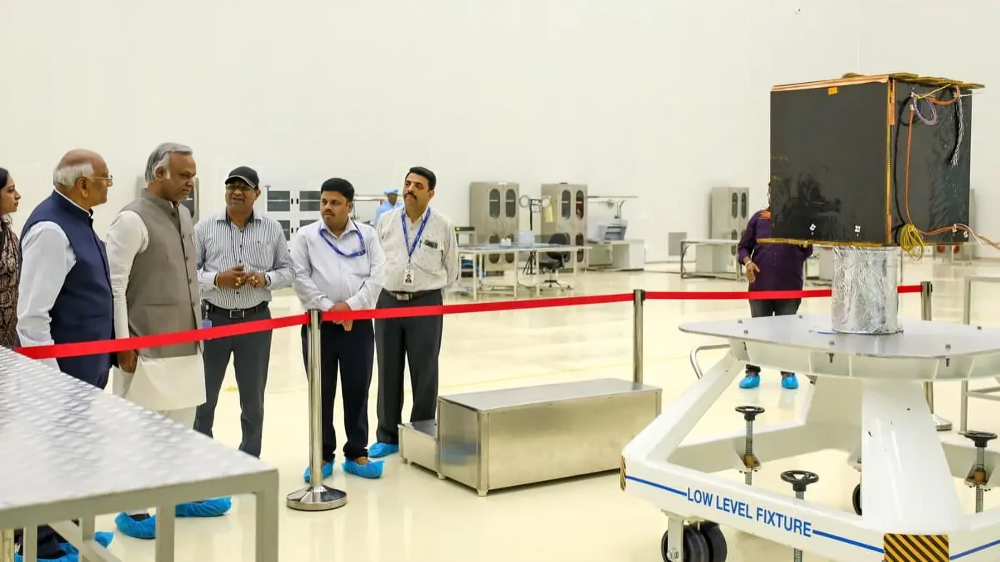
In Bengaluru, the Government of Karnataka has launched the first state-led Centre of Excellence (CoE-ST) in Space Technology nationally. This is a major step on the right path to making India a global leader in the space economy, as this strategic initiative was initiated.
Through the creation of a special center that fills the gap between the state-of-the-art research and commercial success that is scaled-up, Karnataka is strengthening its status as the most preferred location of technological innovation within India.
Primary objective and leadership
The centre was established by Karnataka Innovation and Technology Society (KITS) in a strategic collaboration with Satcom Industry Association (SIA)-India. The Minister of Electronics, IT/BT, and Rural Development and Panchayat Raj, Priyank Kharge, inaugurated it in the presence of a few high government officials and movers of companies in the industry. Critically, this partnership was formalised by a Memorandum of Agreement, which highlights the unified attempt to outline the academic assistance, industrial experience, and governmental help in a singular system.
The key mission that informed the creation of the Centre of Excellence in Space Technology is to help enhance the potential of India in terms of developing advanced space technologies into practical, scalable, commercial products. Although India has been a historical leader in space research, the shift between mission testing success and market-accessible commercial projects has been a multifaceted challenge.
It is especially aimed at this new Centre to overcome this by creating an environment in which innovation is cultivated between the laboratory and the marketplace. The initiative is dedicated to several pillars that are considered cardinal: carrying out high-level research in the fields of space technologies, providing potentially future aerospace professionals with training aligned to the industry, and supporting an active environment where startup incubation might be implemented.
The CoE-ST will transform high-level research into applications by establishing a physical and intellectual environment where all these activities come into play. This strategy will result in high-level economic development, spur the creation of high-quality jobs, and establish Karnataka as a hub in the space ecosystem on a global scale.
In the opening of the ceremony, Minister Priyank Kharge noted that Karnataka has always spearheaded the technological endeavor in India. He observed that the opening of this Centre of Excellence is a logical progression of the historical leadership role played by the state in the past, now being transferred to one of the most important sectors of the future: space technology. The Minister states that the state is not only concerned with the pursuit of theoretical research but rather the establishment of a robust ecosystem within which innovation becomes action-oriented.
As Minister Kharge emphasized, the CoE-ST will be central to ensuring that Karnataka continues to be a primary source of the booming space economy in India. The centre will focus on cross-sector applications to find how space technology can impact other sectors, including telecommunications, agriculture, and urban planning. The multidimensional approach is necessary to scale technologies that have traditionally been restricted to space missions to address problems on Earth and integrate them into the overall economic growth of the state and the country.
Partnership between KITS and SIA-India
The collaboration between CoE-ST and SIA-India through partnership with KITS is an essential part of its operational strategy. The partnership guarantees that the conducted research is industry-oriented, which is crucial in advancing the local startup ecosystem.
The Centre will offer early-stage companies committed incubation space, equipment, mentorship, and industrial networking that such companies require to hone their technologies and expand their operations. The value of this industry-aligned aspect of training is particularly interesting, given that it aims to establish a stream of talent that is ready to meet the unique space industry requirements.
The Centre is set to help in filling knowledge gaps that are prevalent in high-technology sectors by incorporating both academic research and the demands of industry. The emphasis on cross-sector applications implies that the startup ecosystem enabled by this centre will not be exclusively satellite manufacturing, but probably cover software, data analytics, and development of ground-based infrastructure.
The efficient operation of this centre will not only increase the local economy by providing quality jobs but will also enhance the overall strategic autonomy of India on space technology. As Bengaluru keeps building its reputation as the hub of this technological revolution, the Centre of Excellence of Space Technology has remained a beacon of the state’s desire to usher India into a new dawn of economic prosperity made in space.
Conclusion
With its pillar institution (KITS) and the experience of SIA-India, the state government is positioning the pillar in long-term development in a sector that is already taking shape as one of the primary forces of economic activity in the world. With the inception of this Centre, it will probably act as an example to the rest of the states so that a coordinated, state-driven approach works at a faster pace in commercializing deep-tech and space-based technologies.