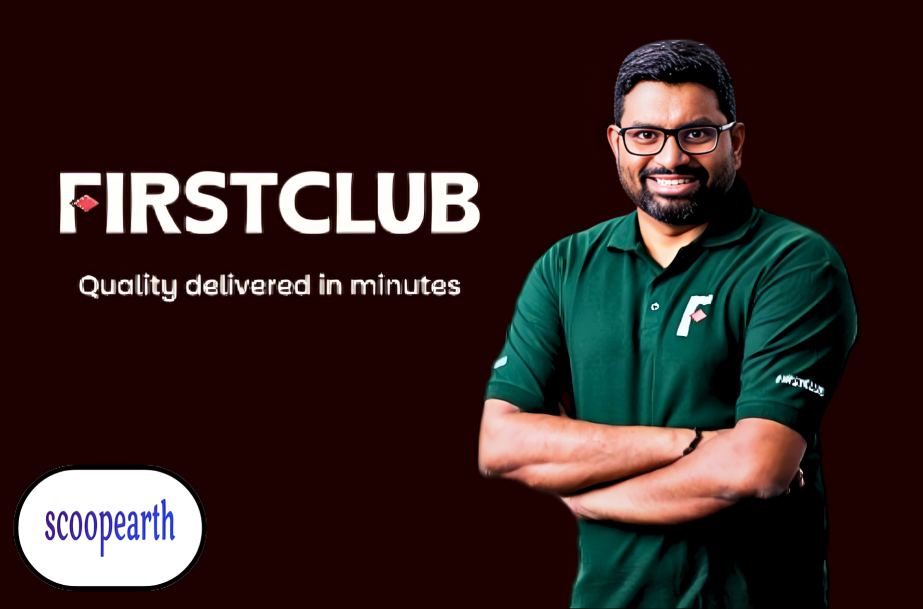
FirstClub has successfully raised $55 million in a Series B funding round. Peak XV Partners and Sofina led this significant financial milestone. The surge is a testament to investors’ faith in the company’s business philosophy centred on quality. FirstClub is valued at approximately $255 million after the recent funding round, according to Ayyappan R, the Founder and CEO, who used to work at Flipkart. Along with the lead investors, Accel, RTP Global, and Paramark Ventures got in on the action too, boosting FirstClub’s profile as a rapidly growing grocery delivery service.
Capital allocation and current operations
FirstClub intends to use the new funds in several strategic ways to drive this next stage of growth. The fund will be used to extend the company’s reach into new cities and support its existing supply chain.
The company is planning to boost its technology capabilities and expand its platform into completely new product categories. The company plans to expand on these product categories in the near future, with beauty and personal care, home essentials, and pets among its program offerings.
First Club has taken an entirely different approach than most quick-commerce businesses that focus on a vast selection of products, incredible discounts, and lightning-fast shipping times. The business has been purposefully designed around the principles of quality, trust, and value.
The founder said that from the beginning, the goal was to create the opposite of what a retail store is supposed to be, which is the “huge selection, lowest price, fastest delivery”. FirstClub aims to be a brand known only for trust, quality, and value.
FirstClub has 24 dark stores, which they internally call clubhouses. The network comprises 21 sites in Bengaluru and 3 sites in Hyderabad. FirstClub already serves around 85% of the most popular postal codes in Bengaluru. They want to increase their coverage there and also start serving Hyderabad. The company’s leadership is eyeing a third city too, hoping to expand into it within the next one to two months.
Core focus and disciplined growth
FirstClub has not shared order volume or gross merchandise value figures directly, though it announced it had doubled order volume every three months. The gross average order size has currently been approximately ₹1200.
The average number of items ordered is approximately 2.5 times higher than the industry average. The company explained that this value at the top is not due to the high price of their products. Rather, it’s because of customer behavior, since those ordering items on the site are buying between 10 and 11 products at once, while other platforms are seeing about 4 items per order.
The company challenges the notion that FirstClub is solely about a “premium grocery platform.” This central mission is not one of exclusivity but one of product quality, and that an item may be high quality even if it is not a part of an elite exclusive group. FirstClub has banned over 200 ingredients on its platform to support this positioning based on quality.
Artificial preservatives, artificial colours, growth hormones, and antibiotics are among the banned components. The startups have lab services and rigorous quality control, including Brix testing for fruit, before they list anything on their app.
The company has purposefully developed a more measured city expansion plan than many of its rapid commerce rivals. Preserving FirstClub’s brand promise remains critical through close sourcing, product testing, and supply chain quality control. Building a known for quality supply chain takes longer, and if they dilute it, the company feels there is no difference between them and others.
FirstClub grows its unit economics into its operating model. The company achieves this through a narrow product mix with fewer stock-keeping units, with limits set on minimum orders, large basket size orders, and efficient order batching. According to the startup, it should be sustainable from the beginning of the business to build a sustainable business.
Conclusion
The company’s successful $55 million Series B funding round and eventual $255 million valuation form a pivotal juncture in the startup’s corporate journey. The grocery delivery service is methodically creating the foundation required to propel into the digital retail market.
The ability to execute efficiently under pressure will be the key to its long-term success as it applies this fresh capital to expand its dark store network, improve its predictive software and expand to new geographic markets as a household service company.