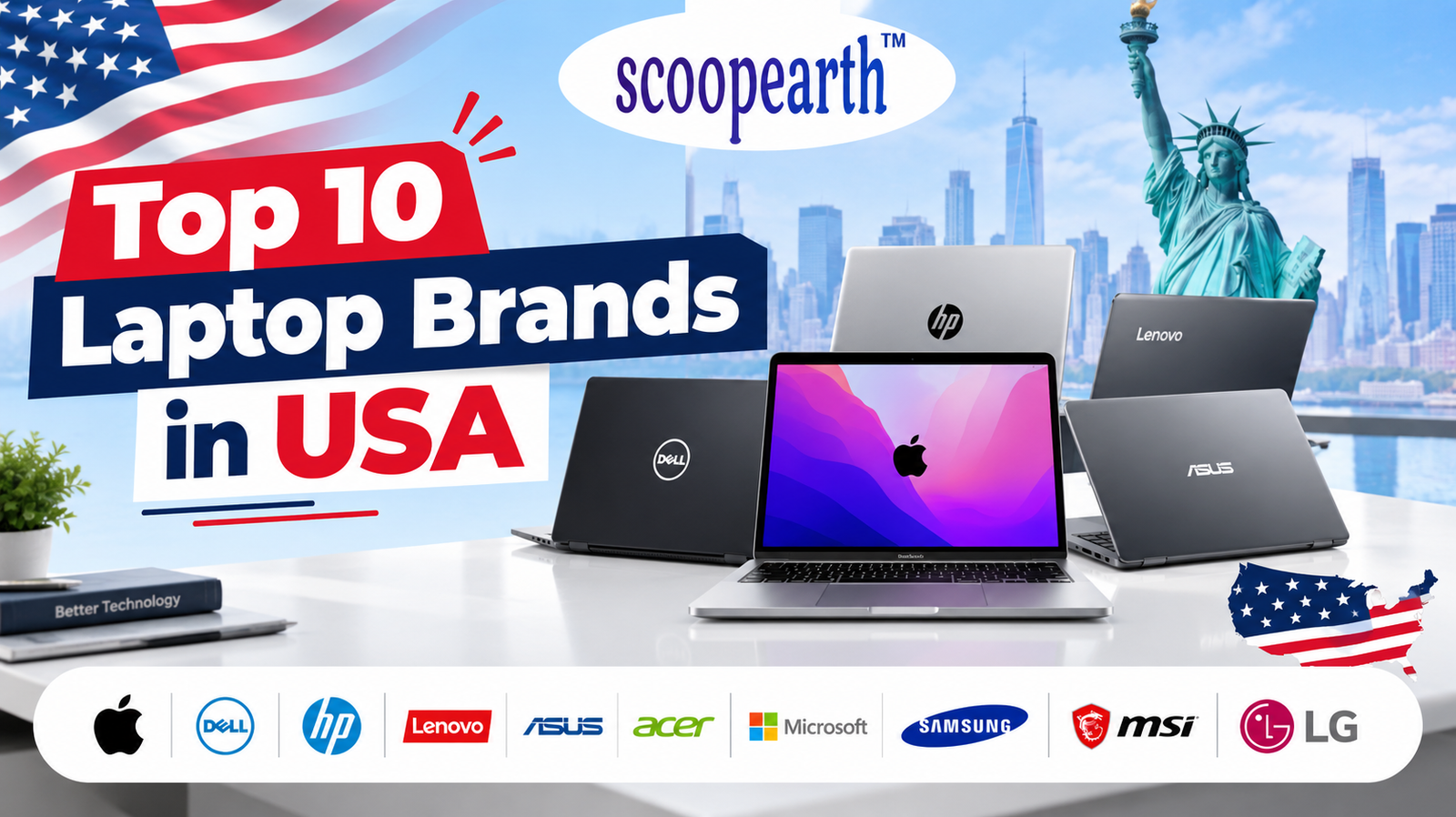
Buying a laptop in the USA can get confusing. There are laptops for students, business laptops, gaming laptops, creative work laptops and premium models that cost much more than a basic notebook. With many choices the brand can be a good starting point.
The top 10 laptop brands in the USA in this list have been selected using a mix of U.S. Market presence, shipment data, product range, brand recognition and availability. For the five positions 2025 U.S. Desktop and notebook shipment data from Omdia provides a clear and measurable basis. HP, Dell, Lenovo, Apple and Acer were the five vendors in that data.
The remaining names are included based on their established presence in the U.S. Laptop market especially in areas such as gaming, premium laptops and Windows-based devices. The list is not meant to say one brand is automatically better than another.
Here are the brands worth knowing along with their available company financial information and the types of laptops they offer.
1. HP
HP is one of the well-known laptop brands in the American market. According to Omdia’s 2025 data for the U.S. HP came in first among desktop and notebook vendors holding a 24.9% market share and shipping around 17.8 million units.
| Founded: 1939 |
| Headquarters: Palo Alto, California, USA |
| Latest Revenue: $55.3 billion (FY2025) |
| Latest Net Income/PAT: $2.53 billion (FY2025) |
| Main Products/Services: Consumer and business laptops, desktops, workstations, printers and related services |
The story of HP began in 1939 when Bill Hewlett and Dave Packard started the company in Palo Alto, California. Over time HPs computer business grew into a household name across homes, schools and workplaces.
Today it offers a range of laptops to meet different needs. The Pavilion and OmniBook lines are built for users. The EliteBook series is aimed at business users who need secure machines. The brand also has the high-end Spectre line for premium users and the OMEN series for gamers.
HP’s financial performance shows that its laptop business is part of a much larger operation. Its Personal Systems segment brought in $38.53 billion in revenue in 2025 including PCs and related products.
2. Dell
Dell holds a position in the U.S. Computer market. Omdia ranked Dell second in 2025 for desktop and notebook shipments with a 23.4% share.
| Founded: 1939 |
| Headquarters: Palo Alto, California, USA |
| Latest Revenue: $55.3 billion (FY2025) |
| Latest Net Income/PAT: $2.53 billion (FY2025) |
| Main Products/Services: Consumer and business laptops, desktops, workstations, printers and related services |
Michael Dell started the company in 1984 while he was a student at the University of Texas. The business originally operated under the name PCs Limited before rebranding as Dell.
For laptop buyers it provides a selection. The Inspiron line is focused on everyday use. Latitude is designed for business professionals. XPS sits at the top as a premium offering and Alienware caters to gaming enthusiasts.
Dell’s financial results reveal that its laptop sales are part of the picture. The company’s infrastructure business plays a role in its overall revenue. That is why Dell’s total revenue is significantly higher than what comes from laptop sales.
3. Lenovo
Lenovo has grown into one of the PC makers in the world and has a solid presence in the United States. Omdia placed Lenovo third in U.S. Desktop and notebook shipments in 2025 with 17.7% of the market.
| Founded: 1984 |
| Headquarters: Beijing, China, with major U.S. operations in Morrisville, North Carolina |
| Latest Revenue: $69.08 billion (FY2025) |
| Latest Net Income/PAT: $1.46 billion (FY2025) |
| Main Products/Services: Laptops, desktops, workstations, tablets, smartphones and IT solutions |
Lenovo’s laptop lineup is broad. Covers many different uses. The ThinkPad series is known for business use. Is popular in corporate environments. IdeaPad machines are aimed at consumers. Yoga models focus on 2-in-1 designs that can function as both laptops and tablets. Legion is a gaming line, built for performance.
Lenovo’s roots go back to an acquisition in 2005 when it bought the former IBM PC business. Since then the company has expanded into areas beyond computers. Its annual reports show that technology now spans beyond just PCs.
For customers Lenovo stands out because the same brand offers options for students, business people and gamers. It’s a one-stop shop for different kinds of laptop needs.
4. Apple
Apple takes a path compared to most laptop makers in the Windows world. Its MacBook line is built around its hardware and software ecosystem. This makes it especially powerful for people who already use iPhones, iPads or other Apple devices.
| Founded: 1976 |
| Headquarters: Cupertino, California, USA |
| Latest Revenue: $416.16 billion (FY2025) |
| Latest Net Income/PAT: $112.01 billion (FY2025) |
| Main Products/Services: MacBook laptops, iPhone, iPad, Apple Watch, services and other consumer technology |
Apple was founded in 1976. Celebrated its 50th anniversary in 2026.
The MacBook product line includes the MacBook Air and MacBook Pro. The Air is designed to be slim and light, ideal for use. The Pro models are built for users who need power—people working in video editing, software development or other creative fields.
Apple’s 2025 financial documents showed $33.71 billion in Mac sales. The company does not break down revenue by models so we don’t know exactly how much came from MacBook sales. Still the total revenue for Apple in that year was $416.16 billion.
5. Acer
Acer is a known laptop brand with a strong foothold in the U.S. Market. Omdia recorded a 5.4% share for Acer in U.S. Desktop and notebook shipments in 2025.
| Founded: 1976 |
| Headquarters: New Taipei City, Taiwan |
| Latest Revenue: NT$275.63 billion (FY2025) |
| Latest Net Income/PAT: NT$3.78 billion (FY2025) |
| Main Products/Services: Laptops, desktops, gaming PCs, monitors and accessories |
The company began in Taiwan in 1976 under the name Multitech. Later changed its name to Acer.
Acer’s laptop range is very diverse. Aspire models are aimed at users looking for value. Swift focuses on lightweight designs for people on the go. Nitro and Predator are built for gaming, offering performance and strong graphics. This variety lets it serve customers across price points.
Acer reported NT$275.63 billion in revenue for fiscal year 2025 with net income of NT$3.78 billion. The company’s financial report noted that personal computers and displays remain parts of its business. At the time other technology areas have continued to grow.
6. ASUS
ASUS is especially known to people looking for gaming laptops and high-performance PCs. The company also makes high-end laptops so its range is not only for gamers.
| Founded: 1989 |
| Headquarters: Taipei, Taiwan |
| Latest Revenue: NT$738.90 billion (FY2025) |
| Latest Net Income/PAT: NT$48.22 billion (FY2025) |
| Main Products/Services: Laptops, gaming PCs, monitors, motherboards, graphics cards and networking products |
ASUS started in Taipei in 1989 when a group of engineers started the company with a focus on PC hardware. It later expanded into computers and consumer electronics.
The ROG line is for gaming while TUF Gaming is for performance at prices. Zenbook is known for high-end laptops and Vivobook is for everyday use.
ASUS had revenue of NT$738.90 billion in 2025 and net income after tax of NT$48.22 billion.
7. Samsung
Samsung is more known in the USA for smartphones, TVs and home electronics. The company also has a laptop line under the Galaxy Book name.
| Founded: 1969 |
| Headquarters: Suwon, South Korea |
| Latest Revenue: KRW 333.6 trillion (FY2025, Samsung Electronics) |
| Latest Net Income/PAT: KRW 45.2 trillion (FY2025, Samsung Electronics) |
| Main Products/Services: Galaxy Book laptops, smartphones, TVs, monitors, appliances and semiconductors |
Samsung Electronics was founded in 1969. Its headquarters are in Suwon.
The Galaxy Book line works closely with Samsung’s Galaxy family. Some models are made for carrying while higher-end versions are for people who want better screen quality and power.
It is important to explain the numbers. The brand does not share Galaxy Book revenue by itself. The numbers above are for Samsung Electronics as a whole, which includes smartphones, displays, chips, appliances and other areas. Samsung Electronics had KRW 333.6 trillion in sales in 2025. Krw 45.2 trillion in net income.
8. MSI
MSI has made much of its laptop reputation around gaming and high-performance computing. It is also more and more aimed at creators and professional users.
| Founded: 1986 |
| Headquarters: New Taipei City, Taiwan |
| Latest Revenue: NT$230.20 billion (FY2025) |
| Latest Net Income/PAT: NT$5.75 billion (FY2025) |
| Main Products/Services: Gaming laptops, creator laptops, desktops, motherboards, graphics cards and monitors |
MSI began as a company focused on hardware like motherboards and add-on cards. It later moved into computer systems and entered the laptop market in 2003.
Its laptop line has models for gaming well as for creators and business use. The company has also grown into areas like servers, industrial computing and AI-related hardware.
MSI’s audited 2025 reports show NT$230.20 billion in sales and NT$5.75 billion in profit.
For buyers who care mostly about gaming power MSI is one of the focused names on this list.
9. Microsoft Surface
Microsoft Surface is different from names here because it is a product brand rather than a separate company. Its presence here shows how it is in the U.S. Premium Windows laptop market.
| Founded: 2012 (Surface brand) |
| Headquarters: Redmond, Washington, USA |
| Latest Revenue: Brand-level revenue not publicly disclosed |
| Latest Net Income/PAT: Brand-level figure not publicly disclosed |
| Main Products/Services: Surface laptops, 2-in-1 devices, tablets and accessories |
Surface started as Microsoft’s hardware line and became a larger family of Windows computers. The range includes Surface Laptop and Surface Pro models, with a focus on Microsoft’s Windows system.
Microsoft does not share a revenue number for Surface laptops. Its More Personal Computing section includes Windows, Surface, gaming and search businesses. In FY2025 Microsoft had company revenue of $281.7 billion and net profit of $101.8 billion.
That total company number should not be seen as Surface revenue.
10. Razer
Razer has a smaller focus than HP, Dell or Lenovo but its name is very well known among gaming fans. The company’s Blade laptops are with gaming accessories and software.
| Founded: 2005 |
| Headquarters: Irvine, California, and Singapore |
| Latest Revenue: Not publicly disclosed |
| Latest Net Income/PAT: Not publicly disclosed |
| Main Products/Services: Gaming laptops, keyboards, mice, headsets, monitors and gaming software |
Razer was started in 2005. Is based in Irvine and Singapore. Its hardware includes Razer Blade gaming laptops along with keyboards, mice and other gaming gear.
Unlike companies like Dell or Apple that share their data, the brand does not give the same kind of public financial reports for people to check its latest sales and profits.
Its spot on this list comes mostly from its U.S. Gaming presence and unique laptop line. For someone who wants a gaming laptop and not a general-purpose computer Razer offers something from big PC brands.
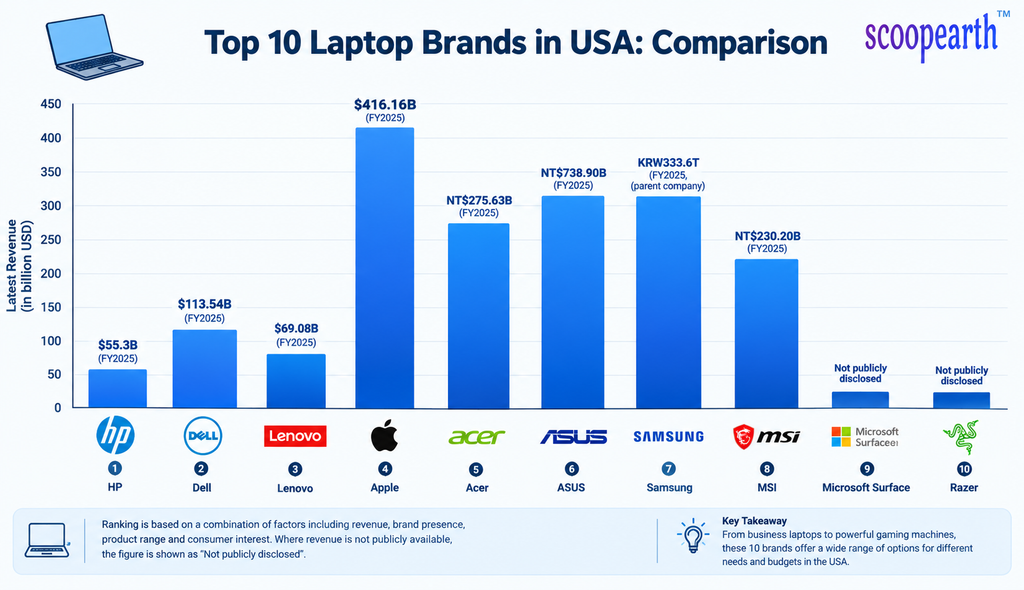
Top 10 Laptop Brands in USA: Comparison
| Rank | Company/Brand | Founded | Latest Revenue | Main Products/Services |
| 1 | HP | 1939 | $55.3B (FY2025) | Consumer and business laptops, desktops, workstations |
| 2 | Dell | 1984 | $113.54B (FY2026) | Laptops, desktops, workstations and IT products |
| 3 | Lenovo | 1984 | $69.08B (FY2025) | Laptops, desktops, workstations and IT solutions |
| 4 | Apple | 1976 | $416.16B (FY2025) | MacBook laptops, iPhone, iPad and services |
| 5 | Acer | 1976 | NT$275.63B (FY2025) | Laptops, gaming PCs, desktops and monitors |
| 6 | ASUS | 1989 | NT$738.90B (FY2025) | Laptops, gaming PCs, monitors and PC hardware |
| 7 | Samsung | 1969 | KRW333.6T (FY2025, parent company) | Galaxy Book laptops, smartphones, TVs and electronics |
| 8 | MSI | 1986 | NT$230.20B (FY2025) | Gaming and creator laptops, desktops and PC hardware |
| 9 | Microsoft Surface | 2012 | Brand-level revenue not publicly disclosed | Surface laptops, 2-in-1 devices and tablets |
| 10 | Razer | 2005 | Not publicly disclosed | Gaming laptops, peripherals and software |
Which Laptop Brand Should You Consider in the USA?
There isn’t one laptop brand that suits every buyer. A student looking for a priced machine may have very different needs from a gamer or someone working in video editing.
HP, Dell, Lenovo and Acer offer ranges covering everyday and business use. Apple is an option for people who prefer macOS and already use other Apple products. ASUS MSI and Razer deserve attention when gaming performance is the priority.
Before buying, check the processor, RAM, storage, display, battery life and warranty rather than choosing only by the logo. Local availability and after-sales service also matter, for an expensive laptop.
Conclusion
The U.S. Laptop market has room for different types of brands. HP and Dell have traditional PC positions Lenovo covers several segments while Apple takes a different approach with the MacBook ecosystem. Acer, ASUS and MSI provide choices across price and performance levels while Indian brands such as Razer and Surface focus on more specific users.
The right choice depends on what the laptop will be used for. Price, performance, portability, software and after-sales support can matter more than brand name alone.
FAQs
1. What are the top laptop brands in the USA?
Some of the laptop brands in the USA include HP, Dell, Lenovo, Apple and Acer. ASUS, Samsung, MSI, Microsoft Surface and Razer also have established positions in segments. The exact ranking can change depending on whether it’s measured by shipments, sales, market share or another factor.
2. Which laptop brand has the U.S. Market share?
Omdia’s 2025 U.S. Desktop and notebook shipment data placed HP first with a 24.9% share, followed by Dell at 23.4% Lenovo at 17.7% Apple at 16.0% and Acer at 5.4%. These figures cover desktop and notebook shipments more than laptops alone.
3. Is Apple a laptop brand?
Apple is an option for people who prefer macOS and want a laptop that works closely with other Apple devices. Its MacBook range includes the MacBook Air and MacBook Pro. The best choice still depends on the users software requirements, budget and preferred operating system.
4. Which laptop brands are good for gaming?
ASUS, MSI and Razer have strong gaming laptop ranges. Their portfolios include models designed around graphics, high-refresh-rate displays and performance-focused hardware. Acer also competes in this segment through its Nitro and Predator families giving gamers brands to compare.
5. Which laptop brands make business laptops?
Dell, HP and Lenovo have extensive business laptop ranges. Dell’s Latitude, HPs EliteBook and Lenovo’s ThinkPad families are examples. These product lines generally focus more on durability, security, manageability and professional features than consumer laptops.
6. Does Samsung make laptops?
Yes. Samsung sells laptops under its Galaxy Book range. These machines are designed to work with the company’s Galaxy ecosystem and include both portable and higher-performance models. Samsung’s overall financial figures should not be treated as Galaxy Book revenue because the company does not separately disclose laptop sales.
7. Which laptop brands make laptops?
Acer, HP, Lenovo and ASUS all have products across different price ranges, including relatively affordable models. However pricing changes frequently depending on processor, memory, storage, display and retailer discounts. Comparing the specifications of models is more useful than choosing purely by brand.
8. Is MSI a gaming laptop brand?
Gaming is a part of MSIs identity but the company has expanded beyond gaming. Its products include creator and professional laptops, desktops, monitors, motherboards, graphics cards and other computing hardware. MSI also works in areas such as servers and industrial computing.
9. Does Microsoft make laptops?
Microsoft makes laptops under its Surface brand. The Surface range includes Surface Laptop and Surface Pro devices. Surface revenue is not separately disclosed in Microsoft’s statements so Microsoft’s total company revenue should not be presented as revenue generated by Surface.
10. How should I choose a laptop brand?
Start with your requirements rather than the brand name. Students may prioritise battery life and price while gamers may need a GPU and a high-refresh-rate display. For business use warranty, security and support can be more important. Comparing specifications, reviews and, after-sales service is a final step.