
The United States is the Centre of the global Software-as-a-Service market. Its local companies provide an array of cloud-based applications to businesses and consumers worldwide. The domestic SaaS market size already exceeds $28.63 trillion per annum.
This industry has grown substantially in recent years. SaaS products have evolved from mere Customer Relationship Management tools into universal platforms covering multifaceted use cases. In particular, artificial intelligence plays an increasingly prominent role in modern SaaS applications.
This article includes an overview of the top 10 U.S.-based SaaS companies, their business models, competitive advantages, and market opportunities. We also discuss key trends affecting this sector in 2026.
Top Companies: What Defines a “Top” SaaS Company
There is no official list of the top SaaS companies in the U.S. Many of the largest software firms are vertically integrated and include SaaS products alongside other divisions. In general, rankings are based on a combination of the following factors:
• Annual revenue or subscription costs;
• Market valuation;
• The number of customers;
• Market leadership status;
• Growth opportunities;
• User retention;
• Revenue from enterprise sales;
Top 10 SaaS Companies in the USA : An Overview
| Rank | Company | Core Category | Headquarters |
|---|---|---|---|
| 1 | Salesforce | CRM & Enterprise Cloud | San Francisco, California |
| 2 | Microsoft (Cloud/SaaS Division) | Productivity & Enterprise Software | Redmond, Washington |
| 3 | Adobe | Creative & Digital Experience | San Jose, California |
| 4 | ServiceNow | IT Workflow & Enterprise Automation | Santa Clara, California |
| 5 | Intuit | Financial & Tax Software | Mountain View, California |
| 6 | Snowflake | Cloud Data Platform | Bozeman, Montana |
| 7 | HubSpot | Marketing & CRM for SMBs | Cambridge, Massachusetts |
| 8 | Atlassian | Developer & Team Collaboration Tools | San Francisco, California / Sydney, Australia |
| 9 | Shopify | E-commerce Platform | Ottawa, Ontario (Major U.S. Operations) |
| 10 | Zoom | Enterprise Communications | San Jose, California |
1. Salesforce
Salesforce pioneered the modern SaaS space and continues to lead the pack in terms of revenue from enterprise software sales. Its application programming interfaces enable third-party developers to build add-ons, thereby generating substantial revenues from the ecosystem play. The company has expanded its footprint to areas beyond its initial concentration on sales force automation. Today, Salesforce covers a gamut of use cases, from marketing and commerce to data warehousing and AI.
Salesforce’s recent launch of the Agent force marks its commitment to the AI space and transition from a business software vendor to an AI infrastructure provider. Notably, Salesforce has acquired a number of data and AI-focused firms to strengthen its capabilities in this area.
Why it’s great: Network effects via the AppExchange platform, heavy AI investments, and enterprise-grade software enabling continuous revenue streams.
2. Microsoft
Although Microsoft is not a SaaS company per se, its software division boasts the largest SaaS business in the U.S. Microsoft 365, Dynamics 365, and Azure-hosted applications generate billions of dollars in revenue for the company annually. Microsoft’s edge comes from its vast enterprise sales and distribution footprint. Turning copilots into AI assistants across its productivity and business applications portfolio represents a compelling growth opportunity for the company.
Why it’s great: Distribution networks that enable hyper-scalability, an extensive customer base, and embedded AI within productivity tools.
3. Adobe
Adobe’s transition from a desktop software vendor to a SaaS publisher of Creative Cloud and Document Cloud paid off handsomely for the company. Its Digital Experience segment focuses on enterprise marketing software, while AI products cut across all four segments to boost productivity and enable new creative workflows.
Adobe’s creative software suite has established itself as an industry standard, with no credible alternatives for designers and video editors. Meanwhile, AI features facilitate graphic design, photo editing, and content creation and empower businesses to leverage data insights.
Why it’s great: Dominance in a high-value vertical, network effects, and predictable, recurring revenues.
4. ServiceNow
ServiceNow’s enterprise software spans a range of domains, including IT service management, human resources, customer service management, and security operations. This company has been able to differentiate itself as the preferred platform for large organizations to design and deliver end-to-end business processes through APIs.
ServiceNow has invested significantly in AI to help enterprises automate their operations, summarize cases, and provide contextual response suggestions. Now Assist is instrumental in enabling this company to compete with Service Portal and Service Cloud.
Why it’s great: High switching costs, predictable revenues, and heavy AI investment.
5. Intuit
Intuit’s personal finance and small business financial management software have found resonance with millions of consumers and businesses. Unlike most enterprise software publishers, this company has been able to acquire a substantial consumer/user base. Its SaaS offerings include TurboTax, QuickBooks, Credit Karma, and Mailchimp. Notably, Intuit’s tax management products derive most of their revenues from small business owners.
Intuit has been investing heavily in AI to provide personalized recommendations and automate financial management processes, including bookkeeping, invoicing, payroll, and payment processing. This company is well-positioned to benefit from the broader adoption of AI in the personal finance space.
Why it’s great: Extreme scalability enabled by a broad customer base, recurring revenues, and exposure to a high-growth AI vertical.
6. Snowflake
Snowflake company is a leading provider of cloud-based data software that enterprises use to unlock the value of their data. Its applications find use in analytics and AI, two areas that represent a $4.8 trillion market opportunity.
Businesses utilizing Snowflake are able to collect, store, process, analyze, and share data with trusted partners securely. In conjunction with its Cortex AI tools, this SaaS company enables customers to harness the power of data to derive actionable insights and build applications.
Why it’s great: Capturing the large analytics market, enabling enterprises to adopt AI, and benefiting from a high-margin SaaS business model.
7. HubSpot
HubSpot provides a suite of marketing, sales, service, and operations software that have been packaged as a CRM solution. As an alternative to Salesforce, this company has been able to grab a considerable market share by focusing on the needs of small and medium-sized businesses (SMBs).
HubSpot has been successful at building a loyal customer base that purchases its products at different price points. The company frequently releases new products and features, including AI-assisted content creation tools, to drive adoption.
Why it’s great: Extreme ease of use has enabled this company to capitalize on the SMB market segment and benefit from a land-and-expand strategy.
8. Atlassian
Atlassian company’s development suite and project management tools are widely used by developers and other knowledge workers in the technology industry. Atlassian’s products facilitate collaborative software development, project planning, and documentation. These tools have become indispensable for technology teams working on enterprise software development projects. This company has also been investing in AI to improve knowledge management and accelerate project delivery.
Why it’s great: Heavy reliance on this technology by developers worldwide, network effects inherent to the platform, and an opportunity to leverage AI to disrupt the knowledge work industry.
9. Shopify
Shopify is an e-commerce powerhouse that provides online merchants with the tools they need to sell their products. Although this company is headquartered in Ottawa, Canada, its U.S. operations support millions of merchants with an extensive array of tools. Notably, Shopify has been able to benefit from the explosion in the online retail sales, particularly during the pandemic. Beyond the subscription-based product management tools, Shopify also profits from merchants’ transaction processing fees.
This company is well-positioned to benefit from the increased use of generative AI across the e-commerce industry. For example, businesses can employ chatbots to assist with their operations, such as customer service, product recommendations, order processing, inventory management, and marketing activities.
Why it’s great: Merchant success leads to increased revenues for this company.
10. Zoom
Zoom has evolved from a video conferencing software provider to a unified communication platform. Its products address a gamut of communication needs, including video conferencing, phone systems, contact center solutions, and collaboration tools. The proliferation of remote work has propelled the demand for video conferencing solutions and facilitated the explosive growth of this company.
Zoom has integrated AI capabilities to enable features such as conversation summarization, transcription, and action item identification. This company can benefit from embedding AI across its product portfolio to enhance customer experiences and increase revenues.
Why it’s great: High-profile software products with large user bases, significant adoption rates among enterprises, and expanded product portfolios to include communication-centric offerings beyond video conferencing.
Trends
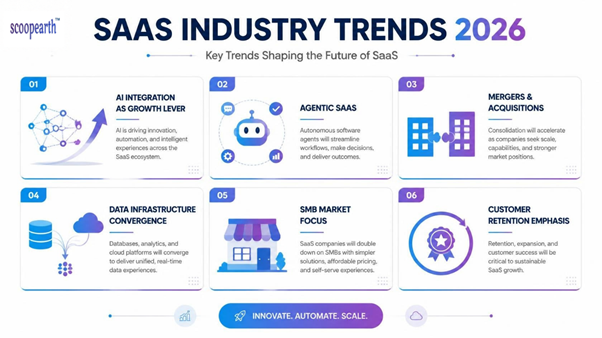
1. Artificial Intelligence is the New Growth Lever
Every company on the list appears to be betting heavily on AI to drive growth. The reason for this is simple: AI is a growth lever. The more products and features a company adds, the more users it attracts, and the more money it makes. However, the more interesting development is that companies are beginning to embed AI within their existing products to enhance functionality.
2. SaaS is Becoming More Agentic
The fundamental premise of SaaS has been that software serves humans. An emerging paradigm is that of agentic SaaS, where the agency is reversed, and SaaS begins to serve software. One of the implications of this trend is that the economics of SaaS are about to change.
3. Mergers and Acquisitions are Set to Accelerate
Larger firms will continue to acquire smaller AI-native startups, and these transactions are set to accelerate through 2026. There will be fewer standalone SaaS firms as larger organizations buy these smaller firms to fill internal skill gaps.
4. Data Infrastructure and SaaS Are Coming Together
Some technology companies, including Snowflake, are blurring the lines between infrastructure and software. This trend is likely to gather pace as enterprises grapple with the challenges of AI adoption.
5. There Will Be More Focus on Small and Medium-Sized Businesses
SMBs represent a substantial market opportunity, and SaaS companies will continue to invest in this area. HubSpot serves as an example of a company that has identified this opportunity and executed on it successfully.
6. There Will Be an Increased Emphasis on Retention
SaaS firms are realizing that it is more difficult and, therefore, more valuable to retain existing customers than to acquire new ones. Companies are prioritizing customer retention and are willing to invest substantially in ensuring that clients continue to use their products and services. As a result, firms are focusing more on cross-selling, upselling, and providing enhanced support to promote customer loyalty.
FAQs
1. Which is the largest SaaS company in the USA?
Salesforce is the largest SaaS company in the U.S. in terms of revenue. Microsoft, on the other hand, would be the largest SaaS company in the world if these two were direct competitors.
2. What is driving SaaS growth in 2026?
The major force driving SaaS growth is artificial intelligence. Firms that embed AI assistants within their products can benefit from the adoption boom and capitalize on the willingness of enterprise customers to pay for these capabilities.
3. Are all “top SaaS companies” purely software businesses?
Not all of them are. Some, including Shopify and Microsoft, have additional revenue streams beyond selling software subscriptions.
4. Is the U.S. SaaS market growing?
Yes, the U.S. SaaS market size is growing at an extraordinary pace. Industry analysts estimate the size of the U.S. SaaS market to be over $28.63 trillion per annum.
5. Why is artificial intelligence essential for SaaS companies?
Artificial intelligence capabilities are crucial for SaaS companies since they allow them to enhance their products and provide a better customer experience. For instance, businesses can utilize AI to make their products intelligent, automate repetitive tasks, recommend related items, provide customer support, and analyze data.
Conclusion
All the top SaaS companies in the USA have recognized the importance of artificial intelligence, and they are investing significantly in this technology to extract value. These companies will continue to disrupt the status quo and invest in innovative ways to improve their products. For instance, Salesforce, Adobe, and Microsoft are investing in AI to enable their products to perform more tasks, while ServiceNow and Snowflake are capitalizing on the increased demand for automation. Notably, companies such as HubSpot continue to leverage their brand reputation to serve the needs of the SMB market. Overall, the competition among these firms will continue to heat up, with each trying to overtake the other by focusing on factors such as network effects, data, and distribution.