
Introduction
The United States is one of the world’s largest and most advanced fintech markets. From digital payments and online banking to investing, lending, cryptocurrency, and financial software, fintech companies have changed the way consumers and businesses manage money.
The growth of smartphones, cloud computing, artificial intelligence, open banking, digital payments, and real-time financial services has helped fintech companies compete with traditional banks and financial institutions. Companies such as PayPal, Stripe, Block, and Fiserv have built large payment networks, while Chime and SoFi have created digital-first financial services for consumers. Coinbase and Robinhood have also made investing and digital assets more accessible to millions of users.
The US fintech industry also has a strong global presence. Many American fintech companies serve customers and businesses around the world and provide infrastructure that supports online commerce, banking, investing, and payments.
This article highlights the Top 10 Fintech Companies in the USA, based on a combination of revenue, payment volume, customer base, valuation, assets, profitability, technology, market reach, and overall influence. The figures below use the latest publicly reported information available as of August 2026. Because these companies have different business models and fiscal years, the most useful metric is not always revenue alone.
Stripe
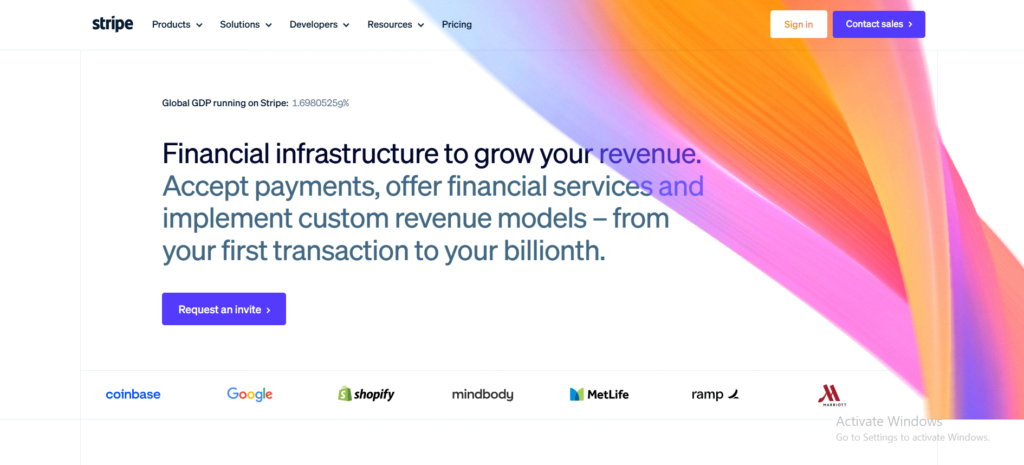
Image Courtesy: E2E Networks Official Website
| Founded | 2010 |
| Headquarters | San Francisco, California |
| 2025 Revenue | US$6.8 billion |
| CEO | Patrick Collison |
Stripe is one of the world’s most important fintech companies and one of the largest privately held financial technology businesses in the United States.
The company provides payment processing and financial infrastructure for internet businesses. Companies use Stripe to accept payments, send payouts, manage subscriptions, prevent fraud, issue cards, and automate other financial processes.
In 2025, businesses using Stripe generated approximately US$6.8 billion in total payment volume, a 34% increase from 2024. Stripe said this represented roughly 1.6% of global GDP. In February 2026, a tender offer for employees and shareholders valued the company at approximately US$159 billion.
Stripe is also expanding beyond traditional payment processing. Its products now cover billing, tax, financial accounts, issuing, fraud prevention, and other financial services. The company is also investing heavily in stablecoin payments and AI-related commerce.
Stripe’s combination of global scale, strong technology, and deep relationships with online businesses makes it one of the most influential fintech companies in the US.
PayPal

Image Courtesy: PayPal Official Website
| Founded | 1998 |
| Headquarters | San Jose, California |
| 2025 Revenue | US$33.17 billion |
| CEO | Enrique Lores |
PayPal is one of the pioneers of digital payments and remains one of the largest fintech companies in the world.
The company provides online payment services through PayPal, Venmo, Braintree, and other products. Consumers can use PayPal to send and receive money, while businesses use its services for online checkout, payment processing, and financial transactions.
PayPal generated US$33.17 billion in net revenue in 2025, up 4% from 2024. Total payment volume reached approximately US$1.79 trillion, while the company had 439 million active accounts at the end of 2025. PayPal also processed more than 25 billion payment transactions during the year.
The company is now focusing more heavily on improving checkout, growing Venmo, expanding Braintree, and using artificial intelligence to improve its operations.
PayPal’s large consumer network and merchant relationships continue to give it a major position in the global digital payments market.
Block
Image Courtesy: Block Official Website
| Founded | 2009 |
| Headquarters | Oakland, California |
| 2025 Revenue | US$24.19 billion |
| CEO | Jack Dorsey |
Block, formerly known as Square, is a major US fintech company with businesses serving both consumers and small businesses.
Its ecosystem includes Square, Cash App, Afterpay, Square Loans, and other financial products. Square helps businesses accept payments, manage sales, handle payroll, access loans, and run their operations. Cash App provides peer-to-peer payments, banking services, investing, borrowing, and other financial products for consumers.
Block generated approximately US$10.4 billion in gross profit in 2025, an increase of 17% from the previous year. Cash App generated about US$6.3 billion in gross profit, up 21%.
The company has also been investing heavily in artificial intelligence and automation. By mid-2026, Cash App had around 59 million monthly active users, showing the size of its consumer platform.
Block is important because it connects two sides of financial services: small businesses through Square and consumers through Cash App.
Fiserv
Image Courtesy: Fiserv Official Website
| Founded | 1984 |
| Headquarters | Milwaukee, Wisconsin |
| 2025 Revenue | US$21.19 billion |
| CEO | Frank Bisignano |
Fiserv is one of the largest financial technology and payments companies in the United States.
Unlike consumer-focused fintechs, Fiserv mainly provides financial technology infrastructure to banks, credit unions, merchants, and other businesses. Its services include payment processing, digital banking, card processing, merchant acquiring, and financial software.
Fiserv generated US$21.19 billion in revenue in 2025, an increase of approximately 4% from the previous year. Operating income was about US$5.82 billion. Processing and services accounted for around 80% of total revenue.
One of its best-known businesses is Clover, a cloud-based point-of-sale and business management platform used by small and medium-sized businesses.
Fiserv shows that fintech is not only about mobile banking apps. A large part of the industry is the technology operating behind banks, merchants, cards, and payment networks.
Coinbase

Image Courtesy: Coinbase Official Website
| Founded | 2012 |
| Headquarters | San Francisco, California |
| 2025 Revenue | US$6.9 billion |
| CEO | Brian Armstrong |
Coinbase is one of the largest cryptocurrency and digital-asset fintech companies in the United States.
The company provides a platform where consumers and institutions can buy, sell, store, and use digital assets. It has also expanded into stablecoins, crypto payments, derivatives, subscriptions, and institutional financial services.
Coinbase generated US$6.9 billion in net revenue in 2025, including approximately US$4.1 billion from transaction revenue and US$2.8 billion from subscription and services revenue. Its total trading volume increased 156% to approximately US$5.2 trillion.
The company has also been reducing its dependence on trading fees by expanding subscription products and stablecoin-related services.
Coinbase is particularly important to the US fintech sector because digital assets are becoming increasingly connected with traditional financial markets. Its future growth will depend on crypto adoption, regulation, institutional demand, and the development of blockchain-based payments.
Robinhood

Image Courtesy: Robinhood Official Website
| Founded | 2013 |
| Headquarters | Menlo Park, California |
| 2025 Revenue | US$4.47 billion |
| CEO | Vlad Tenev |
Robinhood changed retail investing by making stock trading easier and more accessible through a mobile application.
The company originally became known for commission-free stock trading. It has since expanded into options, cryptocurrency, retirement accounts, margin lending, prediction markets, cash management, and other financial products.
Robinhood reported US$4.47 billion in total net revenue in 2025, up 52% from 2024. Funded customers increased to 27 million, while total platform assets reached approximately US$322.1 billion. Robinhood Gold subscribers reached about 4.18 million.
The company has also expanded internationally and strengthened its cryptocurrency business through acquisitions and new products.
Robinhood’s success shows how fintech can simplify traditionally complex financial products and bring investing services to a much larger customer base.
Chime
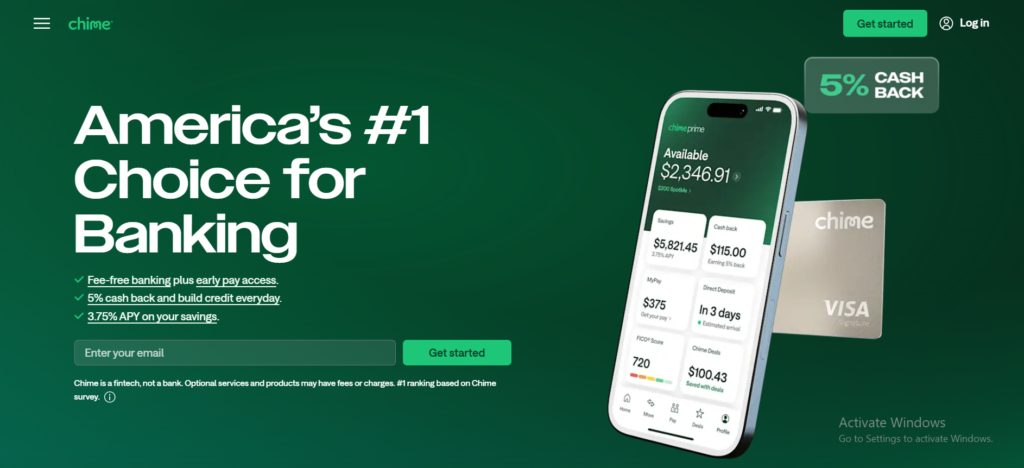
Image Courtesy: Chime Official Website
| Founded | 2012 |
| Headquarters | San Francisco, California |
| 2025 Revenue | US$2.2 billion |
| CEO | Chris Britt |
Chime is one of the largest digital banking fintech companies in the United States.
The company provides checking accounts, debit cards, savings products, credit-building tools, and other financial services through a mobile-first platform. Chime does not operate as a traditional bank itself; banking services are provided by partner banks.
Chime completed its IPO in 2025. For the full year, the company reported US$2.2 billion in revenue, up 31%, and reached 9.5 million active members.
Growth continued in 2026. In the second quarter of 2026, Chime reported revenue of approximately US$670 million, up 27% year over year, while active members increased 20% to 10.4 million. The company also reported US$28 million in net income.
Chime’s focus on simple, low-cost financial products has helped it become a major competitor to traditional banks, particularly among younger consumers.
SoFi
Image Courtesy: SoFi Official Website
| Founded | 2011 |
| Headquarters | San Francisco, California |
| 2025 Revenue | US$3.6 billion |
| CEO | Anthony Noto |
SoFi began with student-loan refinancing but has grown into a broad digital financial services company.
Today, SoFi offers personal loans, student loans, mortgages, investing, banking, credit cards, insurance, and other financial products. Its strategy is increasingly focused on becoming a single platform where customers can manage multiple parts of their financial lives.
SoFi reported approximately US$1.22 billion in revenue in the second quarter of 2026. Its member base reached 15.8 million, while total products increased to approximately 24.4 million. The company also reported record quarterly loan originations of about US$14.8 billion.
SoFi raised its 2026 adjusted net revenue guidance to approximately US$4.75 billion to US$4.85 billion.
The company’s growing product range makes it one of the strongest examples of the “everything app” model in US fintech.
Affirm

Image Courtesy: Affirm Official Website
| Founded | 2012 |
| Headquarters | San Francisco, California |
| 2025 Revenue | $3.22 billion |
| CEO | Max Levchin |
Affirm is one of the leading US fintech companies in the buy-now-pay-later and consumer payments market.
The company allows consumers to split purchases into installments. It works with merchants and online platforms to provide payment options at checkout.
Affirm’s third fiscal quarter of 2026 showed continued strong growth. Revenue increased 33% to approximately US$1.04 billion, while gross merchandise volume increased 35% to US$11.6 billion. Active consumers reached 26.8 million as of March 31, 2026.
Affirm has also expanded beyond traditional BNPL products through its Affirm Card and other payment services. The company is increasingly positioning itself as a broader payment network rather than only a pay-over-time provider.
Its growth reflects the changing way consumers pay for online and offline purchases.
Toast

Image Courtesy: Toast Official Website
| Founded | 2011 |
| Headquarters | Boston, Massachusetts |
| 2025 Revenue | US$4.96 billion |
| CEO | Aman Narang |
Toast is a fintech and technology company focused mainly on the restaurant industry.
Its platform combines point-of-sale software, payment processing, payroll, online ordering, restaurant management, customer engagement, and financial services.
At the end of 2025, approximately 164,000 restaurant locations were using Toast, an increase of 22% from the previous year. These locations processed approximately US$195.1 billion in gross payment volume during the trailing twelve months.
Toast is an important example of embedded fintech. Instead of offering a general banking application, it puts payments and financial services directly inside the software restaurants already use to operate their businesses.
Its growth also shows how fintech is moving into specialized industries such as restaurants, healthcare, retail, and professional services.
Financial Comparison of the Top Fintech Companies in the USA
The companies below operate different types of fintech businesses, so the most useful comparison depends on the business model. Public companies report audited financial results, while Stripe remains privately held and therefore does not disclose the same level of financial information.
| Company | Latest Key Financial Figure | Scale / Key Metric | Main Fintech Area |
| Stripe | US$6.8 billion | US$159B private valuation | Payments infrastructure |
| PayPal | US$33.17B revenue in 2025 | US$1.79T TPV; 439M active accounts | Digital payments |
| Block | US$24.19 billion | Cash App and Square ecosystems | Payments & digital banking |
| Fiserv | US$21.19B revenue in 2025 | Large global merchant and banking network | Payments & financial infrastructure |
| Coinbase | US$6.9B net revenue in 2025 | US$5.2T trading volume | Cryptocurrency |
| Robinhood | US$4.47B revenue in 2025 | US$322.1B platform assets | Investing & trading |
| Chime | US$2.2 billion 2025 | 10.4M active members | Digital banking |
| SoFi | US$3.6 billion | 15.8M members | Digital financial services |
| Affirm | $3.22 billion | US$11.6B quarterly GMV | BNPL & payments |
| Toast | US$4.96 billion | 164K locations | Restaurant fintech |
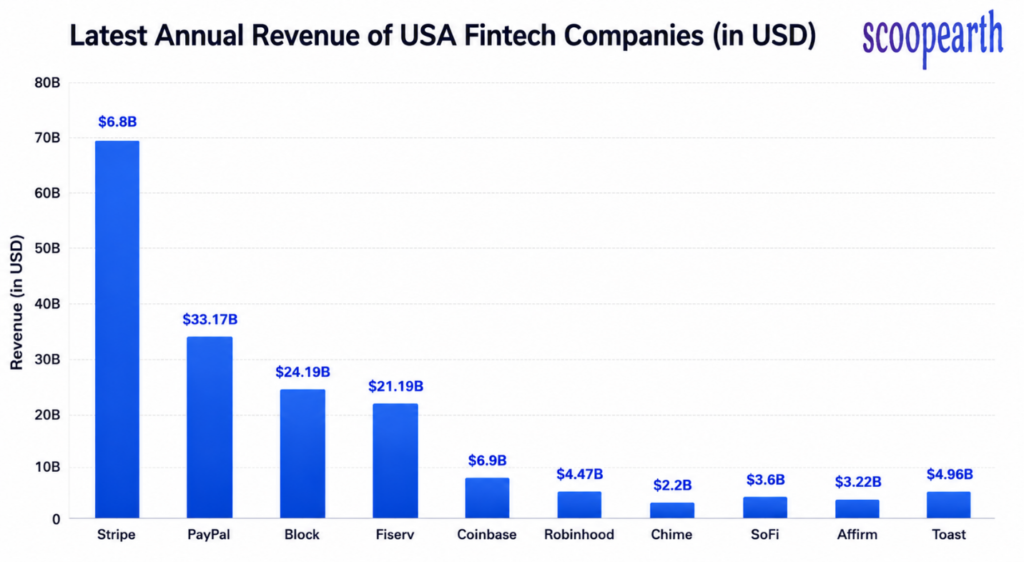
Figures represent the latest publicly reported information available as of August 2026. Fiscal periods differ across companies, so the numbers should not be treated as a direct ranking by revenue alone.
Why These Fintech Companies Lead the US Market
Digital Payments
Stripe, PayPal, Block, and Fiserv have built large payment networks that support millions of consumer and business transactions. Their technology allows payments to happen quickly across websites, mobile applications, stores, and other digital channels.
Digital Banking
Chime and SoFi are changing how consumers interact with financial services. Customers can open accounts, manage money, borrow, save, invest, and make payments without visiting a traditional bank branch.
Investing and Digital Assets
Robinhood has made retail investing more accessible, while Coinbase has become a major platform for cryptocurrency and blockchain-based financial services.
Embedded Finance
Toast and Block show how financial services can be built directly into business software. This model allows companies to offer payments, lending, banking, and financial management without requiring customers to use separate systems.
Artificial Intelligence and Automation
AI is becoming an important part of fintech. Companies are using AI for fraud detection, customer service, credit decisions, financial recommendations, risk management, software development, and personalized financial products.
Conclusion
The United States has one of the world’s strongest fintech ecosystems, with companies operating across digital payments, banking, investing, lending, cryptocurrency, and financial infrastructure.
Stripe has become one of the most valuable private fintech companies in the world, while PayPal continues to process trillions of dollars in payments. Block and Fiserv provide important payment and financial technology infrastructure, while Coinbase and Robinhood have transformed digital investing and trading.
Chime and SoFi are building large digital financial platforms for consumers, while Affirm is changing the way people pay for purchases. Toast shows how fintech can become part of specialized business software and support entire industries such as restaurants.
The US fintech sector has moved far beyond simple payment applications. Many of its leading companies now operate large financial networks with millions of customers, billions of dollars in revenue, and payment or asset volumes measured in trillions of dollars. This makes the United States one of the most important markets for the future of financial technology.
Frequently Asked Questions (FAQs):
What is fintech?
Fintech means using technology to provide and improve financial services.
Which is the biggest fintech company in the USA?
PayPal, Stripe, and Fiserv are among the largest US fintech companies by scale, although they use different business models.
What does Stripe do?
Stripe provides payment processing and financial infrastructure for online businesses.
What is PayPal mainly used for?
PayPal is mainly used for online payments, money transfers, and digital checkout.
What is Block known for?
Block is known for Square business payments and the Cash App consumer financial platform.
What does Fiserv provide?
Fiserv provides payment processing and financial technology to banks, merchants, and businesses.
What is Coinbase?
Coinbase is a major cryptocurrency platform that allows users to buy, sell, store, and use digital assets.
What does Robinhood offer?
Robinhood provides digital investing and trading services for stocks, options, cryptocurrencies, and other financial products.
What is Chime?
Chime is a digital banking fintech that provides banking and credit-building services through a mobile platform.
What is SoFi?
SoFi is a digital financial services company offering banking, lending, investing, and other financial products.
What does Affirm do?
Affirm provides buy-now-pay-later and installment payment services to consumers.
What is Toast?
Toast provides restaurant technology that combines payments, point-of-sale software, and business management tools.
Why is fintech important in the USA?
Fintech makes financial services faster, more convenient, accessible, and technology-driven.
What technologies are driving US fintech?
Artificial intelligence, cloud computing, mobile applications, blockchain, and real-time payments are major fintech technologies.
What is the future of fintech in the USA?
US fintech is expected to grow through AI, digital payments, embedded finance, stablecoins, and automated financial services.