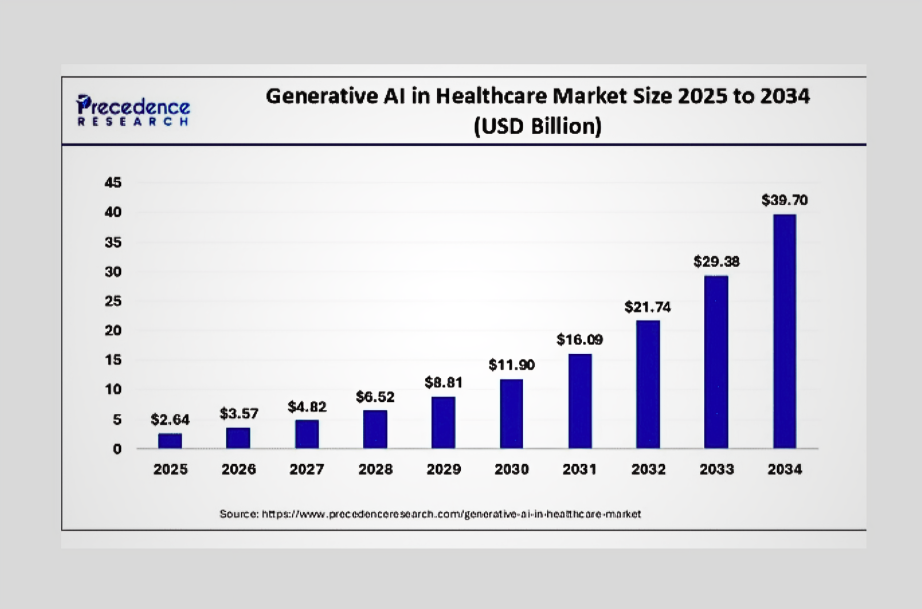
The Generative AI in Healthcare Market is in a transformative stage where the adoption rate of the technology in the large segments, i.e., hospitals, pharmaceutical companies, diagnostics laboratories, and digital health solutions, is high. Recent findings of the Exactitude Consultancy point to the fact that generative AI is becoming one of the most influential and changing technologies in the healthcare ecosystem. These advanced Artificial Intelligence systems can now create life-like synthetic medical images, make correct predictions of how different patients will react to various treatments, create new molecule structures to develop new drugs, and automate many other tasks basic to clinical care.
Transformative market size for Generative AI
The Generative AI market size in Healthcare is confidently estimated to hit an incredible $98.4 billion by the year 2030. This is the expected growth rate, and this is a phase of hyper growth as shown by the Compound Annual Growth Rate (CAGR) of 34.8% expected in the period of growth between the years 2025 and 2030. The main developments and strategic changes in healthcare delivery globally support this strong growth trend. The area that has the most significant impact is drug discovery, and this is mainly due to generative AI, which also shortens the timeframes involved in the sophisticated research and development.
Generative AI models, which include Generative Adversarial Networks (GANs), Large Language Models (LLMs), transformers, and diffusion models, are essentially transforming clinical and research processes within the healthcare industry. These modernized systems come with a variety of robust features that are transforming traditional ways of doing things. They can further be employed in research to generate novel drug molecules as well as accurately predict their binding affinity, which provides an unparalleled acceleration in pharmaceutical research and development.
These models provide transformative tools in the clinical setting. They have the capability to produce artificial medical images that are necessary to train diagnostic AI without exposing the privacy of patient data. They also offer useful aid to radiologists by giving automated interpretation of images. In the field of direct patient care, AI generative models can be used to develop highly individualized treatment plans and allow human-like communication through medical chatbot assistants.
The technology also makes administration and data management tasks, including summarising Electronic Health Records (EHR) data and the automatic creation of clinical notes, significantly easier. They can be used to simulate complicated clinical outcomes, thus expediting the development of precision medicine. The symbiotic syncretism of AI, scalable cloud computing, and integrated digital health systems is enabling both hospitals and pharmaceutical firms to make very big cost reductions, enhance overall accuracy, and provide very personalised care to the individual patient.
Global impact and market segmentation
The Generative AI in Healthcare Market will be divided into a variety of essential aspects, showing the variety of its applications and technological basis. Google DeepMind has also introduced innovative models such as Med-PaLM and AMIE, which have had a massive impact on medical reasoning and the ability of clinical assistants.
Microsoft has introduced GPT-based clinical note automation into the largest EHR systems. NVIDIA extended its BioNeMo platform to be able to use generative AI simulations to find drugs faster. Pfizer and Insilico Medicine have already launched drug candidates developed using AI into clinical preparations in the pharmaceutical industry. Generative imaging AI has been implemented by Siemens Healthineers to greatly streamline the operations of radiology.
The current market is dominated by North America, with its top ecosystem of AI research and development and a favorable regulatory framework for AI pilot programs. Europe is striving to prove itself as a model of responsible AI systems and quality clinical compliance. The economy of the Asia Pacific is expected to have the highest adoption rate due to the high government digital health programs and smart hospitals equipped with AI. The Middle East and Africa (MEA) and Latin America (LATAM) are also getting stronger on adoption and have new deployments centered around AI imaging and workflow automation.
Conclusion
The Generative AI in Healthcare Market is conclusively in a hyper-growth trajectory, and the trend is unmistakably moving towards the goal of becoming a $98.4 billion industry by 2030. The process is stimulated by the fact that the industry moves to smarter diagnostics, highly automated processes, actually personalized precision medicine, and AI-engineered therapies.