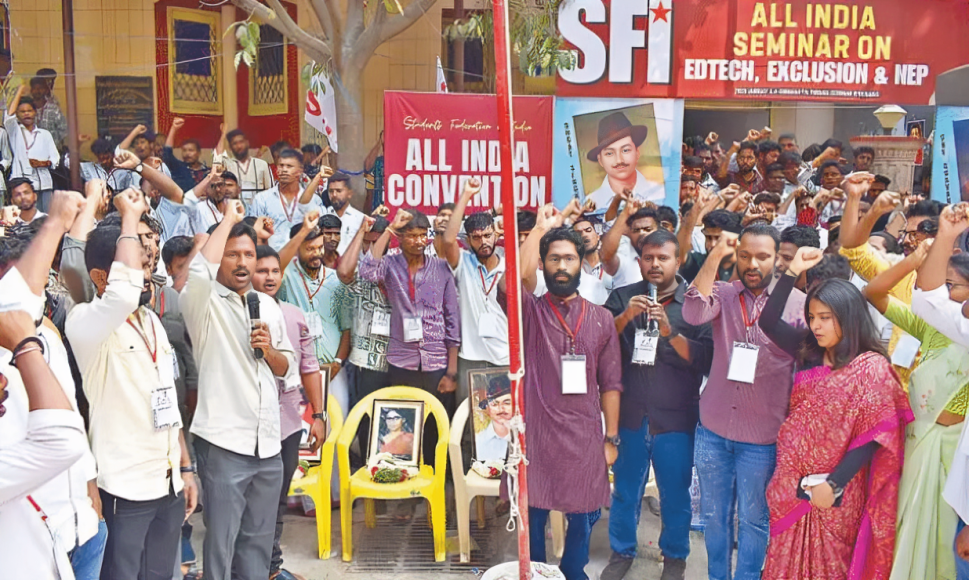
A major national convention was recently held in Osmania University in Hyderabad by the Students Federation of India to discuss the fast-changing face of modern education. The event, titled “Artificial Intelligence and Future of Education”, was a critical engagement between student leaders, academics, and policymakers on the nexus of the evolving technologies and equity in education. The convention was mainly concerned with two issues: the immediate necessity of democratizing Artificial Intelligence (AI) so that it does not become a means of further social stratification, and a fresh, sharp appeal to oppose the National Education Policy (NEP) 2020.
Convention and central theme
One of the main ideas of the convention was that Artificial Intelligence should be treated as a public good, not a corporate good. Among the most vocal participants, one of the Members of Parliament, V. Sivadasan, stressed that even though AI could change learning and research radically, the current direction of its development poses a threat of increasing disparity.
This convention held the belief that, by staying in the possession of a few international technology giants and elite institutions, the AI technology would bring about a new digital colonialism. This will place students with disadvantaged backgrounds and students in rural areas at a long-term disadvantage, as they will not be able to utilize the tools to succeed academically in the modern world.
The SFI representatives demanded that the government take the initiative to make AI resources equally available to every student in the nation. In their argument, they claimed that it is the role of the government to see that technological advancements are incorporated in the public education system in a manner that is beneficial to all.
The convention emphasized the fact that the present infrastructural shortage in most government schools and colleges renders the concept of AI-driven education appear discriminatory. Equitable access is not only in software and algorithms, but in the inherent right of every student in India to have high-quality and modern infrastructure.
Resistance and corporate surveillance
The convention was a center stage in the formative expression of a wholesome critique of the National Education Policy. The discussions were chaired by the SFI President of the country, VP Sanu, and General Secretary Mayukh Biswas, who described NEP as a blueprint that will enable the privatization and commercialization of education. The policy, according to the speakers, promotes a change in thinking where the state is no longer required to provide free and accessible education, but instead the sector can be opened to the profits of the hands of the business. This has been interpreted as a direct attack on the democratic character of Indian education since it focuses on the people who can afford to pay, rather than the merit and the needy.
The convention was very concerned with centralization and the saffronization of education under NEP. The participants stated that the policy aims to compromise the independence of learning institutions and the state government in designing the curricula.
This centralization of power, the SFI argues, is the government trying to enforce a mono-ideological discourse upon the broad array of students in India. The convention decided to establish a huge student movement to oppose the execution of these policies, which they think will cause the elimination of the scientific temper and critical thinking in the classroom.
A major aspect of the AI discourse was the possibility of data misuse and monitoring in the academic ecosystem. The convention sounded warning bells over the possibility that the personal information of millions of students could be mined by private companies in the name of personalized learning. The speakers insisted on the enactment of a strong data protection statute that is focused on the requirements of the educational sector. They claimed that, unless governed by stringent ethical standards and legal regulations, AI would potentially be applied to monitor and suppress the actions of students as opposed to influence their creative and intellectual development.
The SFI underscored the idea that technology in education must be beneficial to the learners and teachers and not the profit motive of EdTech companies. The convention requested the creation of local, open-source artificial intelligence, which is transparent and responsible. With its opposition to the corporate model of AI implementation, the SFI attempts to safeguard the privacy and intellectual liberty of the student body, making sure that technology becomes its servant, and not its dictator.
Conclusion
The national convention held at Osmania University ended with a strong determination to protect the future of the Indian student community. The SFI has positioned a holistic fight against the soul of the education system in the nation by connecting the mandate of equity in AI access with the opposition to the NEP.
The convention left no doubt that the future generation of students will not see the use of technology as a wall to marginalise the poor and policy as a tool to destroy the current education system. When the SFI is planning to put these demands on the streets and campuses around the country, the convention has a clear message, and that is education should be kept as a democratic right, which is enabled by the available technology and which is not commercially exploited.