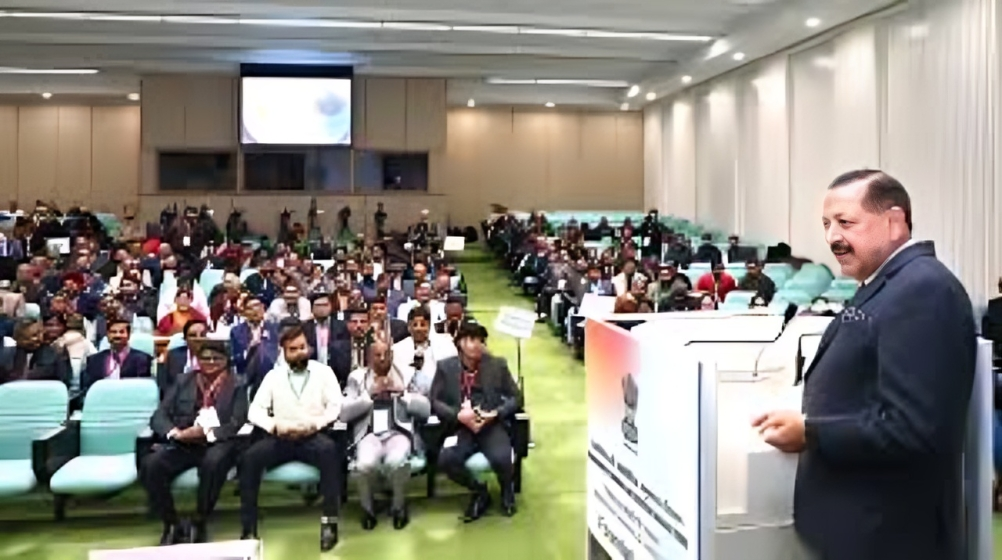
A policy change was recently implemented by the Union Government that seeks to give a boost to the Indian deep-tech ecosystem by softening the rules of the eligibility process to be officially recognised. The government stated during the 42nd Foundation Day of the Department of Scientific and Industrial Research that the three-year existence requirement of startups was removed.
It is a major step which is also shared by Dr Jitendra Singh, the Union Minister of State for Science and Technology, and is aimed at providing deep-tech startups with recognition and institutional support much earlier in the course of their operations. Removing such a historical entry barrier, the government is hoping to give early-stage innovators the impetus they need to develop their ideas and get them market-ready without having to waste time satisfying the length of administrative lifespan criteria.
Relaxation and financial assistance
The relaxation directly affects the Industrial Research and Development Promotion Programme, which is a pillar programme of the Department of Scientific and Industrial Research. In the past, startups had to prove a record of at least three years of existence and financial viability to be allowed to receive numerous types of government support and recognition.
With the understanding that deep-tech projects are frequently characterised by years of development and huge amounts of money before they become commercially viable, the government has made the shift to a more malleable approach. This policy reform is likely one of the greatest incentives for first-time entrepreneurs and young innovators who are developing innovative technologies that need early acceptance by a respectable government agency.
Dr Jitendra Singh placed this decision in the context of the larger picture of research and development financing in India in his address. He observed that even though the massive ₹1 lakh crore Research, Development, and Innovation Fund has received a lot of attention within the country, it is mostly set in such a way that it can assist the startups that have already attained a certain level of technological preparedness.
The government keeps the pipeline of innovation busy by having several other schemes in various departments, such as the Department of Science and Technology, the Council of Scientific and Industrial Research and the Technology Development Board. The elimination of the three-year rule means that these players in their initial stages will not be left out of the loop just because they are new to the market.
These programs have long been a lifeline to research-intensive startups in terms of financial assistance. The loans offered by the Council of Scientific and Industrial Research had a limit of ₹1 crore, though they were firmly bound by the sustainability criteria of a three-year term under previous norms. Having this requirement scrapped now, deep-tech startups are able to get such financial support much quicker.
The Minister explained that this slackening is not an abacus of quality or scientific rigour. The government will change focus to evaluation criteria that are directly proportional to the technological maturity of the project, as opposed to the age of the company. This is to ensure that the state supports only high-quality and scientifically sound innovations.
The policy reform also correlates with the changing position of India in the world arena. The Minister pointed out that the nation has now gone beyond the original goals of Atmanirbhar Bharat, or self-reliant India, and has entered a new phase where other countries are becoming more reliant on the Indian technological strength.
Since the emergence of vaccines up to the creation of sophisticated medical equipment and local industrial technologies, India is shifting towards not only being the consumer of world technologies but also being a supplier. The government considers the opening up of the DSIR recognition regulation as a strategic move to sustain this leadership role by creating an environment where innovation is not hindered by red tape.
Technology transfer agreements and the foundation day event
The Foundation Day event was also used to launch several other critical projects and deals that further strengthen the government with regard to technology. The government also launched the PRISM Network Platform-TOCIC Innovator Pulse and the Creative India 2025 program as part of the PRISM scheme, along with the new requirements of deep-tech startup recognition.
A new DSIR Disaster Management Plan was introduced to incorporate scientific research into national safety frameworks. These efforts have the backing of top-level leadership, including DSIR Secretary Dr N. Kalaiselvi and Principal Scientific Advisor Prof. Ajay Kumar Sood, and can be seen as a multi-pronged approach to institutionalisation of research.
Outside of monetary and recognition-based rewards, the government is also prioritising inclusivity and regional development. It was during the event that agreements were made to have a Skill Satellite Centre in Dhamtari, Chhattisgarh, under the Technology Development and Utilisation Programme for Women.
To fill the gap that existed between high-end research and the practical needs of Micro, Small, and Medium Enterprises, technology transfer agreements were signed. The government has been working to ensure that the positive impacts of deep-tech innovation are felt across many fields of the economy and by a wide range of people through empowering the four pillars of science, industry, research and development, and technology transfer.
Conclusion
The news on the three-year relaxation rule is a game-changer in the way India develops its most ambitious tech inventor. The Department of Scientific and Industrial Research is eliminating one of the largest obstacles that had earlier stifled the development of young deep-tech companies by focusing on technological maturity, as opposed to years of operation.
This reformation not only has short-term financial and institutional benefits but also represents a more fundamental faith in the innovators in the country. With India aspiring to become a technology-sovereign country, these policies are vital to ensure that good ideas are implemented promptly and in a cost-effective manner so that they can elevate the country to have a future-ready and globally significant economy.