Private equity firms are companies that collect large amounts of money from investors, such as pension funds and wealthy individuals. They use this money to buy other companies, improve their business, and sell them after a few years to make a profit.
The United States has the largest private equity industry in the world. These firms own or invest in many types of business, including hospitals, software companies, grocery stores, and hotels. However, most people may not realize that a private equity firm is behind these well-known businesses.
In this article, we’ll discuss the top 10 private equity firms in the United States, based on their scale, founding year, ownership, and the type of deals they focus on.
Quick Comparison
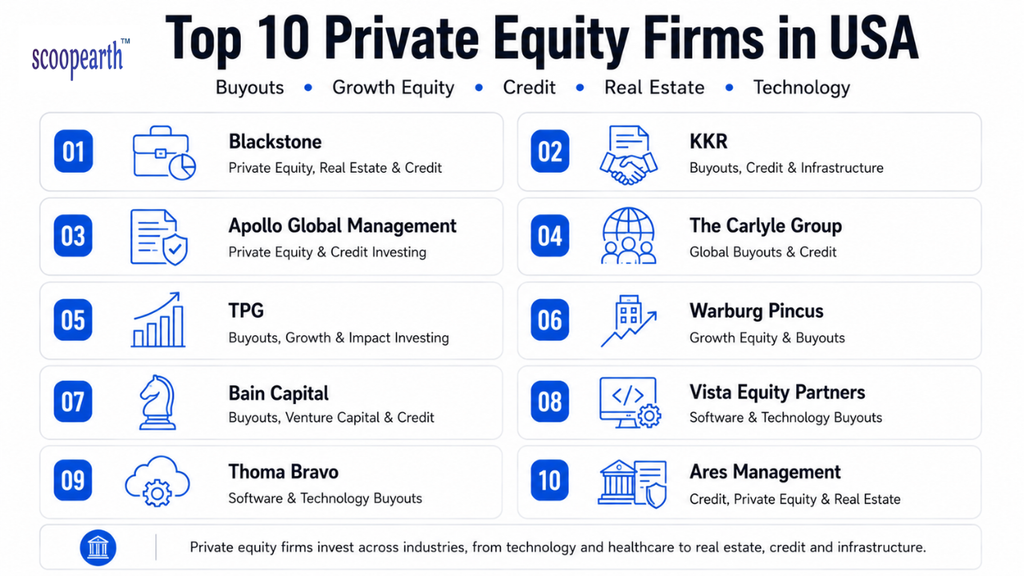
| Rank | Firm | Founded | Owner / Founders | Headquarters | Core Focus |
| 1 | Blackstone | 1985 | Founded by Stephen Schwarzman & Pete Peterson; publicly listed (NYSE: BX); led by CEO Stephen Schwarzman | New York, New York | Private Equity, Real Estate & Credit |
| 2 | KKR | 1976 | Founded by Jerome Kohlberg, Henry Kravis & George Roberts; publicly listed (NYSE: KKR); led by Co-CEOs Joseph Bae & Scott Nuttall | New York, New York | Buyouts, Credit & Infrastructure |
| 3 | Apollo Global Management | 1990 | Founded by Leon Black, Josh Harris & Marc Rowan; publicly listed (NYSE: APO); led by CEO Marc Rowan | New York, New York | Private Equity & Credit Investing |
| 4 | The Carlyle Group | 1987 | Founded by William Conway, Daniel D’Aniello & David Rubenstein; publicly listed (Nasdaq: CG); led by CEO Harvey Schwartz | Washington, D.C. | Global Buyouts & Credit |
| 5 | TPG | 1992 | Founded by David Bonderman & Jim Coulter; publicly listed (Nasdaq: TPG); led by CEO Jon Winkelried | Fort Worth, Texas | Buyouts, Growth & Impact Investing |
| 6 | Warburg Pincus | 1966 | Founded by Lionel Pincus & Eric Warburg; privately held, led by CEO Jeffrey Perlman | New York, New York | Growth Equity & Buyouts |
| 7 | Bain Capital | 1984 | Founded by Mitt Romney, T. Coleman Andrews III & Eric Kriss; privately held | Boston, Massachusetts | Buyouts, Venture Capital & Credit |
| 8 | Vista Equity Partners | 2000 | Founded by Robert F. Smith; privately held | Austin, Texas | Software & Technology Buyouts |
| 9 | Thoma Bravo | 1980 | Founded by Carl Thoma & Stanley Golder; privately held, led by Managing Partner Orlando Bravo | Chicago, Illinois | Software & Technology Buyouts |
| 10 | Ares Management | 1997 | Founded by Tony Ressler; publicly listed (NYSE: ARES); led by CEO Michael Arougheti | Los Angeles, California | Credit, Private Equity & Real Estate |
1. Blackstone – The World’s Largest Alternative Asset Manager
- Founded: 1985
- Owner: Founded by Stephen Schwarzman & Pete Peterson; publicly listed, led by CEO Stephen Schwarzman
- Headquarters: New York, New York
Blackstone is a company that invests in businesses, buildings, and loans for large investors. Stephen Schwarzman and Pete Peterson started it in 1985 with a small amount of money and a small team. It began as a simple advisory firm before growing into something much bigger.
Today, Blackstone is the biggest private investment firm in the world. It manages more than $1.2 trillion for its investors. The company now invests in real estate, business buyouts, and lending across the globe.
What Blackstone does: Buys and manages companies, real estate, and other assets on behalf of large investors.
Services: Private equity buyouts, real estate investing, credit and lending, and infrastructure investment.
2. KKR – The Firm That Invented the Modern Buyout

- Founded: 1976
- Owner: Founded by Jerome Kohlberg, Henry Kravis & George Roberts; publicly listed, led by Co-CEOs Joseph Bae & Scott Nuttall
- Headquarters: New York, New York
KKR is one of the very first buyout firms in the United States. Three men, Jerome Kohlberg, Henry Kravis, and George Roberts, started it in 1976. They came up with a new way to buy companies using mostly borrowed money, which later became common across the whole industry.
The firm is now run by two leaders, Joseph Bae and Scott Nuttall, who took over from the founders smoothly. KKR today invests in company buyouts, loans, and infrastructure projects like roads and power plants.
What KKR does: Buys companies and manages large investment funds across many industries.
Services: Leveraged buyouts, credit investing, infrastructure, real estate, and insurance solutions.
3. Apollo Global Management – A Firm Built on Distressed Deals

- Founded: 1990
- Owner: Founded by Leon Black, Josh Harris & Marc Rowan; publicly listed, led by CEO Marc Rowan
- Headquarters: New York, New York
Apollo was started in 1990 by three friends, Leon Black, Josh Harris, and Marc Rowan, after their old company shut down. They built their name by buying struggling companies at a low price and fixing them up.
Marc Rowan became the firm’s CEO in 2021 and has grown it a lot since then. Apollo now manages hundreds of billions of dollars, much of it through lending and its large insurance business.
What Apollo Global Management does: Invests in private equity, credit, and insurance-linked assets.
Services: Private equity buyouts, credit investing, real estate, and retirement and insurance solutions.
4. The Carlyle Group – A Washington-Born Global Investor
- Founded: 1987
- Owner: Founded by William Conway, Daniel D’Aniello & David Rubenstein; publicly listed, led by CEO Harvey Schwartz
- Headquarters: Washington, D.C.
Carlyle was started in 1987 by a small group of investors who chose to base the firm in Washington, D.C. instead of New York. This helped the company build strong ties with government and defense-related businesses early on.
After some changes in leadership, Harvey Schwartz, a former Goldman Sachs banker, became CEO in 2023. Carlyle now manages hundreds of billions of dollars in company buyouts and lending deals around the world.
What The Carlyle Group does: Buys and manages companies across a wide range of global industries.
Services: Private equity buyouts, credit investing, real estate, and fund-of-funds investment solutions.
5. TPG – A Texas-Based Global Investment Firm

- Founded: 1992
- Owner: Founded by David Bonderman & Jim Coulter; publicly listed, led by CEO Jon Winkelried
- Headquarters: Fort Worth, Texas
TPG was started in 1992 by David Bonderman and Jim Coulter, who chose Texas instead of a typical Wall Street city as their base. One of their early deals, buying Continental Airlines, helped build the firm’s name for fixing struggling companies.
TPG has since grown into a large global investor. It puts money into technology, healthcare, and clean energy companies. The firm went public in 2022 and is now led by CEO Jon Winkelried.
What TPG does: Invests in and helps grow companies across many industries and stages of business.
Services: Private equity buyouts, growth equity, real estate, credit, and impact investing.
6. Warburg Pincus – One of the Oldest Names in Private Equity
- Founded: 1966
- Owner: Founded by Lionel Pincus & Eric Warburg; privately held, led by CEO Jeffrey Perlman
- Headquarters: New York, New York
Warburg Pincus is one of the oldest private equity firms still around today. It started in 1966 when Lionel Pincus joined the Warburg family’s investment business. From early on, the firm focused on backing fast-growing companies instead of just older, settled ones.
The firm has stayed privately owned for many years, which is unusual for such a large investor. Jeffrey Perlman now leads Warburg Pincus as CEO, guiding its investments across many industries and countries.
What Warburg Pincus does: Invests in growing companies and helps them expand into larger businesses.
Services: Growth equity investing, buyouts, and long-term partnership support for founders.
7. Bain Capital – Born From a Consulting Firm
- Founded: 1984
- Owner: Founded by Mitt Romney, T. Coleman Andrews III & Eric Kriss; privately held
- Headquarters: Boston, Massachusetts
Bain Capital began in 1984 as a spin-off from a well-known consulting company called Bain & Company. One of its founders, Mitt Romney, later became a US senator and even ran for president.
Over time, the firm grew far beyond its consulting roots. Bain Capital now invests in company buyouts, startups, and loans. It remains privately owned and is run by a small group of senior partners rather than one CEO.
What Bain Capital does: Invests in companies at many different stages, from startups to large buyouts.
Services: Private equity buyouts, venture capital, credit investing, and real estate.
8. Vista Equity Partners – A Software-Focused Powerhouse

- Founded: 2000
- Owner: Founded by Robert F. Smith; privately held
- Headquarters: Austin, Texas
Robert F. Smith started Vista Equity Partners in 2000 with one clear goal: buy and improve software companies. This narrow focus turned out to be a smart choice, since the software industry grew massively in the years that followed.
Vista has become one of the biggest technology investors in the world. At any given time, it owns dozens of software companies. The firm is known for using the same playbook to improve every business it buys.
What Vista Equity Partners does: Buys and improves software and technology companies.
Services: Private equity buyouts, growth investing, and operational support for software businesses.
9. Thoma Bravo – A Leader in Software Buyouts
- Founded: 1980
- Owner: Founded by Carl Thoma & Stanley Golder; privately held, led by Managing Partner Orlando Bravo
- Headquarters: Chicago, Illinois
Thoma Bravo’s history goes back to 1980, but the firm took its current shape after Orlando Bravo joined and helped reshape its strategy. Like Vista, the firm chose to focus mainly on software and technology deals.
Under Orlando Bravo’s leadership, Thoma Bravo has become one of the most active software buyers in the industry. It often takes public software companies private, and now splits its main offices between Chicago and San Francisco.
What Thoma Bravo does: Buys software and technology companies and helps them grow more efficiently.
Services: Private equity buyouts and growth investing focused on software businesses.
10. Ares Management – A Fast-Growing Credit and Buyout Firm

- Founded: 1997
- Owner: Founded by Tony Ressler; publicly listed, led by CEO Michael Aroughetix
- Headquarters: Los Angeles, California
Ares Management started in 1997 under founder Tony Ressler, with a first focus on credit and lending rather than typical buyouts. That early focus on loans gave the firm a different path from many of its Wall Street rivals.
Over time, Ares grew into private equity, real estate, and infrastructure too. Under CEO Michael Arougheti, the firm has expanded quickly and now manages hundreds of billions of dollars across these areas.
What Ares Management does: Provides credit, private equity, and real estate investment for large investors.
Services: Direct lending, private equity buyouts, real estate investing, and infrastructure investment.
Frequently Asked Questions (FAQs)
1. Which is the largest private equity firm in the USA?
Blackstone is the largest, managing more than $1.2 trillion across private equity, real estate, credit, and infrastructure.
2. Which firms on this list are privately held versus publicly traded?
Warburg Pincus, Bain Capital, Vista Equity Partners, and Thoma Bravo are privately held, while Blackstone, KKR, Apollo, Carlyle, TPG, and Ares are publicly traded.
3. What is the difference between private equity and venture capital?
Private equity firms usually buy established, older companies and try to improve them, while venture capital firms invest smaller amounts in brand-new startups.
4. Which firms focus mainly on software companies?
Vista Equity Partners and Thoma Bravo both focus heavily on buying and improving software and technology businesses.
5. Which firm is known for inventing the modern leveraged buyout?
KKR is widely credited with pioneering the leveraged buyout strategy, most famously with its 1989 deal for RJR Nabisco.
6. Are private equity firms regulated in the USA?
Yes, private equity firms are regulated by the SEC, especially around how they raise money and report information to their investors.
7. Which firm was founded by a future US presidential candidate?
Bain Capital was co-founded by Mitt Romney, who later became a US senator and ran for president in 2012.
8. Why is Carlyle headquartered in Washington, D.C. instead of New York?
Carlyle’s founders chose Washington, D.C. on purpose, which helped the firm build strong early ties to government, defense, and policy-related industries.
9. How do private equity firms actually make money?
They raise money from investors, use it to buy companies, try to grow the value of those companies, and then sell them later for more than they paid.
10. Why do these ten firms matter to everyday people?
These firms own companies that touch daily life, from healthcare providers to grocery chains, so their decisions can affect jobs, prices, and services across the country.
Conclusion
The U.S. private equity industry has come a long way since a handful of boutique firms controlled the market in the 1970s and 1980s. The industry has grown to be worth several billions of dollars and plays a critical role in the American economy.
Firms such as Blackstone, KKR, and Carlyle have risen to prominence on the back of billions of dollars of high-profile deals, while others, such as Vista Equity Partners and Thoma Bravo, focused on one specific industry and reaped phenomenal rewards.
Representatives of all ten company on the list manage thousands of dollars and have a significant presence in various sectors of the economy. These companies will continue to dominate the market and dictate the terms of deals for years to come.