
Railroads still carry a large share of freight in the United States. Trains move grain, coal, automobiles, chemicals, consumer goods, construction materials and shipping containers between ports, factories and distribution centres.
The U.S. freight rail system covers nearly 140,000 miles. The Association of American Railroads currently counts six Class I freight railroads and roughly 615 short line railroads. Class I carriers account for about 67% of freight rail mileage and 94% of industry revenue.
The biggest railway companies in USA are not all the same. Union Pacific and BNSF run huge western freight systems. CSX and Norfolk Southern cover much of the eastern half of the country. CPKC and Canadian National connect U.S. customers with Canada, while CPKC also reaches Mexico. Amtrak handles national intercity passenger travel.
Short line operators matter too. Genesee & Wyoming and Watco operate dozens of smaller railroads that connect factories, farms and local businesses with the Class I system.
This list looks at network size, current operations, financial results and the type of rail service each company provides. It is not a strict revenue ranking because Amtrak works mainly with passengers, private rail companies do not publish the same financial information as listed businesses, and some companies have headquarters outside the United States.
Quick Look at the Top Railway Companies in USA
| Rank | Company | Type | Main U.S. Area / Work |
| 1 | Union Pacific Railroad | Class I freight | Western United States |
| 2 | BNSF Railway | Class I freight | Western and central United States |
| 3 | CSX Transportation | Class I freight | Eastern United States |
| 4 | Norfolk Southern Railway | Class I freight | Eastern United States |
| 5 | Canadian Pacific Kansas City | Class I freight | U.S., Canada and Mexico |
| 6 | Canadian National Railway | Class I freight | Midwest and Gulf connections |
| 7 | Amtrak | Passenger | National intercity passenger rail |
| 8 | Genesee & Wyoming | Short line / regional | More than 100 North American railroads |
| 9 | Watco | Short line / logistics | Short line and industrial rail |
| 10 | Florida East Coast Railway | Class II freight | Florida |
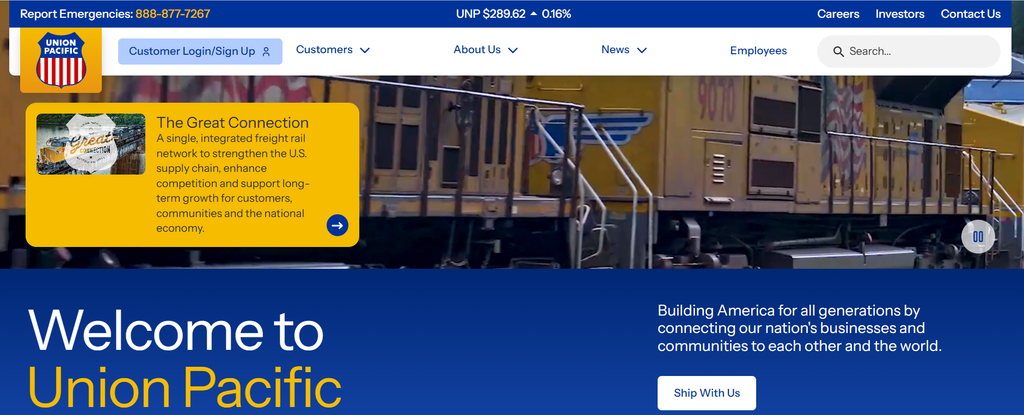
1. Union Pacific Railroad
| Founded | 1862 |
| Headquarters | Omaha, Nebraska |
| Network | Around 32,000 miles |
| 2025 Operating Revenue | $24.5 billion |
| Main Work | Freight and intermodal rail |
Union Pacific has one of the largest freight systems in the country. Its tracks cover much of the western United States and reach major ports, industrial areas, agricultural regions and six important rail gateways into Mexico. The company operates about 32,000 miles of track.
Its freight includes agricultural products, automobiles, chemicals, coal, industrial goods and intermodal containers.
Union Pacific reported $24.5 billion in operating revenue for 2025, up 1% from the previous year. Net income reached $7.1 billion.
The company is also trying to acquire Norfolk Southern. The Surface Transportation Board restarted its formal review of the proposed transaction in August 2026, but the deal has not received final approval, so the two railroads still operate separately.
Main Services
- Freight rail
- Intermodal transportation
- Automotive transportation
- Agricultural and industrial freight
- Rail service to major Mexico gateways
2. BNSF Railway
| Headquarters | Fort Worth, Texas |
| Owner | Berkshire Hathaway |
| Network | More than 32,500 route miles |
| 2025 Operating Revenue | $23.35 billion |
| Main Work | Freight rail |
BNSF Railway runs another very large western freight network. It operates more than 32,500 route miles in 28 states and also runs trains in three Canadian provinces.
Its system connects ports on the Pacific coast with inland markets, agricultural areas and large cities such as Chicago, Dallas-Fort Worth and Kansas City.
BNSF moves consumer products, grain, chemicals, industrial products, coal and other freight. Intermodal cargo forms a large part of the business because the railroad carries containers that move between ships, trains and trucks.
BNSF reported $23.35 billion in operating revenue during 2025, with freight revenue of about $22.79 billion.
Berkshire Hathaway owns BNSF, so the railroad does not trade separately on the stock market.
Main Services
- Consumer and intermodal freight
- Agricultural products
- Industrial freight
- Coal transportation
- Port and inland rail connections
3. CSX Transportation
| Headquarters | Jacksonville, Florida |
| Network | About 20,000 route miles |
| 2025 Revenue | $14.1 billion |
| Main Area | Eastern United States |
CSX has about 20,000 route miles in 26 states, Washington, D.C., Ontario and Quebec. Its routes reach many large markets in the eastern United States, including New York, Philadelphia, Boston, Atlanta, Miami, New Orleans, Memphis and Chicago.
The railroad carries automobiles, chemicals, agricultural products, coal, metals, minerals, steel forest products and intermodal freight.
CSX also has access to more than 70 ocean, river and lake ports. More than 230 short line and regional railroads connect with its network.
Revenue came to $14.1 billion in 2025, down 3% from 2024. Lower export coal revenue and weaker merchandise volumes affected the result.
CSX remains one of the railway companies in USA with a large presence east of the Mississippi River.
Main Services
- Merchandise freight
- Intermodal containers
- Automotive rail
- Coal transportation
- Port connections
4. Norfolk Southern Railway
| Headquarters | Atlanta, Georgia |
| Network | About 19,200 route miles |
| States Served | 22 |
| 2025 Railway Revenue | $12.2 billion |
Norfolk Southern operates about 19,200 route miles in 22 states. Its routes cover many industrial and population centres in the eastern United States.
The company has a large intermodal business and connects with Atlantic, Gulf Coast and Great Lakes ports. It carries agricultural goods, automobiles, metals, chemicals, construction materials and consumer products.
Norfolk Southern reported $12.2 billion in railway operating revenue for 2025. Income from railway operations reached $4.4 billion.
Union Pacific announced plans to acquire Norfolk Southern in 2025. Federal regulators are still reviewing the proposal in 2026, so Norfolk Southern remains a separate railroad at present.
Main Services
- Intermodal freight
- Automotive transportation
- Agricultural freight
- Industrial products
- Port rail connections
5. Canadian Pacific Kansas City
| Formed | 2023 |
| Headquarters | Calgary, Canada |
| Network | Around 20,000 route miles |
| 2025 Revenue | C$15.1 billion |
| Countries Served | Canada, United States and Mexico |
Canadian Pacific Kansas City, usually called CPKC, came from the merger of Canadian Pacific and Kansas City Southern in 2023.
Its headquarters are in Canada, but it has a large U.S. rail business and therefore belongs in a list of railway companies in USA.
CPKC operates about 20,000 route miles and is the only single-line railway that directly links Canada, the United States and Mexico.
The network reaches U.S. markets such as Chicago, Kansas City, Dallas, Houston and New Orleans and continues south into Mexico.
CPKC reported C$15.1 billion in revenue during 2025, up 4% from the year before.
Main Services
- Cross-border freight
- Automotive transportation
- Grain and agricultural products
- Energy and industrial freight
- Intermodal service
6. Canadian National Railway
| Founded | 1919 |
| Headquarters | Montreal, Canada |
| North American Network | Nearly 20,000 miles |
| 2025 Revenue | C$17.30 billion |
| Main U.S. Area | Midwest to Gulf Coast |
Canadian National, or CN, is another Canadian company with a sizeable U.S. rail operation.
Its nearly 20,000-mile North American system links Canada’s Atlantic and Pacific coasts with the U.S. Midwest and Gulf Coast.
CN routes in the United States reach markets including Chicago, Detroit, Memphis and New Orleans. The company moves more than 300 million tons of natural resources, manufactured goods and finished products each year.
For 2025, CN reported C$17.30 billion in revenue, up 2% from 2024. Net income reached C$4.72 billion.
CN’s U.S. operation makes it one of the railway companies in USA that has an important cross-border freight business.
Main Services
- Grain and agricultural freight
- Forest products
- Petroleum and chemicals
- Automotive freight
- Intermodal transportation
7. Amtrak
| Started | 1971 |
| Headquarters | Washington, D.C. |
| Network | More than 21,000 route miles |
| FY2025 Ridership | 34.5 million trips |
| FY2025 Operating Revenue | $3.9 billion |
Amtrak is different from the freight companies on this list because it carries passengers.
The national rail operator serves more than 500 destinations in 46 states, Washington, D.C. and three Canadian provinces. Its trains run on more than 21,000 route miles.
Amtrak operates long-distance trains and shorter state-supported routes. It also runs the Northeast Corridor between cities such as Washington, Philadelphia, New York and Boston.
Fiscal 2025 was a record year. Amtrak carried 34.5 million customer trips and reported $3.9 billion in total operating revenue. Adjusted ticket revenue reached $2.7 billion.
For passenger travel, Amtrak is the best-known name among railway companies in USA.
Main Services
- Intercity passenger trains
- Northeast Corridor service
- Long-distance routes
- State-supported passenger services
- High-speed Acela service
8. Genesee & Wyoming
| Started | 1899 |
| Corporate Headquarters | Darien, Connecticut |
| Railroads | More than 100 |
| Track | More than 13,000 miles |
| Main Work | Short line and regional freight |
Genesee & Wyoming, often shortened to G&W, operates smaller freight railroads rather than one huge national system.
The company owns or leases more than 100 freight railroads in North America. Its subsidiaries and joint ventures serve around 2,000 customers over more than 13,000 miles of track.
G&W also provides rail service at more than 30 ports, industrial switching, transloading and railcar repair.
Its railroads often handle the first or last part of a shipment before a Class I company takes the freight farther.
Brookfield Infrastructure and GIC own the company. Its corporate headquarters are in Darien, Connecticut.
Main Services
- Short line railroads
- Regional freight
- Port rail service
- Industrial switching
- Transloading and railcar repair
9. Watco

| Founded | 1983 |
| Headquarters | Pittsburg, Kansas |
| Short Line Network | 48 railroads in North America and Australia |
| Employees | Nearly 5,000 |
| Main Work | Rail, terminals and logistics |
Watco began in 1983 with a locomotive and eight employees working at an industrial site in Louisiana. The company now has nearly 5,000 employees and runs rail, terminal, port and logistics operations.
Its short line business covers many U.S. states. Current Watco railroads include the Kansas & Oklahoma Railroad, Wisconsin & Southern Railroad, Grand Elk Railroad, Ann Arbor Railroad and Texas & New Mexico Railway.
The company’s short line network reached 48 railroads after the addition of the Smoky Ridge Railroad in Tennessee.
Watco also handles industrial switching, railcar storage, repair, terminals and transloading.
Main Services
- Short line rail operations
- Industrial switching
- Railcar repair
- Terminals and ports
- Transloading and logistics
10. Florida East Coast Railway
| Origins | 1885 |
| Main Route | Jacksonville to Miami |
| Mainline | 351 miles |
| Type | Class II regional freight railroad |
| Owner | Grupo México Transportes |
Florida East Coast Railway, or FEC, runs a much smaller system than Union Pacific or BNSF, but its location gives it a clear role in Florida freight.
The railroad owns the full 351-mile mainline between Jacksonville and Miami.
FEC carries automobiles, food products, building materials, petroleum products, aggregates and intermodal containers. It also provides direct rail access to major South Florida ports.
Grupo México Transportes owns the railroad.
Its route follows Florida’s east coast, one of the fastest-growing parts of the state, and links South Florida with other North American railroads through Jacksonville.
Main Services
- Intermodal freight
- Automotive transportation
- Building materials
- Food and refrigerated freight
- South Florida port connections
How the U.S. Railroad Industry Is Structured
Class I Railroads
The six current Class I freight railroads are Union Pacific, BNSF, CSX, Norfolk Southern, CPKC and CN. Together they handle most freight rail revenue in the United States.
These companies usually move freight over long distances between large cities, ports and industrial areas.
Short Line and Regional Railroads
Short lines cover smaller areas but remain useful to local industries.
There are roughly 615 short line railroads in the United States. They connect farms, factories, warehouses and smaller communities with Class I rail lines.
Genesee & Wyoming and Watco are two of the biggest companies in this part of the business.
Passenger Rail
Amtrak handles national intercity passenger service, but it does not own every track its trains use.
Freight railroads provide much of the track used by Amtrak outside the Northeast Corridor. The Association of American Railroads says freight railroads host about 70% of Amtrak train-miles.
Why Rail Freight Still Matters in the USA
Rail works well for heavy goods and long trips.
A single freight train can move a large amount of grain, coal, automobiles, chemicals or containers without putting the same number of trucks on highways.
The U.S. freight rail network is privately owned for the most part, so freight railroad companies pay for much of their own track, signals, bridges and other infrastructure.
Ports also depend on rail. Containers arriving by ship can move inland by BNSF, Union Pacific, CSX, Norfolk Southern and other carriers before trucks handle the final part of the trip.
Trade with Canada and Mexico adds another reason rail remains important. CN and CPKC move freight between the United States and Canada, while CPKC and Union Pacific also have important Mexico connections.
Conclusion
The top railway companies in USA cover freight, passenger travel, regional rail and local short line operations.
Union Pacific and BNSF operate the two largest western freight networks. CSX and Norfolk Southern cover much of the eastern United States. CPKC connects the U.S. directly with Canada and Mexico, while CN links U.S. markets with Canada’s rail system and Gulf Coast routes.
Amtrak handles national passenger service. Genesee & Wyoming and Watco show how much work takes place on smaller railroads, while Florida East Coast Railway handles an important freight route between Jacksonville and Miami.
These companies cannot be compared only by revenue. Network size, geography, freight type, port access and customer base all change the role each railroad has in the U.S. transportation system.
Frequently Asked Questions
Which is the largest railway company in the USA?
Union Pacific is one of the largest U.S. railroad companies by revenue and reported $24.5 billion in operating revenue during 2025, while BNSF operates a slightly larger route network of more than 32,500 miles.
What are the six Class I freight railroads in the USA?
The six Class I freight railroads are Union Pacific, BNSF, CSX, Norfolk Southern, Canadian Pacific Kansas City and Canadian National.
Which company has the largest rail network in the USA?
BNSF operates more than 32,500 route miles, while Union Pacific operates roughly 32,000 miles, so both have very large western U.S. networks.
Is Amtrak a freight railroad?
No. Amtrak mainly provides intercity passenger rail service and currently serves more than 500 destinations in 46 states.
Is BNSF owned by Berkshire Hathaway?
Yes. Berkshire Hathaway owns BNSF Railway.
Are CPKC and Canadian National American companies?
No. Both companies have headquarters in Canada, but each operates a large rail network in the United States.
Has Union Pacific already bought Norfolk Southern?
No. The proposed merger is still under review by the Surface Transportation Board as of September 2026, and the two companies continue to operate separately.
What does a short line railroad do?
A short line usually moves freight over a smaller local or regional route and connects customers such as factories, farms or warehouses with larger Class I railroads.