
While most Indian e-commerce ventures are focused on rapid delivery and aggressive discounting, Meesho is a social commerce platform that allows people to resell on WhatsApp and Facebook without investing in inventory.
This relatively simple idea has made Meesho one of the most popular social commerce startups in India and one of the most anticipated initial public offerings (IPOs) in recent years – with Meesho’s founders becoming billionaires almost overnight.

This article provides an in-depth overview of Meesho’s valuation, revenue, founders, and funding, as well as the details of Meesho’s IPO and business growth.
Quick Overview
| Detail | Information |
| Full Name | Meesho (legally Meesho Limited, formerly Fashnear Technologies) |
| Founded | December 2015, as Fashnear; rebranded to Meesho in 2016 |
| Founders | Vidit Aatrey (CEO) and Sanjeev Barnwal (CTO) |
| Headquarters | Bengaluru, Karnataka, India |
| Industry | Social commerce / horizontal e-commerce marketplace |
| Known For | Zero-commission-style reseller model; strong presence in Tier 2, 3, and 4 Indian towns |
| Total Funding Raised (pre-IPO) | Reported in the range of $1.1–1.36 billion across roughly 12–14 rounds |
| Key Investors | SoftBank, Meta (Facebook), Sequoia/Peak XV Partners, Prosus, Elevation Capital, Fidelity Investments, Tiger Global, Y Combinator |
| IPO Listing Date | December 10, 2025, on the NSE and BSE |
| IPO Performance | Listed at a 46% premium; shares later surged over 74% above the issue price |
| Estimated Market Valuation (post-IPO surge) | Approximately $6–7 billion (subject to daily stock price movement) |
What is Meesho, and who founded it?

Meesho is a social commerce and e-commerce marketplace that connects small businesses and individual resellers with customers on WhatsApp and Facebook. It was founded in December 2015 by IIT Delhi graduates Vidit Aatrey and Sanjeev Barnwal, who initially launched a hyperlocal fashion delivery service named Fashnear.
However, the venture did not gain any significant traction. In 2016, the founders decided to pivot their business model and launched Meesho – a social commerce platform that would allow individual resellers and small businesses to sell their products on WhatsApp and Facebook without any inventory.
The name Meesho is derived from the Hindi phrase “Meri Shop,” which roughly translates to “My Shop.”
Meesho’s Valuation and Market Value
Meesho’s valuation has changed significantly over time – both before and after its recent IPO.
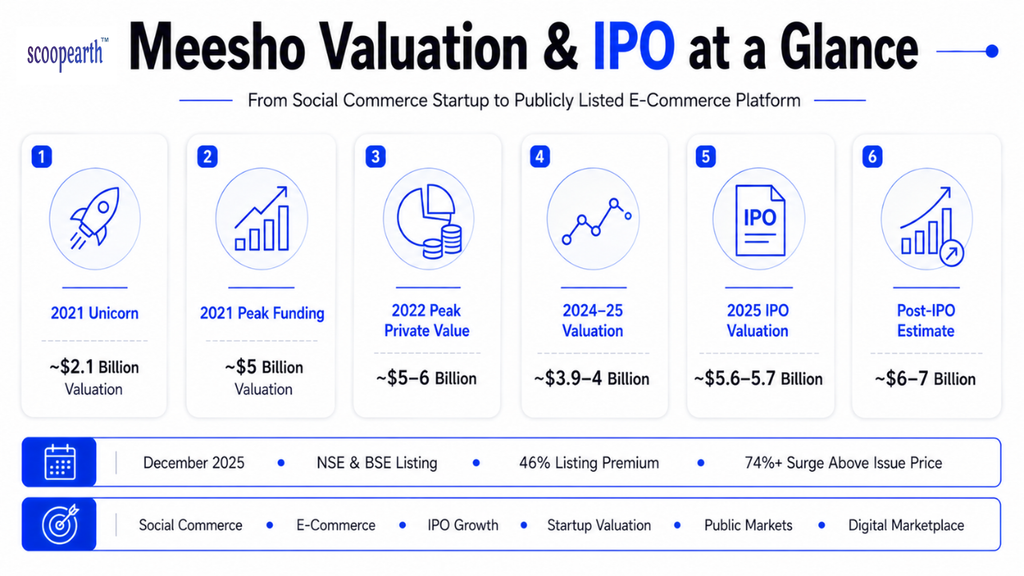
Timeline of Meesho’s Valuation
| Period | Reported Valuation | Context |
| April 2021 | ~$2.1 billion | Became a unicorn following a $300 million round led by SoftBank |
| September 2021 | ~$4.9–5 billion | Raised $570 million in its largest single funding round, its Series F, led by Fidelity Investments |
| 2022 (peak private valuation) | Approximately $5–6 billion | Reflected broader 2021–2022 Indian startup funding boom |
| 2024–early 2025 | Approximately $3.9–4 billion | Valuation cooled alongside the broader global startup funding slowdown |
| December 2025 (IPO) | Approximately $5.6–5.7 billion at listing | Public market debut on the NSE and BSE |
| Post-IPO surge | Approximately $6–7 billion | Shares rallied more than 74% above the issue price within weeks of listing |
This valuation trajectory is not uncommon for Indian consumer tech startups that went public in 2025 – having raised significant funds in the 2021 funding boom and needing to demonstrate their unit economics before going public.
What drives Meesho’s Valuation?
- Large network of resellers: Meesho is estimated to have about 15 million resellers, most of whom are women.
- Focus on ‘Tier 2,’ ‘Tier 3,’ and ‘Tier 4’: Unlike other e-commerce players, Meesho focuses on smaller towns and cities, where the ‘big four’ e-commerce companies (Flipkart, Amazon, Snapdeal, and Meesho itself) have relatively less reach.
- Asset-light: Meesho does not hold inventory, which allows it to maintain a high margin. It has its logistics arm, Valmo, to ensure rapid delivery of products.
- Revenue growth: Meesho’s revenue is projected to grow at a compound annual growth rate (CAGR) of approximately 31% between FY25 and FY28. According to some estimates, Meesho’s EBITDA (Earnings Before Interest, Taxes, Depreciation, and Amortization) crossed 66.9% in FY23.
Meesho’s Revenue Growth and Financial Performance
Meesho’s revenue has grown significantly since its inception. However, Meesho, like many other Indian consumer internet companies, has been losing money for much of its existence.
Meesho’s Revenue Growth
| Fiscal Year | Reported Revenue | Notes |
| FY21 | Approximately ₹1,123 crore | Reported a net loss of around ₹498.6 crore in the same period |
| FY22 | Continued rapid growth | Contribution margins improved as the platform scaled |
| FY23 | Approximately ₹6,875 crore | Significant year-over-year growth; EBITDA margin on core operations reported around 66.9% |
| Recent estimates (FY24–25) | Reported in the range of $840 million to $900 million (approximately ₹7,000–7,500 crore) | Continued growth alongside expanded logistics and warehousing investment |
As mentioned above, Meesho has been losing money for much of its existence, despite its massive revenue. Some of the figures cited above only represent the contribution margin, not the overall EBITDA. Meesho’s analysts projected that the company would be EBITDA positive by FY27, which suggests that Meesho is not yet profitable but is steadily moving toward profitability.
Meesho’s Founders: Vidit Aatrey and Sanjeev Barnwal
Vidit Aatrey and Sanjeev Barnwal are the co-founders of Meesho. Aatrey and Barnwal are both IIT Delhi alumni. Aatrey was employed with ITC before he became the CEO of Meesho; he was also a part of InMobi. On the other hand, Sanjeev Barnwal was employed with Times Internet before he became the CTO of Meesho.
In 2015, Aatrey and Barnwal founded Fashnear while still being employed with their respective companies. However, Fashnear did not gain any significant traction, and the two eventually quit their jobs to focus on Fashnear. The two even went to great lengths to promote Fashnear by picketing outside various stores in Bengaluru.
However, Fashnear eventually closed down in 2016, and Aatrey and Barnwal decided to pivot their business model and launched Meesho.
Following Meesho’s recent IPO, the wealth of the two co-founders has skyrocketed. According to recent estimates, Aatrey owns approximately 47.25 crore shares (or 11.1%). With the stock price surging more than 74% above the IPO price, Aatrey’s personal net worth has crossed the ₹9,000-crore mark, making him a billionaire.
On the other hand, Sanjeev Barnwal owns approximately 31.6 crore shares (or 7.4%), which makes his personal net worth between ₹5,700–6,900 crore.
Meesho’s Business Model and Growth Strategy
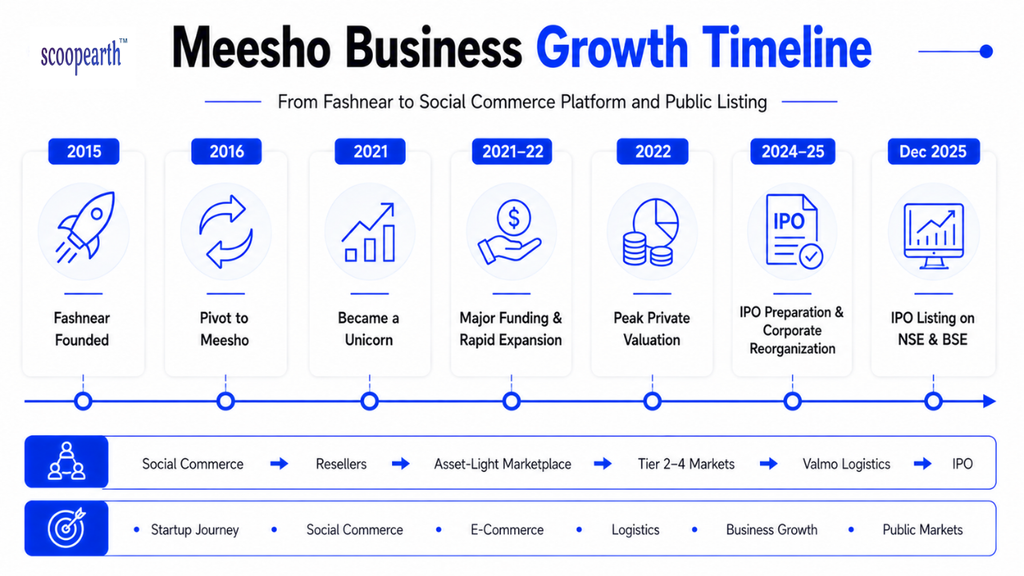
Fashnear to Meesho (2015–2016)
Meesho’s history is an interesting one because it began its journey as Fashnear, a hyperlocal fashion discovery and delivery service. As mentioned above, Fashnear was launched by Aatrey and Barnwal in 2015.
The idea was to connect local fashion retailers with local buyers. However, the venture did not gain any significant traction. Nevertheless, Fashnear eventually pivoted to a marketplace model where resellers could list their products on the company’s website. However, this too did not gain any significant traction, and Fashnear eventually shut down in 2016.
Pivot to Reseller Marketplace and Rapid Growth (2016–2021)
Following Fashnear’s closure, Aatrey and Barnwal launched Meesho in 2016 – a social commerce marketplace that would allow resellers to sell their merchandise on WhatsApp and Facebook.
According to various reports, Meesho gained significant traction among Indian women, who were the core of Meesho’s reseller network. In 2016, Meesho participated in Y Combinator’s Summer 2016 cohort. By April 2021, Meesho had become a unicorn after raising $300 million in a funding round led by SoftBank.
Growth, Logistics Expansion, and Pivot (2021–2024)
Meesho’s growth trajectory between 2021 and 2024 has been nothing short of spectacular. The company raised the largest funding round in its history, $570 million, at a valuation approaching $5 billion, in 2022.
Additionally, Meesho launched Meesho Superstore, which would sell groceries. However, Meesho eventually shut down most of its Superstore warehouses after realizing that the venture was not as profitable as projected. Between 2021 and 2024, Meesho also invested significantly in its logistics arm, Valmo.
This was done to reduce its dependence on third-party logistics (3PL) providers and to cut costs, particularly in its delivery network, which spans ‘Tier 2,’ ‘Tier 3,’ and ‘Tier 4’ Indian towns.
Preparation for IPO and Public Listing (2024–2025)
With its valuation peaking in 2022, Meesho’s management eventually decided to go public. Between 2024 and 2025, Meesho reorganized its corporate structure and moved its parent entity back to India from Delaware, USA. This was done to facilitate its IPO. In January 2025, Meesho raised funds in its Series F funding round before eventually going public in December 2025.
Meesho’s IPO and Public Listing (December 2025)
Meesho’s shares began trading on the National Stock Exchange (NSE) and the Bombay Stock Exchange (BSE) on December 10, 2025. The IPO’s share price was fixed at a range of ₹105–111. With a valuation of between $5.6–5.7 billion at the top end of the range, Meesho’s IPO raised significant investor attention.
On the day of listing, Meesho’s shares opened 46% higher than the IPO price and eventually surged more than 74% above the IPO price, reaching an intraday high of ₹193.50. The valuation increase had an immediate impact on the wealth of Meesho’s co-founders, Vidit Aatrey and Sanjeev Barnwal.
Following the listing, Aatrey became a billionaire, with his 11.1% stake in Meesho worth more than ₹9,000 crore. Meanwhile, Sanjeev Barnwal’s 7.4% stake was worth between ₹5,700–6,900 crore.
Frequently Asked Questions (FAQs)
1. What is Meesho’s current valuation?
Following its recent initial public offering (IPO) in December 2025 and the surge in its stock price, Meesho’s valuation currently falls between $6–7 billion. However, it is important to note that the valuation changes every day depending on the stock price.
2. Who founded Meesho, and when was it founded?
Meesho was founded in December 2015 by Vidit Aatrey and Sanjeev Barnwal – two IIT Delhi alumni. It was initially launched as Fashnear, a hyperlocal fashion delivery service, before it eventually pivoted to its current business model.
3. Is Meesho a publicly listed company?
Yes, Meesho is a publicly listed company. It was listed on the National Stock Exchange (NSE) and the Bombay Stock Exchange (BSE) in December 2025.
4. How much funding did Meesho raise before its IPO?
Meesho raised between $1.1–1.36 billion in private funding before its IPO. The company raised funds from several investors, including SoftBank, Meta, Sequoia/Peak XV Partners, Prosus, Elevation Capital, Fidelity Investments, Tiger Global, and Y Combinator, among others.
5. How did Meesho’s IPO perform?
Meesho’s IPO performed exceptionally well, with its shares opening 46% higher than their initial public offering (IPO) price. Additionally, the shares surged more than 74% above the IPO price.
6. What are Meesho’s major competitors?
Meesho’s major competitors include Flipkart (Shopsy), Amazon, and Snapdeal. However, Meesho has carved a niche for itself by focusing on India’s ‘Tier 2,’ ‘Tier 3,’ and ‘Tier 4’ towns and utilizing a reseller network.
7. What is Meesho’s business model?
Meesho’s business model can be described as an asset-light marketplace where individual resellers and small businesses can sell their merchandise on WhatsApp and Facebook without having to hold any inventory. The company also has its logistics arm, Valmo.
8. Is Meesho a profitable company?
Meesho has not been particularly profitable, as it has been operating at a net loss for much of its existence. However, the company has been steadily improving its contribution margins and is projected to be EBITDA positive by FY27.
9. How much do Meesho’s founders earn?
Following Meesho’s recent IPO, the personal net worth of the company’s co-founders, Vidit Aatrey and Sanjeev Barnwal, has skyrocketed. Aatrey’s 11.1% stake in Meesho is worth more than ₹9,000 crore, while Barnwal’s 7.4% stake is worth between ₹5,700–6,900 crore.
10. What makes Meesho unique compared to other e-commerce companies in India?
Meesho has several unique aspects about it, including its focus on individual resellers (especially women), its use of WhatsApp and Facebook as its sales channels, and its focus on ‘Tier 2,’ ‘Tier 3,’ and ‘Tier 4’ Indian towns.
Conclusion
Meesho’s journey from a failed hyperlocal fashion delivery service to a social commerce marketplace and finally to a publicly listed company is truly remarkable. What makes Meesho’s story even more interesting is the fact that it has managed to sustain its business model by focusing on individual resellers, most of whom are women.
Additionally, Meesho has carved a niche for itself by focusing on ‘Tier 2,’ ‘Tier 3,’ and ‘Tier 4’ Indian towns and avoiding competition with the ‘big four’ Indian e-commerce companies – Flipkart, Amazon, Meesho itself, and Snapdeal.
Meesho’s recent initial public offering (IPO) in December 2025 has made Meesho’s co-founders, Vidit Aatrey and Sanjeev Barnwal, billionaires. As Meesho continues to navigate its way through the competitive Indian e-commerce marketplace, one can only hope that the company will continue to deliver value to its shareholders and customers for many years to come.