Most large business groups are created by a single entrepreneur and passed down as an inheritance to his children. Unlike these businesses, the Tata Group was built on the principle that the majority of the parent company’s shares should belong to charities.
Image Courtesy: Tata Group / Official Website
This feature, and the accompanying intricacies of the group’s structure, have allowed the company to survive for more than 160 years, to withstand a hostile takeover attempt and a power struggle in the second generation of leadership, and to occupy the leading position in terms of market value among India’s business groups.
This article will cover the value, revenue, companies, shareholders, and management of the conglomerate better known as the Tata Group, presenting verified information and analysis of the data to answer the questions that are most common for this business group.
Quick Overview
| Detail | Information |
| Full Name | Tata Group |
| Founded | 1868, by Jamsetji Nusserwanji Tata |
| Headquarters | Mumbai, Maharashtra, India |
| Holding Company | Tata Sons Private Limited |
| Majority Owner | Tata Trusts, holding approximately 65–66% of Tata Sons |
| Chairman (Tata Sons) | Natarajan Chandrasekaran, since February 2017 |
| Chairman (Tata Trusts) | Noel Tata, since October 2024 |
| Number of Companies | Around 100 operating companies, of which roughly 25–30 are publicly listed |
| Employees | Over 1.15 million globally |
| Combined Listed Market Capitalization | Approximately ₹26 lakh crore (roughly $300+ billion), making it India’s most valuable business group |
| Group Revenue (FY26) | Approximately ₹16.24 lakh crore (~$190 billion) |
| Group Profit After Tax (FY26) | Approximately ₹1.71 lakh crore (~$20 billion) |
| Largest Group Company | Tata Consultancy Services (TCS), by both market capitalization and profit contribution |
Who Owns the Tata Group?
Unlike many other large family-run conglomerates, there is, for the Tata Group, one important difference in their business and ownership model – namely, its philanthropic focus. In particular, while Tata Trusts hold the majority of the shares in Tata Sons, the holding company of the conglomerate, which in turn owns the majority of the group’s other companies, they are not owned directly by the founding Tata family of Ratan and Shiv Nadar.
Instead, with the majority of shares belonging to the Sir Dorabji Tata Trust and the Sir Ratan Tata Trust, these charitable foundations control a little over 65% of Tata Sons’ shares, and thus own roughly two-thirds of the conglomerate’s profits. These profits are then partially redirected towards the charitable foundation under the supervision of Ratan Tata’s half-brother Noel Tata.
The latter, in turn, has succeeded his brother as the new chairman of Tata Trusts following the passing of the 86-year-old business magnate in late October 2024. Despite Tata Trusts being the majority shareholder in Tata Sons, the actual management of the conglomerate falls to the newly installed Chairman N. Chandrasekaran.
The Shapoorji Pallonji Group, the family-owned conglomerate of the Mistry family, owns just under 18% of Tata Sons’ shares, and thus is the largest single shareholder not affiliated with the Trusts. This made them, and specifically their scion Cyrus Mistry, a major protagonist in the family feud which erupted in the Trusts and Sons boardrooms in 2016-2017.
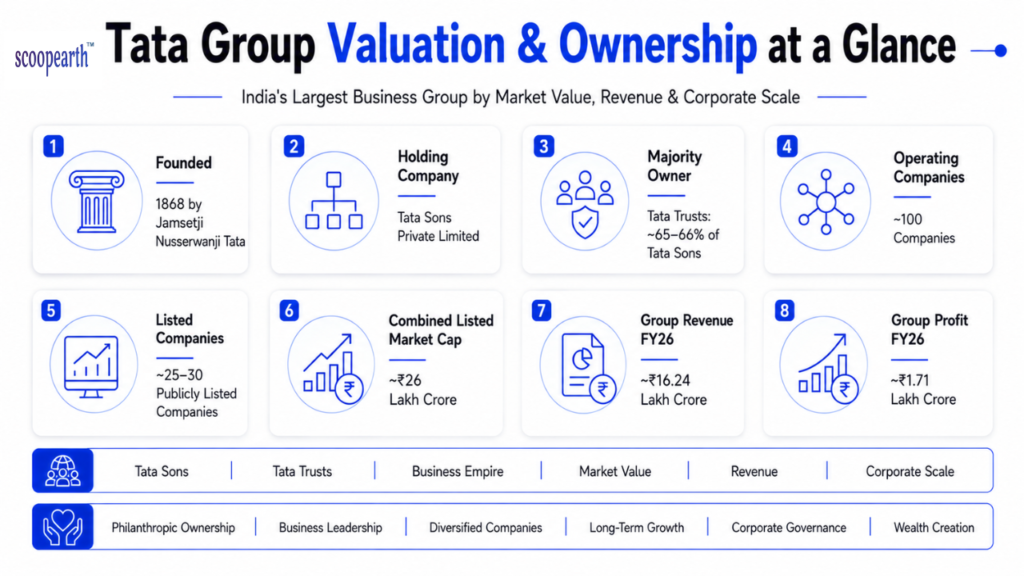
Tata Group Valuation and Financial Scale
The Tata Group’s overall financial scale can be measured in two distinct ways: its combined market capitalization across publicly listed companies, and its aggregate revenue and profit across the entire group, including privately held entities.
Valuation and Financial Snapshot
| Metric | Recent Reported Figure | Context |
| Combined listed market capitalization | Approximately ₹26 lakh crore (~$300+ billion) | Spans roughly 25–30 publicly listed Tata companies; larger than Reliance Industries’ single-entity market cap |
| Group aggregate revenue (FY26) | ₹16,24,030 crore (~$190 billion), up 7.8% year-over-year | Includes both listed and unlisted Tata Group entities |
| Group aggregate profit after tax (FY26) | ₹1,70,525 crore (~$20 billion), up 51.9% year-over-year | Reflects strong profitability growth, according to Tata Sons Chairman N. Chandrasekaran |
| Tata Sons standalone revenue (FY26) | ₹42,367 crore, up 9.1% year-over-year | Tata Sons itself functions as the group’s principal investment holding company |
| Market cap growth under Chandrasekaran | Up approximately 188% since February 2017 | Reflects strong stock performance across group companies, led significantly by TCS |
It’s worth understanding why these two figures, market capitalization and aggregate revenue/profit, tell somewhat different stories.
Market capitalization reflects investor sentiment and stock price movements across listed entities on any given day, while aggregate revenue and profit reflect the actual scale of business activity across the entire group, including large unlisted businesses. Both paint a picture of significant scale, but they shouldn’t be treated as interchangeable.
What Drives the Group’s Value
- Tata Consultancy Services (TCS) — By a wide margin, the group’s most valuable and most profitable company, generating tens of billions of dollars in annual revenue from global IT services and consulting, and historically responsible for a disproportionate share of the group’s overall profitability.
- Automotive (Tata Motors and Jaguar Land Rover) — A major revenue contributor, spanning both the domestic Indian passenger and commercial vehicle market and the British luxury brand Jaguar Land Rover, acquired in 2008.
- Steel and materials (Tata Steel) — One of the world’s larger steel producers, with operations spanning India, Europe, and Southeast Asia, following the landmark 2007 acquisition of Anglo-Dutch steelmaker Corus.
- Consumer-facing brands (Titan, Tata Consumer Products, Trent) — Spanning jewelry, watches, packaged foods and beverages, and fast-fashion retail, these businesses have delivered some of the group’s strongest recent stock performance.
- Newer, capital-intensive bets (Air India, Tata Electronics, Tata Digital, Agratas) — Representing the group’s more recent, higher-risk expansion into aviation, semiconductor manufacturing, digital commerce, and battery technology, several of which remain in earlier, less profitable stages of growth.
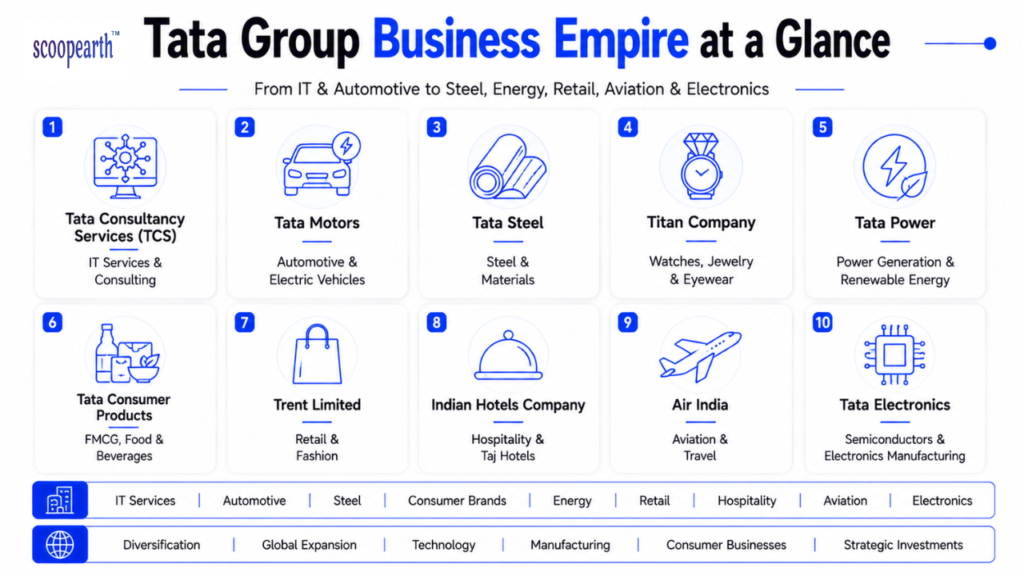
Major Companies Under the Tata Group
The Tata Group’s roughly 100 operating companies span an unusually wide range of industries, often summarized as running “from salt to software.” Some of its most significant businesses include:
| Company | Sector | Notable Detail |
| Tata Consultancy Services (TCS) | IT services & consulting | The group’s largest company by market capitalization and profit contribution; publicly listed since 2004 |
| Tata Motors | Automotive | Owns Jaguar Land Rover; spans passenger vehicles, commercial vehicles, and electric vehicles |
| Tata Steel | Steel & materials | One of the world’s larger steel producers, with major European operations following the Corus acquisition |
| Titan Company | Watches, jewelry, eyewear | Includes brands such as Tanishq; among the group’s stronger-performing consumer stocks |
| Tata Power | Power generation & renewables | Spans conventional and renewable energy generation and distribution |
| Tata Consumer Products | FMCG / packaged foods | Includes Tata Tea and Tata Salt, among India’s most recognized household brands |
| Trent Limited | Retail (fast fashion) | Operates Westside and Zudio; chaired by Noel Tata |
| Indian Hotels Company | Hospitality | Operates the Taj Hotels chain, among India’s most prestigious hospitality brands |
| Air India | Aviation | Reacquired by the Tata Group in 2022, decades after the airline was originally founded by the group and later nationalized |
| Tata Electronics | Semiconductors & electronics manufacturing | A newer, rapidly scaling venture; became the group’s fourth-largest company by revenue within four years of its launch |
A Brief History: From a Bankrupt Oil Mill to a Global Conglomerate
Founding and Early Growth (1868–1938)
The Tata Group traces its origins to 1868, when Jamsetji Nusserwanji Tata purchased a bankrupt oil mill in Mumbai for ₹21,000, a substantial sum at the time, and converted it into a cotton mill.
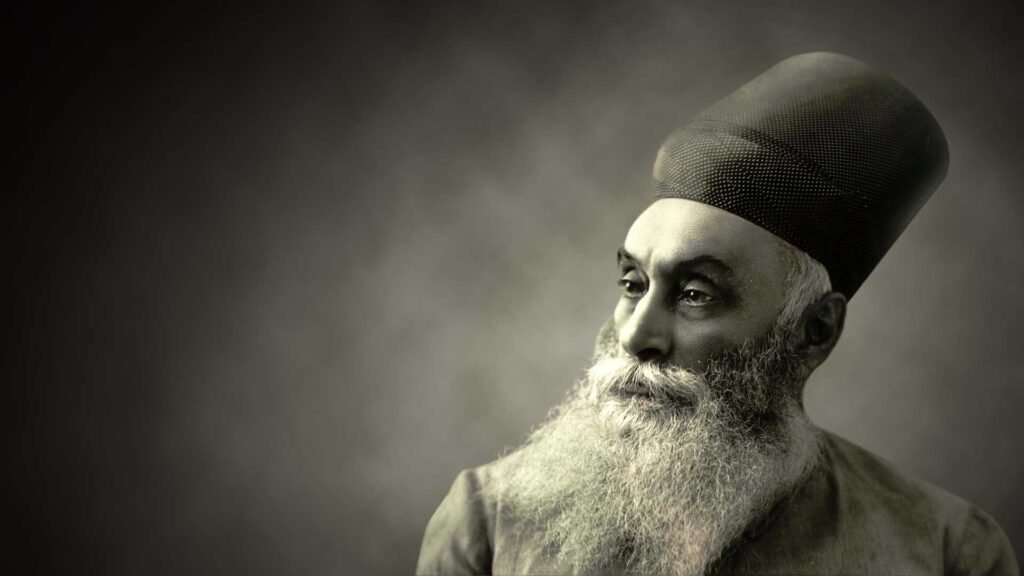
Image Courtesy: Tata Group / Official Website (Jamsetji Nusserwanji Tata)
Over the following decades, Jamsetji Tata laid the foundation for what would become some of India’s most significant industrial institutions, including the Indian Institute of Science and the earliest plans for what became Tata Steel, though he did not live to see many of these ventures fully realized.
Expansion Under J.R.D. Tata (1938–1991)
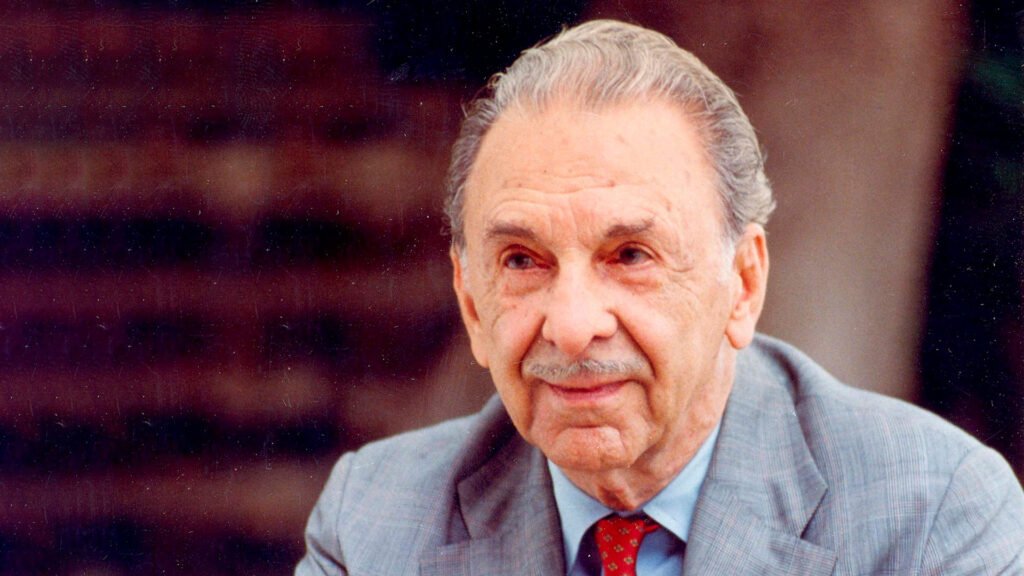
Image Courtesy: Tata Group / Official Website (J.R.D. Tata)
Under J.R.D. Tata’s leadership, spanning more than five decades, the group expanded significantly into aviation, chemicals, and consumer goods, growing from roughly $101 million to $5 billion in revenue over his tenure. J.R.D. Tata also famously founded Tata Airlines in 1932, which was later nationalized by the Indian government and became Air India — a business the group would eventually reacquire nearly a century later.
Globalization Under Ratan Tata (1991–2012)
Ratan Tata took over as chairman in 1991, just as India began liberalizing its economy, and led the group through its most significant era of global expansion.
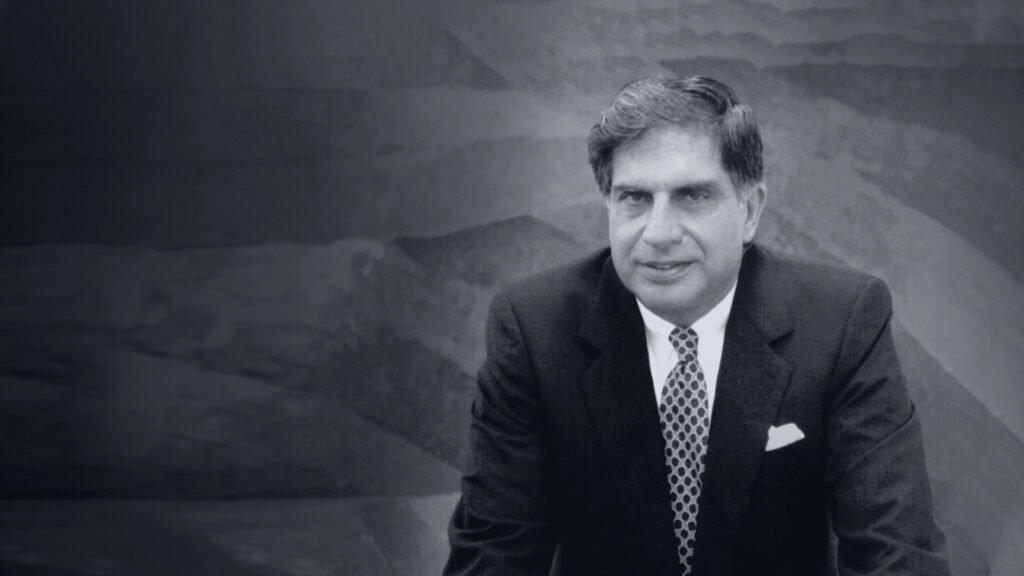
Image Courtesy: Tata Group / Official Website (Ratan Tata )
Under his leadership, Tata acquired British tea company Tetley in 2000 for approximately ₹1,870 crore, Anglo-Dutch steel giant Corus in 2007 for roughly $12 billion, and British luxury automaker Jaguar Land Rover in 2008 for approximately $2.3 billion, transforming Tata from a primarily India-focused conglomerate into a genuine multinational.
The 2004 public listing of TCS during this period is widely regarded as one of the most consequential wealth-creation events in Indian corporate history. By the time Ratan Tata retired as chairman in 2012, group revenue had grown to exceed $100 billion.
The Chandrasekaran Era and Recent Developments (2017–Present)
N. Chandrasekaran became chairman of Tata Sons in February 2017, following a highly public and contentious removal of his predecessor, Cyrus Mistry, in 2016 — a dispute that eventually escalated into prolonged legal proceedings between the Tata and Mistry families.
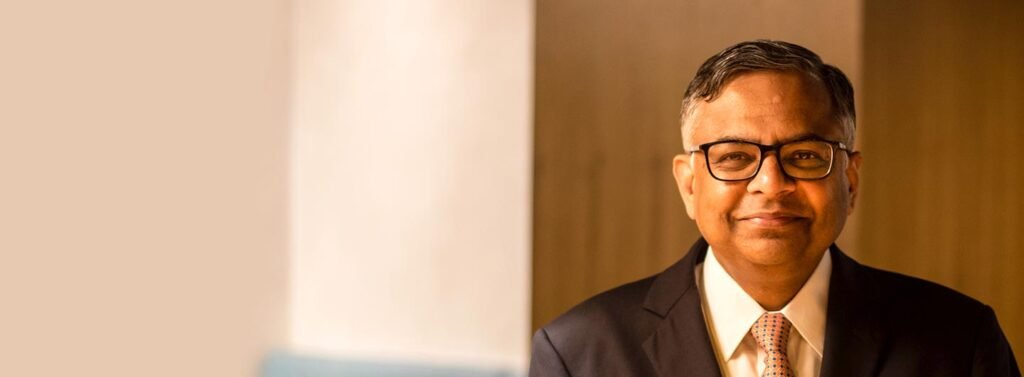
Image Courtesy: Tata Group / Official Website(N. Chandrasekaran)
Under Chandrasekaran’s leadership, the group’s combined market capitalization has grown substantially, rising roughly 188% between February 2017 and early 2026, significantly outperforming the broader Indian stock market (the BSE Sensex) over the same period, though this growth has been notably concentrated in TCS’s performance relative to the rest of the group.
Recent years have also seen the group re-enter aviation through its 2022 reacquisition of Air India, and expand aggressively into semiconductors and electronics manufacturing through Tata Electronics, which Chandrasekaran has highlighted as having become the group’s fourth-largest company by revenue within just four years of its establishment.
The group has also continued developing newer ventures including Tata Digital and Agratas (battery technology), reflecting a deliberate strategic push into capital-intensive, higher-growth sectors aligned with India’s broader manufacturing and technology ambitions.
Leadership Transition Following Ratan Tata’s Death (2024)
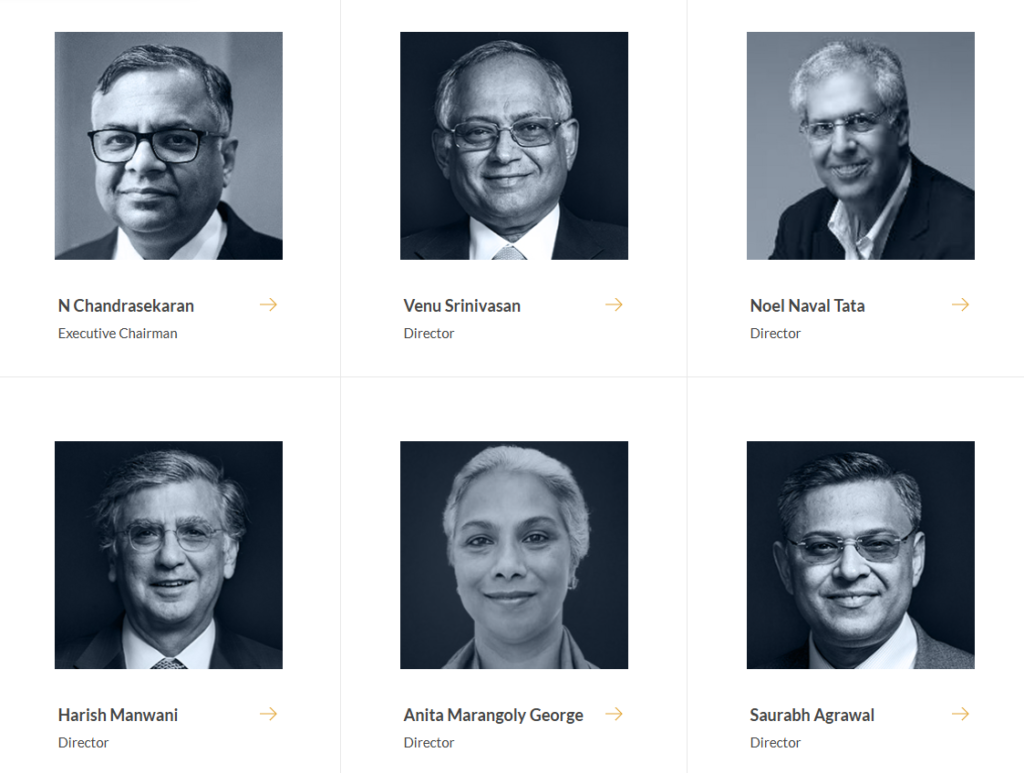
Image Courtesy: Tata Group / Official Website
Ratan Tata passed away on October 9, 2024, at the age of 86, prompting an outpouring of tributes across India and drawing a formal day of mourning in Mumbai. Just two days later, Tata Trusts unanimously appointed Noel Tata, Ratan Tata’s half-brother, as its new chairman, a decision that carried significant weight given Tata Trusts’ approximately 66% controlling stake in Tata Sons.
While Chandrasekaran continues to lead Tata Sons’ day-to-day operations, the appointment placed ultimate governance influence over the group firmly within the extended Tata family once again.
Frequently Asked Questions (FAQs)
What is the Tata Group worth?
The combined market value of the approximately 25–30 publicly listed companies that comprise the business conglomerate has been estimated at around ₹26 lakh crore (over $300 billion), making it the largest business group in India in terms of market value. It is, however, a fluctuating number that varies with the stock market.
Who owns the Tata group?
The ownership of the conglomerate is split between several philanthropic trusts, with Tata Sons being the main holding company and possessing around 65–66% of the shares. The Shapoorji Pallonji Group owns the lion’s share of the remaining 33–34%, with a stake of around 18%.
Who runs the Tata group?
N. Chandrasekaran has been the managing director and CEO of Tata Sons since his appointment in February 2017. He presides over the conglomerate’s day-to-day operations, while Noel Tata became the chairman of Tata Trusts in October 2024, overseeing its shareholder control function.
What happened to Ratan Tata?
The former chairman and CEO of the conglomerate, Ratan Tata, passed away on October 9, 2024. He was 86 years old. He was the central figure behind many of the Tata Group’s acquisitions, including the purchases of Tetley, Corus Steel, and Jaguar Land Rover, which propelled it to international prominence.
Who is the new chairman of Tata Trusts?
Noel Tata, the half-brother of Ratan Tata and former executive director of the conglomerate, has been elected as the new chairman of Tata Trusts. He took office two days after the passing of Ratan Tata, becoming the new leader of the conglomerate that owns 65% of Tata Sons.
How big is Tata Group?
In terms of revenue, the business conglomerate generated an aggregate revenue of around ₹16.24 lakh crore ($190 billion) for the fiscal year ended 2026. It recorded a revenue growth of 7.8% year-over-year (YoY) and registered a rise in profits by 51.9% YoY, reaching ₹1.71 lakh crore.
Which is the biggest company owned by the Tata Group?
Tata Consultancy Services (TCS) is the largest company in terms of both market value and profits for the business conglomerate. It has consistently contributed the largest percentage of net profit among all peers in the group, registering at an unfair advantage over the others.
When did Tata Group buy Jaguar Land Rover?
In 2008, the business conglomerate purchased the British car manufacturer Jaguar Land Rover from Ford Motor Company for around $2.3 billion. It was part of the acquisition spree embarked on by Ratan Tata that saw the purchase of luxury brand Tetley, steel-making company Corus Steel, and the launch of several international initiatives.
Did Tata Group buy Air India?
The conglomerate reacquired Air India in 2022, almost 90 years after its founding as Tata Airlines in 1932. Originally, Air India was privatized when the Indian government took over the then-Tata Airlines.
How many companies does Tata Group own?
Around 100 companies comprise the conglomerate. However, only around 25–30 are publicly listed on the stock exchanges, while the rest are privately held.
Conclusion
The more than a century-and-a-half-long history of the creation and development of the TATA group is truly extraordinary. It is strategically located around a philanthropic ownership model that has proven its ability to sustain itself for decades after the death of its founder.
The group has gone through a public feud and survived, overcoming the challenges of the outgoing chairman and, as many believe, one of India’s greatest business minds. From a bankrupt oil refinery, which Jamsetji Tata had to sell in 1868, the company grew by leaps and bounds. Thus, in the first few decades, it managed to transform from a small enterprise into an integrated corporate conglomerate.
The group constantly redefines itself under the leadership of J.R.D. Tata, who laid the foundation for the group’s future development, and Ratan Tata, who began his work by acquiring major world companies. Finally, in the present day, under the leadership of Ratan’s son Chandrasekaran, TATA continues to develop and expand, investing heavily in promising and high-tech spheres such as semiconductors, aviation, and alternative energy.
Meanwhile, the chairmanship of the Trust, which owns the majority of the group, belongs to Noel Tata. This way, the future of TATA, as one of the largest IT service providers in the world, is undoubtedly one of the most exciting topics in the business world.