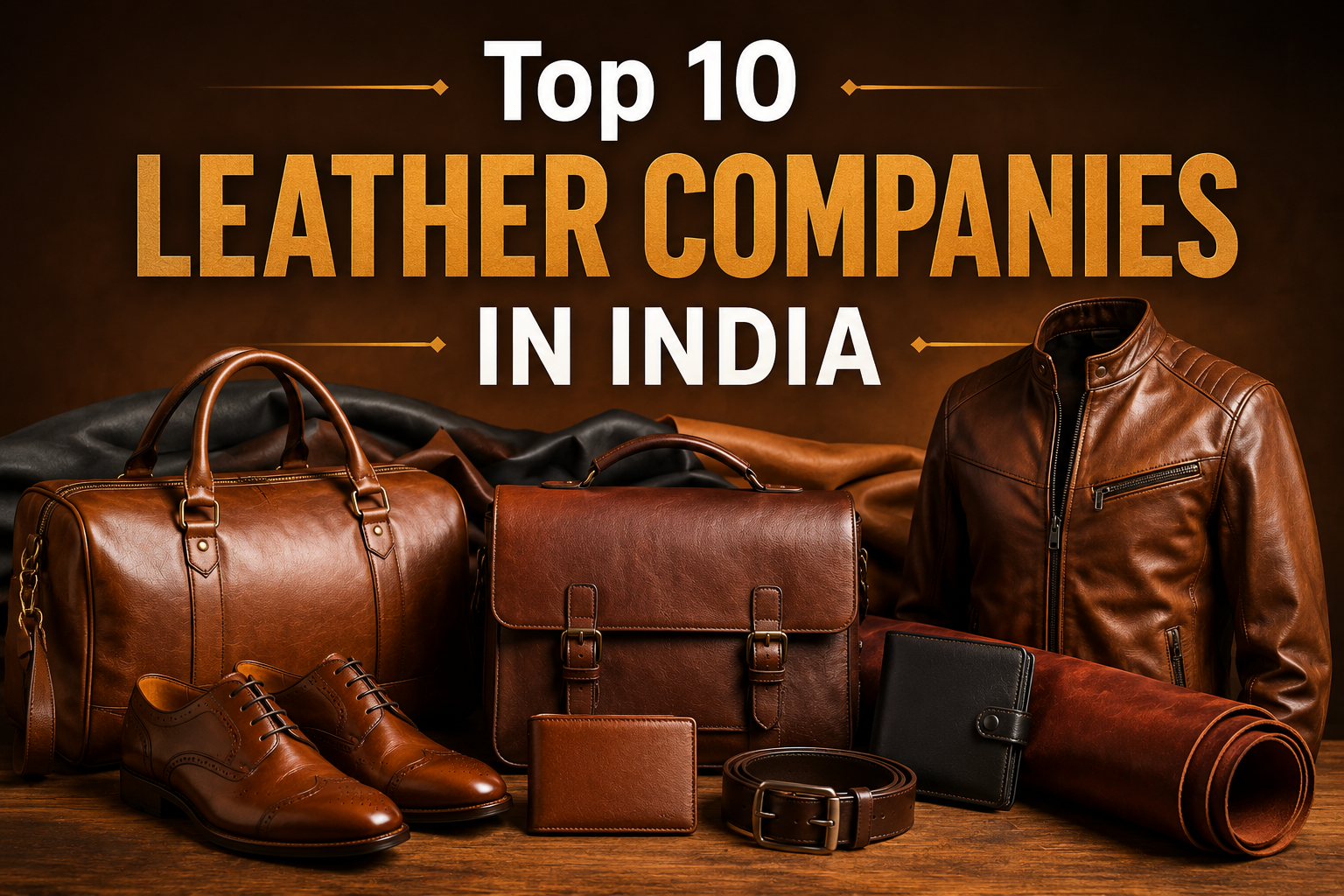
India’s leather industry is one of the strongest pillars of the country’s manufacturing sector. It is a massive job creator, one of the country’s oldest foreign exchange earners, and a major player globally. As of 2026, India accounts for roughly 13% of the world’s leather hides and skins production, supporting a multi-billion-dollar ecosystem that combines traditional craftsmanship with modern manufacturing.
What makes the Indian leather landscape unique is its strategic geographic clustering. From the colossal processing hubs in Tamil Nadu (Chennai, Ambur, Vaniyambadi) and the historical tanneries of Kanpur in Uttar Pradesh, to the specialized leather goods clusters in Kolkata and the booming manufacturing centers of Haryana, the sector is highly specialized. With global fashion houses increasingly leaning into the “China Plus One” sourcing strategy, Indian leather companies are scaling up rapidly to meet premium international and domestic demands.
Let’s break down the Top 10 Leather Companies in India that are steering this massive machine.
Company Name Primary Manufacturing Core Product Strength Main Market FocusHub
Tata International
Dewas (MP) & Chennai (TN)
Finished Hides & Luxury Shoes
Global Export (B2B)
Mirza International
Kanpur (UP)
Integrated Tanning & Red Tape Retail
Balanced (Export + Domestic)
Farida Group
Ambur (TN)
High-volume Shoe Uppers & Footwear
Global Export (B2B)
Superhouse Group
Kanpur (UP)
Safety/Tactical Boots & Equestrian Gear
Global Export (B2B)
Bhartiya International
Bengaluru (KA) & Chennai (TN)
High-Fashion Outerwear & Jackets
Global Luxury Sourcing
KH Group
Chennai (TN)
Fine Premium Skin Tanning & Bags
Premium Export (B2B)
Liberty Shoes
Karnal (HR)
Formal & Institutional Footwear
Domestic Retail
Bata India
Batanagar (WB) & Patna (BR)
Mass Formal & Casual Footwear
Mass Domestic Retail
Metro Brands
Pan-India Sourcing Network
Premium Fashion & Ethnic Footwear
Premium Domestic Retail
Mayur Uniquoters
Jaipur (RJ)
Automotive & Industrial Synthetic Leather
Global Automotive + Footwear
Tata International Limited (Leather Products Division)
You cannot talk about institutional manufacturing in India without mentioning the House of Tata. Tata International’s Leather Products Division is arguably the most globally integrated player on this list, operating with a deep focus on sustainability and high-performance engineering.
• Headquarters: Mumbai, Maharashtra (Key operations in Dewas, Madhya Pradesh and Chennai, Tamil Nadu)
Tata International acts as a primary supply-chain backbone for some of the world’s most demanding brands across Europe, the US, and Asia. Their massive state-of-the-art tannery in Dewas is a benchmark for environmental management in India, focusing heavily on zero liquid discharge (ZLD) and chromium-free tanning techniques. Beyond supplying raw processed hides, they are a dominant force in private-label footwear manufacturing, exporting millions of pairs of shoes annually.
Mirza International Limited
If you have ever worn or seen a pair of rugged, stylish Red Tape boots or formal shoes, you are looking at the handiwork of Mirza International. Based out of Kanpur—India’s historic “Leather City”—Mirza International is a masterclass in vertical integration.
• Headquarters: Kanpur, Uttar Pradesh
• Established: 1979
• Core Focus: Fully integrated leather processing, domestic lifestyle footwear (Red Tape), and massive export operations to the UK and Europe.
Key Takeaway: Mirza controls the entire value chain. They buy the raw hides, tan them in their own ultra-modern facilities outside Kanpur, design the shoes, and retail them through their own sprawling network of domestic and international outlets.
What Makes It Different
While their domestic retail footprint with Red Tape has exploded, Mirza remains a cornerstone of Indian leather exports. Over 50% of their core manufacturing output goes directly overseas to white-label for major international high-street brands. Their ability to rapidly pivot to modern, automated footwear assembly lines has kept them incredibly competitive in terms of pricing and quality.
Farida Group
While it might not be a household name on retail billboards across Indian malls, the Farida Group is a giant in the B2B and export space. Operating out of the prolific Ambur leather cluster in Tamil Nadu, this group is one of the single largest exporters of finished leather footwear in the country.
• Headquarters: Ambur / Chennai, Tamil Nadu
• Established: 1957
• Core Focus: High-end finished leather production, shoe uppers, and full-shoe manufacturing for top-tier international brands.
Why They Matter
Farida Group is proof of how massive the scale of Indian contract manufacturing has become. They operate multiple specialized factories across Tamil Nadu handling everything from raw hide processing to precision stitching of intricate shoe uppers. When global sneaker and formal footwear giants source from India, Farida is frequently one of their primary manufacturing partners due to their stringent quality compliance protocols.
Superhouse Group
Superhouse Group is another diversified multi-industrial titan anchored deeply in the leather sector. What sets them apart is their incredible breadth of product offerings—spanning far beyond basic footwear.
Superhouse has strategically positioned itself as a global leader in safety and tactical footwear. If a worker in a European oil rig or an automobile factory is wearing specialized steel-toe leather safety boots, there is a very high probability they were engineered in a Superhouse plant. They operate over a dozen specialized manufacturing facilities, keeping a firm grip on both the industrial and high-fashion leather export markets.
Bhartiya International Limited
When it comes to premium, high-fashion leather apparel—like luxury leather jackets, trench coats, and high-end consumer bags—Bhartiya International is the undisputed king of the Indian market.
• Headquarters: New Delhi (with key manufacturing hubs in Bengaluru and Chennai)
• Established: 1990
• Core Focus: High-fashion leather outerwear, luxury accessories, and contract manufacturing for global design houses.
Unlike companies that focus strictly on low-cost volume, Bhartiya built its reputation on design sophistication. With design studios operating directly out of Milan and Delhi, they stay perfectly aligned with rapidly changing global fashion cycles. They are the production force behind many of the premium leather jackets sold by global retail conglomerates across Europe and North America.
KH Group (K.H. Arind Private Limited)
Operating directly out of the heart of Chennai’s leather ecosystem, the KH Group is a deeply respected heritage player that has consistently set the standard for finished leather quality in India.
The soul of KH Group lies in their expert tanneries. They are highly specialized in processing goat, sheep, and calfskin into incredibly soft, durable leather that global luxury goods manufacturers crave. Their long-term partnerships with European luxury houses showcase their commitment to technical precision in chemical tanning and leather finishing.
Liberty Shoes Limited
While Liberty has diversified into synthetic and sports footwear over the decades to keep up with consumer trends, its heritage, scale, and core foundation remain deeply anchored in high-quality leather shoe manufacturing.
• Headquarters: Karnal, Haryana
• Established: 1954
• Core Focus: Institutional and retail leather footwear (including iconic sub-brands like Ambassador and Fortune).
The Domestic Powerhouse
Liberty is a household name that helped shape the organized retail leather footwear market in India. Operating from mega-facilities in Haryana and Uttarakhand, they produce tens of thousands of pairs of shoes daily. Their institutional supply chains—providing durable leather footwear to the Indian Armed Forces, corporate sectors, and schools— make them a structurally critical player in the domestic ecosystem.
Bata India Limited
Purists will point out that Bata’s parent company is headquartered in Europe, but from an operational, economic, and manufacturing standpoint, Bata India operates as a deeply entrenched domestic giant.
• Headquarters: Gurugram, Haryana (with massive historical manufacturing in Batanagar, West Bengal) • Established: 1931
Bata India’s biggest strength is its enormous retail network, with more than 1,500 stores across the subcontinent. Their historical Batanagar plant in West Bengal remains a monumental hub for leather footwear production. By combining localized manufacturing with an unmatched distribution network, Bata has kept formal leather products affordable for the Indian middle class for generations.
Metro Brands Limited
Metro Brands is the ultimate retail aggregator of premium leather footwear and lifestyle accessories in India. Rather than focus heavily on upstream raw tanning, Metro has mastered downstream product curation, branding, and high margin retail.
Metro Brands is highly profitable because they sit perfectly at the intersection of retail and premium manufacturing. They collaborate with a massive, vetted network of specialized Indian leather artisans and manufacturers, enforce strict quality benchmarks, and sell under their incredibly strong in-house brands. Their ability to capture high-margin festival and wedding footwear demand makes them a retail juggernaut.
Mayur Uniquoters Limited (The Alternate Leather Pioneer)
To understand the future of the leather ecosystem, we must look at the synthetic and artificial leather space. Mayur Uniquoters is one of India’s leading manufacturers in India for high-grade synthetic leather (PVC/PU vinyl), which is rapidly replacing traditional hides in several core industrial applications.
• Headquarters: Jaipur, Rajasthan
• Established: 1994
• Core Focus: High-end synthetic leather for the automotive, footwear, and upholstery sectors.
Crucial Role in the Ecosystem
Why include a synthetic producer on a leather list? Because the global market is shifting rapidly toward sustainable alternatives, and Mayur is at the forefront. They supply artificial leather to global automotive giants (including Ford, Chrysler, and major Indian OEMs like Mahindra and Tata Motors) for vehicle interiors and seating. As footwear companies look to balance costs, Mayur’s synthetic alternatives serve as an essential material provider for the global fashion industry.
The Road Ahead: Operational Challenges and Opportunities
While these ten companies represent the pinnacle of success, the Indian leather sector is going through a massive structural evolution.
1. Environmental Mandates: Tanneries are historically resource-intensive and face heavy scrutiny over effluent discharge. The leaders are investing millions in Common Effluent Treatment Plants (CETPs) and water recycling loops to stay compliant with increasingly strict global and domestic environmental standards.
2. Technological Automation: The shift from semi-skilled manual cutting and stitching to automated CAD/CAM pattern layout designs and robotic lasting machines is accelerating. This technological upgrades help maintain identical tolerances required by western export contracts.
3. The Rise of Alternative Materials: With “vegan leather” and high-grade PU/PVC materials gaining consumer traction, traditional players are increasingly setting up dual-track manufacturing lines to capture both raw hide and synthetic markets simultaneously.
Driven by a combination of skilled craftsmanship, massive systemic scaling, and a strong push toward sustainable tanning practices, India’s leather champions are uniquely positioned to secure a dominant share of the evolving global supply chain.
Frequently Asked Questions (FAQ)
What are the main leather production hubs in India?
Tamil Nadu dominates premium footwear, Kanpur and Haryana lead in industrial tanning, and Kolkata is the hub for leather goods and bags.
How do Indian leather companies meet global environmental standards?
They secure international Leather Working Group (LWG) certifications and install Zero Liquid Discharge (ZLD) water recycling systems.
What is the difference between vertically integrated companies and downstream retailers?
Integrated companies process everything from raw hide to finished product, while downstream retailers focus strictly on design, branding, and store sales.
Are Indian leather companies adopting synthetic alternatives?
Yes, they are rapidly adding PU and PVC synthetic lines to meet the global demand for affordable, uniform, and cruelty-free materials.
Why is the global “China Plus One” strategy benefiting Indian manufacturers?
It drives massive international contracts to India because the country uniquely offers both an abundant supply of raw hides and cost-effective, skilled labor.