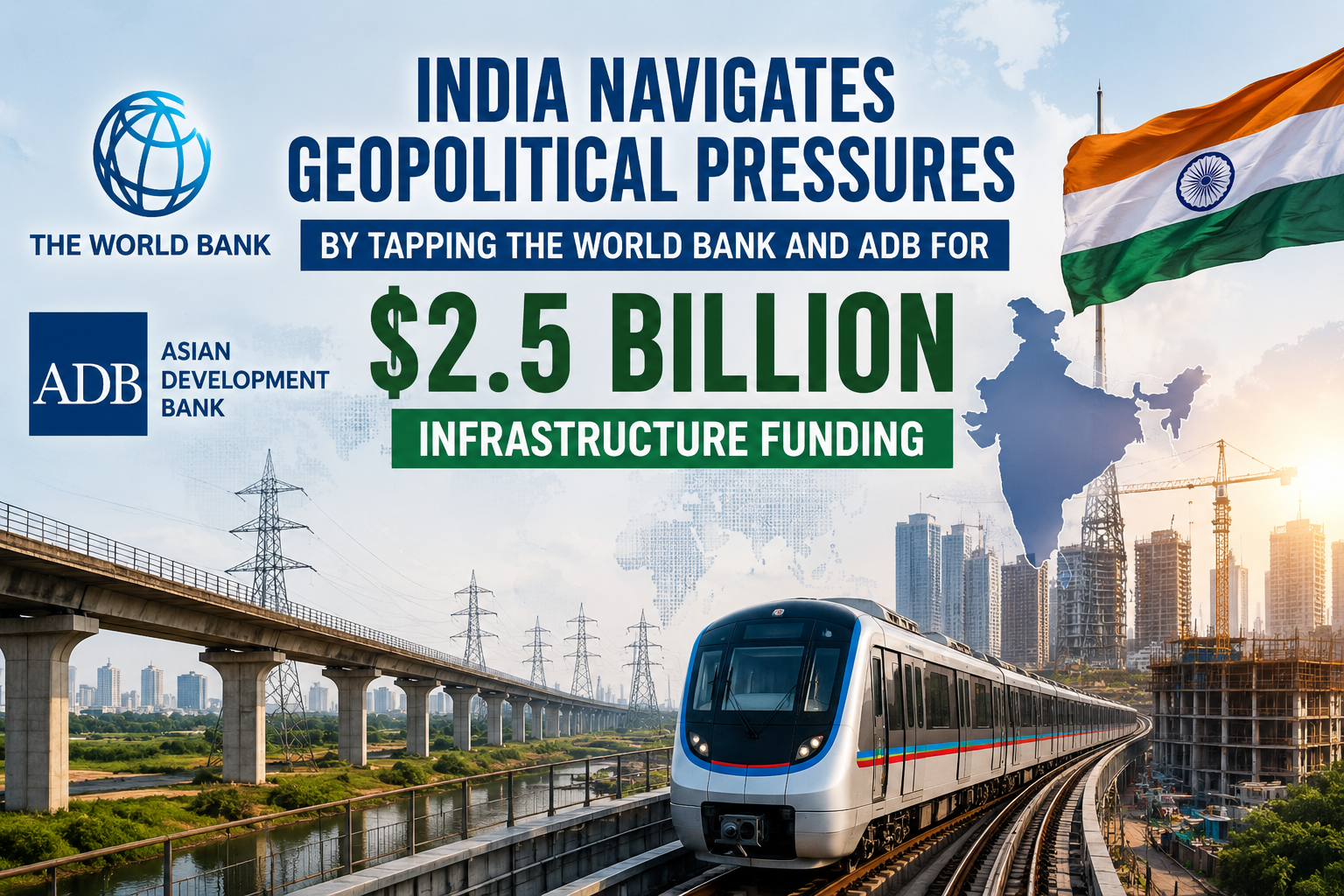
The Government of India is seeking to raise approximately $2.5 billion through existing credit facilities from important multilateral lending institutions (MLIs). The targeted financial mobilization is split between the two major global players, with the World Bank negotiating the disbursement of $1.5 billion and the Asian Development Bank (ADB) having prepared its own loan package valued at $1 billion. Formal statements announcing the finalization of these structural loan agreements are expected to be made public in the next couple of months, according to those knowledgeable with the circumstance.
Capital allocation and core operational objective
The massive capital push coincides with New Delhi’s push for alternative stable sources of international finance. Recent external macroeconomic disruptions have meaningfully reinforced the strategic transition to access these existing credit lines.
The growing level of conflict in the Middle East has severely restricted the Indian government from increasing its own domestic spending without some reliable MDB lending as an alternative source of finance. This infrastructure spending plan, valued at $2.5 billion, aims at strong, tangible outcomes in the local economy.
The World Bank and Asian Development Bank will be spending significant amounts of money on strengthening urban infrastructure frameworks in the country’s rapidly growing metropolitan and regional hubs. The government intends to support long-term commercial and industrial growth by upgrading and modernizing the essential public utilities, transport infrastructure and civic services of the city, to produce a resilient city’s fundamentals.
The entire expenditure structure is a straight macro-economic instrument for stimulating the home market of labour. A shortage of a workforce, both skilled and unskilled, is apparent from the outset because the execution of infrastructure projects of this magnitude is inherently manual. The flow of these substantial foreign loans into ground-level regional development schemes is aimed at generating thousands of durable jobs that will absorb manpower resources and increase consumer spending power in the region’s difficult economic environment.
Ongoing geopolitical instability and financial strategy
The move to use existing multilateral credit lines reflects the intricate geopolitical balancing act that India is engaged in. The geopolitical uncertainty and increased fragmentation in the Middle East have impacted global energy markets and current supply lines, making conditions for emerging markets exceptionally challenging.
Such external shocks have imposed additional unintended fiscal pressures on India and have made it difficult for the nation to pursue infrastructure spending through public equity markets or the national budget. India has long had a structured, established partnership with the World Bank and the ADB, and by so doing, it seems that India is successfully insuring its development needs against global market volatility by virtue of its creditworthiness.
The existing multilateral pipelines provide access to highly competitive, long-term interest rates that the country would not be able to replicate in the private commercial debt market in the face of a world war. This financial planning measure helps ensure that important national modernization pipelines do not deteriorate or experience significant financial delays because of friction in the international geopolitical arena.
Conclusion
India’s forward-looking approach in negotiations with the Asian Development Bank and the World Bank to access $2.5 billion in funding is a prudent and consequential move against the backdrop of the increasingly volatile global economic environment. New Delhi’s sourcing of $1.5 billion and $1 billion from reliable multilateral lenders, respectively, is increasingly helping it protect the financial impact of the Middle East conflict on its domestic growth motor.
Capital injections will give the nation enough cover to proceed with an aggressive infrastructure development agenda while these loan agreements are being formally concluded in the coming two months. India is progressively paving the way to sustaining its economic momentum and withstanding external geopolitical vulnerabilities with a systematic effort that translates these global institutional loans into localized urban infrastructure assets and broad-based employment opportunities.