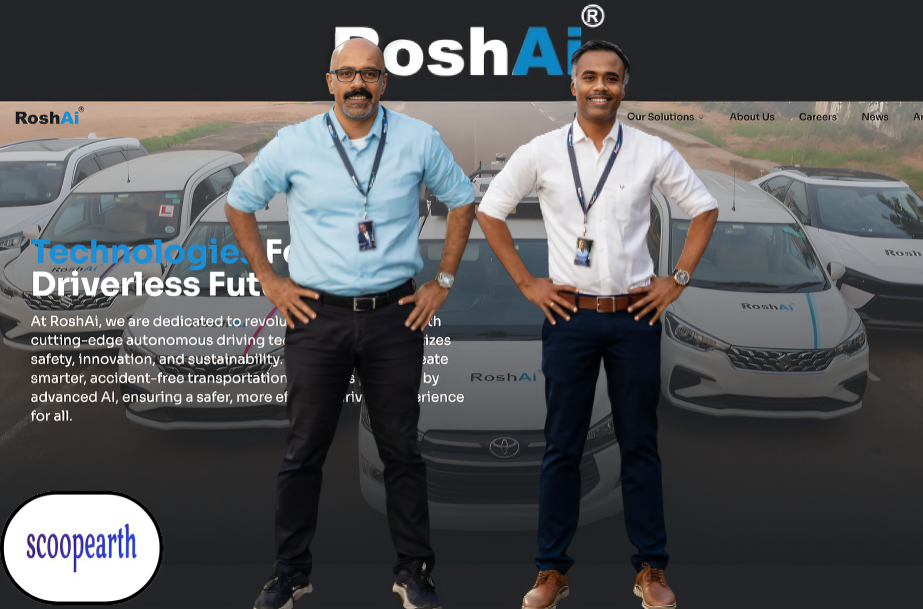
The industrial market across the globe is experiencing a massive transformation with the requirements of increased safety and operational efficiency, and 24/7 work, motivating the move to adopt autonomous technology. RoshAi is a Kochi-headquartered deep-tech company. RoshAi is taking its place on the centre stage and has managed to cut a distinctive niche by specialising in the autonomous issue of heavy-duty industrial automobiles. Focusing on a “retrofit-first” approach, RoshAi is essentially unlocking one of the most significant entry barriers in industrial automation, the cost of acquiring completely new autonomous fleets, which is prohibitively high.
Operational strategy
RoshAi was established by Dr. Roshy John and Rajaram Moorthy in 2021. RoshAi is transforming the way ports, mining sites, airports, and logistics hubs view vehicle automation. The fundamental principle of the RoshAi operational approach is to give up its legacy model of designing proprietary autonomous vehicles from scratch.
The startup will use what can be termed as an “Android-like autonomy strategy. This model concentrates on the retrofitting of standard and old heavy-duty vehicles with advanced autonomy stacks. RoshAi enables companies to update their operations by converting ordinary equipment into intelligent self-driving assets without retiring their current capital investments.
The approach accommodates the financial fact of industrial operators, who need high-performance automation, but do not have the capital resources to invest in replacing whole fleets with costly, off-the-shelf autonomous aggressors. The retrofit hardware that consists of drive-by-wire kits and an array of sensor suites blends perfectly with the existing vehicle infrastructure.
This enables trucks, loaders, and other high-power devices that are often present in ports and mining settings to be autonomous. The availability of autonomy to more legacy machinery is making RoshAi stand out as an all-purpose supplier of platforms that connect the current needs of software-conscious operations with traditional mechanical engineering.
Technology stack and value proposition
Mines and seaports are the most infamous examples of high-variability environments found in industrial settings. These locations are characterized by unreliable environments when compared to the controlled environment of a climate-controlled warehouse, including rugged terrain, rough weather, and intricate challenges that require high-level perceptual skills.
The technology stack at RoshAi is aimed at navigating through these complexities with a set of perception, navigation, and control algorithms. The entire platform developed by the startup connects AI software to physical equipment, allowing cars to interpret their surroundings on-the-fly, evading hazards and choosing predestined routes with the utmost accuracy. RoshAi allows operators to operate and control multi-vehicle groups with capabilities that were previously not achievable by consolidating the control layer into a centralized cloud interface.
The information obtained with the assistance of such systems makes it possible to make informed decisions, to contribute to the increase of uptime, and to prolong the lifetime of industrial equipment. The inherent reliability of the company, as evidenced by more than 100,000 kilometers of tests with zero safety incidents, emphasizes the safety of the company in high-risk industrial regions.
The motivation attributed to independence in these particular industries is caused by desperate efficiency requirements. In mining, when having operations down is expensive, and in ports, when container turnover is a competitive incentive, autonomy provides a direct payback. The systems developed by RoshAi allow companies to reduce human exhaustion and enhance safety standards in risky conditions by bringing stability and the absence of errors to the functioning.
This value proposition has been institutional, attracting, and the company has recently raised an important funding round headed by the Alpha Fund of the IAN Group. The purpose of the capital infusion is to scale operations, reinforce the core technology stack, and extend the organization into international presence.
RoshAi is aggressively expanding its operations in different geographies, such as the United States, Australia, and Southeast Asia. The company is not simply constructing a software solution; it is developing a platform where autonomy is treated as a utility important to heavy industry that is readily available. The startup is aligning itself to become a central architect of the next generation of industrial mobility as it collaborates with original equipment manufacturers and industrial operators.
Conclusion
The rise of RoshAi in the deep-tech sector is part of a larger pattern: high-end industrial automation is becoming more democratized. With its retrofit-first approach that has combined the twin issues of cost and compatibility against the most hostile industrial surroundings, the company has developed a scalable blueprint of automation procedures in the world.
By combining the power of advanced AI software, intelligent perception systems, and proactive fleet management, RoshAi is demonstrating that the future of mine and port logistics is not only new hardware but the smartening of the already existing infrastructure. The company is in a strong position to make the industrial world more efficient, autonomous, and safer as it grows its presence across the globe and the autonomy stack.