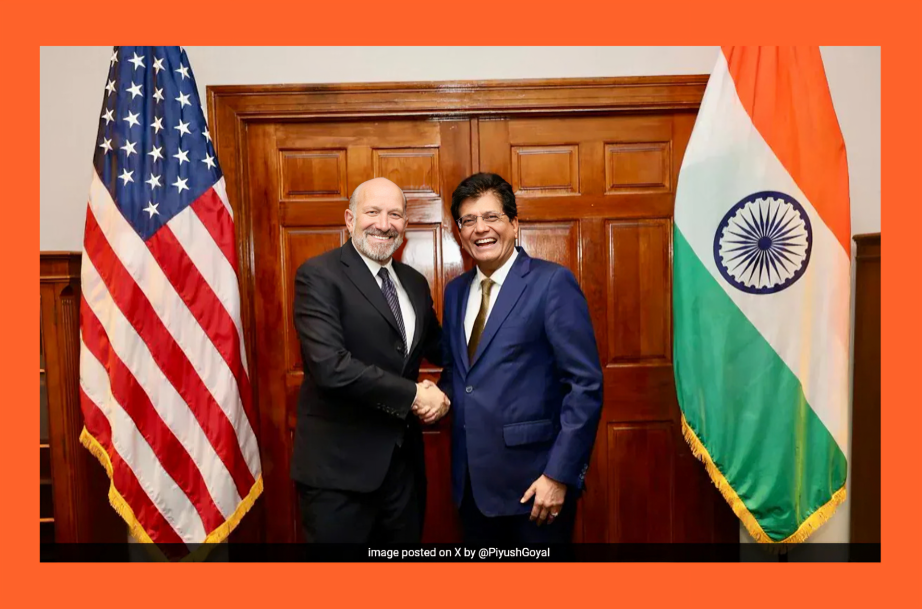
Even as India formally completes a Free Trade deal (FTA) with New Zealand, Union Commerce and Industry Minister Piyush Goyal has signaled substantial progress on a prospective trade deal between India and the United States, which is a significant move for India’s foreign trade policy. The statements, which highlighted India’s growing emphasis on strategic trade alliances across important global economies, were delivered in New Delhi during a media conference following the successful conclusion of the India-New Zealand Free Trade Agreement.
In order to improve market access, lower tariff barriers, and expand its economic influence in the Indo-Pacific region and beyond, India is aggressively recalibrating its trade policy at the time of the announcement. Goyal claims that in addition to being a bilateral milestone, the New Zealand pact is an indication of India’s larger intention to engage meaningfully with industrialized countries through fair and advantageous trade agreements.
Developments in the US-India trade arrangement
Commerce Secretary Rajesh Agrawal has reaffirmed that India is “very close” to finalizing a first framework agreement with the United States, bolstering the minister’s remarks. The proposed agreement seeks to resolve reciprocal tariff issues and provide the groundwork for a future, more comprehensive Bilateral Trade Agreement (BTA).
Speaking to the media earlier this month, Agrawal stated that significant progress has been achieved during six rounds of discussions despite the lack of a set deadline. The outline of a long-term trade framework as well as a temporary agreement to lower high tariffs on
important exports have been discussed. He continued, “There is a legitimate expectation that an interim agreement could be reached to ease tariff pressures on the majority of Indian exports to the US market.”
The severity of the continuing discussions was further highlighted by the Deputy US Trade Representative’s recent visit to India. Reviewing bilateral economic ties, assessing the BTA’s development, and progressing talks about the proposed framework agreement were the main objectives of the visit.
Increasing commerce between the Indo-Pacific region
India is stepping up its attempts to improve commercial connections throughout the Indo Pacific region in addition to its engagement with Washington. Goyal expressed optimism that the FTA with New Zealand will be crucial in boosting regional economic cooperation and opening up new commercial prospects for Indian companies.
After similar accords with Australia and the United Kingdom, the deal between India and New Zealand is India’s third free trade pact with members of the Five Eyes alliance. Goyal indicated that although negotiations with the United States are already at an advanced level, India would soon start talks on terms of reference with Canada.
Important advantages of the India-New Zealand Free Trade Agreement
India will have 100% market access for products and much enhanced access across a wide range of service sectors under the terms of the India-New Zealand Free Trade Agreement. These include construction, computer technology, tourism, telecommunications, and audio
visual services. With both nations anticipating the possibility of doubling bilateral commerce during the next five years, the deal opens 118 service sectors overall.
Indian pharmaceutical businesses stand to gain the most from the agreement. It creates a fast track clearance process that will make it easier for Indian medications and pharmaceuticals to enter the New Zealand market. Furthermore, two countries have reached an agreement on mutual recognition of Good Manufacturing Practices (GMP), allowing goods that have been authorized by regulators in the US, UK, EU, Canada, or India to enter the New Zealand market more quickly.
Conclusion
When combined, the India-New Zealand Free Trade Agreement and the development of the India-US trade framework demonstrate India’s increasing self-assurance and strategic aim in international trade talks. In an increasingly linked global trade environment, India is positioning itself to improve export competitiveness, establish regulatory coherence, and promote long-term economic growth by combining regional alliances with focused engagement with large economies.