Introduction
Plastic is one of the most widely used materials in India. From water pipes and food packaging to automobile components, electrical products, industrial containers, films, furniture, and medical products, plastic is part of everyday life as well as modern manufacturing.
India has developed a large plastic manufacturing ecosystem over the years. The industry includes companies that manufacture plastic pipes, packaging materials, films, containers, industrial products, furniture, and specialty plastic products. The sector also supports thousands of small and medium-sized businesses that work with larger manufacturers and suppliers.
The Indian government has also been giving greater attention to plastic recycling, waste management, sustainable packaging, and domestic manufacturing. In February 2026, the government released the Plastic Industry Status Report 2025 during PLASTINDIA 2026, highlighting the importance of the industry and its future growth opportunities.
The Indian plastic market is estimated to have been worth around US$26.6 billion in 2025, with forecasts suggesting that it could reach about US$44.6 billion by 2030.
This article covers 10 important plastic manufacturing companies in India, considering factors such as revenue, manufacturing scale, product range, market presence, production capacity, and importance within the Indian plastic industry. The companies are not presented as a strict ranking by revenue because their businesses are different and some report plastic-related activities alongside other products.
1. Supreme Industries Limited
| Founded | 1942 |
| Headquarters | Mumbai, Maharashtra |
| FY2025-26 Revenue from Operations | ₹11,217.67 crore |
| FY2025-26 Plastic Goods Sold | 753,907 MT |
| FY2025-26 PAT | ₹911.29 crore |
Supreme Industries Limited is one of India’s largest and best-known plastic manufacturing companies. It has a broad product portfolio covering plastic piping, packaging products, industrial components, consumer products, and other polymer-based solutions.
The company is particularly strong in plastic pipes and fittings. These products are used in housing, agriculture, irrigation, water supply, drainage, and infrastructure projects.
Supreme Industries reported ₹11,217.67 crore in revenue from operations for FY2025-26. During the same year, it sold approximately 753,907 metric tonnes of plastic goods, showing the enormous scale of its manufacturing business. Operating profit was ₹1,553.87 crore and profit after tax was ₹911.29 crore.
2. Astral Limited
| Founded | 1996 |
| Headquarters | Ahmedabad, Gujarat |
| FY2025-26 Revenue from Operations | ₹6,568.6 crore |
| Manufacturing Capacity | 5,49,126 MT per year |
| Manufacturing Units | 21 |
Astral Limited has become one of India’s leading manufacturers of plastic piping and related products. The company is particularly famous for its plumbing and piping solutions. Its products are used in residential buildings, commercial projects, agriculture, water management, infrastructure, and industrial applications.
Astral’s latest company information shows ₹65,686 million, or about ₹6,568.6 crore, in revenue from operations for FY2025-26. The company also reported a manufacturing capacity of 5,49,126 tonnes per year across 21 manufacturing units and a workforce of more than 9,500 people.
3. Finolex Industries Limited
| Founded | 1979 |
| Headquarters | Pune, Maharashtra |
| FY2024-25 Revenue | ₹4,141.97 crore |
| FY2024-25 EBITDA | ₹476 crore |
| PVC Pipes & Fittings Sales | 347,982 MT |
Finolex Industries Limited is one of India’s major manufacturers of PVC products and PVC resin. The company has an important advantage because its business is connected to both raw material production and finished plastic products. It manufactures PVC resin and PVC pipes and fittings, which are used extensively in agriculture, housing, sanitation, water supply, and infrastructure.
For FY2024-25, Finolex Industries reported ₹4,141.97 crore in revenue from operations. EBITDA stood at about ₹476 crore. Its profit after tax was ₹777.86 crore, although the year’s PAT benefited from an exceptional gain.
The company sold approximately 347,982 metric tonnes of PVC pipes and fittings during the year, compared with 336,577 tonnes in FY2023-24.
4. Jain Irrigation Systems’ Plastic and Irrigation Value Chain
| Founded | 1986 |
| Headquarters | Jalgaon, Maharashtra, India |
| FY2025-26 Revenue | ₹6,399.5 crore |
Jain Irrigation Systems is another important Indian company with a strong presence in plastic piping and irrigation products. Unlike companies that are primarily focused on household plumbing, Jain Irrigation has a particularly strong connection with agriculture and water-management solutions.
The company manufactures products such as PVC and HDPE pipes, drip irrigation systems, sprinkler systems, and other water-management products. Its plastic-pipe business is closely linked to India’s agricultural sector, where efficient irrigation is important for reducing water wastage and improving farm productivity.
Jain Irrigation is relevant to India’s growing demand for plastic products because irrigation infrastructure requires large quantities of durable pipes and fittings. Government investment in agriculture, water conservation, micro-irrigation, and rural infrastructure can support demand for these products.
5. Nilkamal Limited
| Founded | 1934 |
| Headquarters | Mumbai, Maharashtra |
| FY2024-25 Consolidated Revenue | ₹3,313 crore |
| FY2024-25 PAT | ₹107 crore |
| Major Products | Plastic furniture, material handling and packaging |
Nilkamal Limited is one of India’s most recognizable plastic-product companies. While many large plastic manufacturers focus on pipes or industrial materials, Nilkamal has a strong position in moulded plastic products, furniture, material handling solutions, and packaging.
Nilkamal reported consolidated revenue of ₹3,313 crore in FY2024-25, compared with ₹3,196 crore in the previous year. Consolidated profit after tax was ₹107 crore.
The company also has international operations and subsidiaries. Its U.S. joint venture, Cambro Nilkamal Private Limited, recorded turnover of ₹131 crore during FY2024-25.
6. Time Technoplast Limited
| Founded | 1992 |
| Headquarters | Mumbai, Maharashtra |
| Main Business | Industrial and polymer products |
| Markets | India and international markets |
Time Technoplast Limited is an important manufacturer of polymer-based industrial products. The company makes products such as industrial packaging, composite cylinders, automotive components, infrastructure products, and other specialized polymer solutions.
Time Technoplast operates across multiple countries and has built a diversified customer base. Its products are used by industries where lightweight, durable, and corrosion-resistant materials are useful.
During Q1 FY2025-26, the company reported consolidated sales of approximately ₹1,354 crore, compared with ₹1,231 crore in Q1 FY2024-25. It also reported an order pipeline of approximately ₹425 crore for packaging solutions during the 2025 calendar year.
7. Prince Pipes and Fittings Limited
| Founded | 1987 |
| Headquarters | Mumbai, Maharashtra |
| FY2025-26 Revenue | ₹2,598 crore |
| FY2025-26 EBITDA | ₹232 crore |
Prince Pipes and Fittings Limited is one of India’s major integrated plastic piping companies. The company manufactures PVC, CPVC, PPR, HDPE, and other piping products. These are used in plumbing, agriculture, irrigation, drainage, sewage, construction, and infrastructure projects.
Prince Pipes reported FY2025-26 revenue from operations of ₹2,598 crore, up from ₹2,524 crore in FY2024-25. EBITDA increased to approximately ₹232 crore from ₹162 crore.
The company has expanded its manufacturing network over the years and has invested in additional capacity to serve India’s growing demand for piping systems.
8. Jindal Poly Films Limited
| Founded | 1974 |
| Headquarters | Bulandshahr, Uttar Pradesh, India |
| FY2025-26 Revenue | ₹3,502.58 crore |
The company operates in areas such as packaging films and specialty films used in consumer goods and industrial applications. Its products are important in flexible packaging, where lightweight plastic films are used to protect and transport food, beverages, household goods, and other products.
Jindal Poly Films has a substantial manufacturing and international presence. Its corporate structure includes businesses and subsidiaries involved in films, specialty products, nonwoven materials, and related operations. The company’s investor-relations disclosures show continued reporting for FY2025-26 and multiple subsidiaries in the films and packaging value chain.
The company is particularly relevant to the Indian plastic industry because flexible packaging is one of the largest applications for plastic films.
At the same time, this part of the industry is changing quickly. Customers increasingly want thinner films, better barrier properties, recyclable structures, and materials that use less plastic while maintaining product protection.
9. Polyplex Corporation Limited
| Founded | 1984 |
| Headquarters | Noida, Uttar Pradesh |
| Main Products | Polyester and polypropylene films |
| FY2025-26 Quarterly Sales | ₹1,871 crore in Q4 |
Polyplex Corporation Limited is a major manufacturer of plastic films and flexible packaging materials.
The company produces polyester films, BOPP films, cast polypropylene films, coated films, and other specialty products. These materials are used in packaging, electronics, labels, industrial products, and other applications.
Polyplex has a significant international footprint, with manufacturing and sales operations serving customers across several regions.
Its consolidated sales were approximately ₹1,871 crore in the quarter ended March 2026, according to reported financial data. The company had quarterly sales of ₹1,682 crore in December 2025 and ₹1,794 crore in September 2025.
The company operates in a highly competitive segment where product quality, raw-material prices, energy costs, and international demand can significantly affect profitability.
Polyplex remains important because specialty films are a key part of the modern packaging and manufacturing supply chain.
10. Mold-Tek Packaging Limited
| Founded | 1986 |
| Headquarters | Hyderabad, Telangana |
| FY2024-25 Revenue | ₹781.32 crore |
| FY2024-25 EBITDA | ₹143.83 crore |
Mold-Tek reported ₹781.32 crore in revenue from operations in FY2024-25, an increase of 11.83% from ₹698.65 crore in FY2023-24. EBITDA rose to approximately ₹143.83 crore.
The company sold approximately 38,264 metric tonnes of products during FY2024-25.
Mold-Tek has also developed expertise in in-house mould design and manufacturing. Its packaging products are designed to meet the needs of large industrial and consumer brands.
The company illustrates another important part of India’s plastic industry: rigid packaging. As packaged food, paints, lubricants, personal-care products, and other consumer goods expand, demand for reliable packaging also increases.
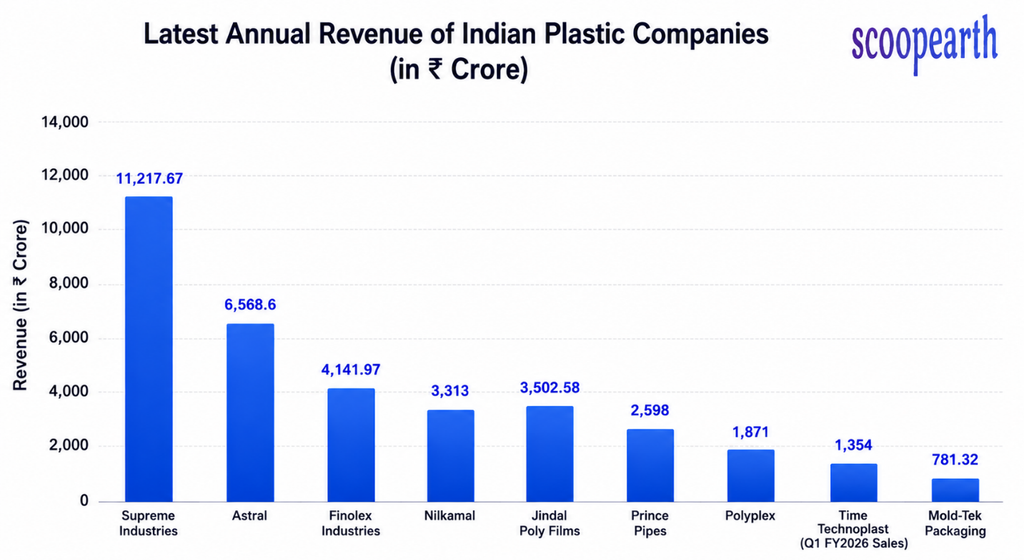
Financial and Operational Comparison
| Company | Latest Revenue Figure | Main Plastic Business |
| Supreme Industries | ₹11,217.67 crore, FY2025-26 | Pipes, packaging, industrial plastics |
| Astral | ₹6,568.6 crore, FY2025-26 | Pipes, plumbing and building products |
| Finolex Industries | ₹4,141.97 crore, FY2024-25 | PVC resin, pipes and fittings |
| Nilkamal | ₹3,313 crore, FY2024-25 | Furniture, material handling, packaging |
| Time Technoplast | Q1 FY2026 sales ₹1,354 crore | Industrial polymer products |
| Prince Pipes | ₹2,598 crore, FY2025-26 | Plastic pipes and fittings |
| Jindal Poly Films | ₹3,502.58 crore | Films and packaging materials |
| Polyplex | ₹1,871 crore, Q4 FY2025-26 sales | Plastic films |
| Mold-Tek Packaging | ₹781.32 crore, FY2024-25 | Rigid plastic packaging |
Why the Indian Plastic Manufacturing Industry Is Growing
1. Construction and Infrastructure
Construction is one of the biggest drivers of plastic demand in India.
Plastic pipes are used in residential buildings, commercial properties, irrigation systems, water supply networks, drainage systems, and sanitation projects.
Government programs related to housing, water supply, sanitation, and infrastructure have therefore created opportunities for manufacturers of pipes and fittings.
Astral’s FY2025 annual report noted that India’s plastic pipe industry had crossed an estimated ₹50,000 crore in size by FY2025, supported by continued volume growth.
2. Growing Packaging Demand
Packaging is another major application for plastics.
Food products, medicines, personal-care products, household goods, electronics, and industrial products all need packaging. Flexible films and rigid containers help protect products, extend shelf life, and make transportation easier.
Companies such as Jindal Poly Films, Polyplex, and Mold-Tek Packaging are positioned in this part of the market.
3. Agriculture
Plastic pipes, irrigation systems, water-storage products, films, and other polymer products are widely used in agriculture.
As Indian agriculture becomes more focused on efficient water usage, demand for drip irrigation, piping, and other water-management solutions can support the plastic industry.
4. Automobile and Industrial Manufacturing
Modern vehicles contain many plastic components because plastics can reduce weight and provide flexibility in design.
Plastic and polymer products are also used in electrical equipment, machinery, industrial packaging, material handling, and infrastructure.
This is creating opportunities for companies that can manufacture specialized and higher-value plastic products rather than only basic commodity items.
5. Recycling and Sustainable Manufacturing
Sustainability is becoming increasingly important.
Plastic manufacturers are under pressure to reduce waste, use recycled materials where technically possible, improve product design, and support better recycling systems.
The government highlighted waste reduction, technology, sustainability, and innovation during the release of the Plastic Industry Status Report 2025 at PLASTINDIA 2026.
This means the future of India’s plastic industry will not depend only on producing more plastic. Companies will increasingly need to produce better, lighter, recyclable, and more resource-efficient products.
Conclusion
India’s plastic manufacturing industry has grown far beyond traditional household plastic products. Today, it includes large companies producing pipes, packaging, films, industrial products, furniture, specialty materials, and advanced polymer solutions.
Supreme Industries remains one of the largest and most diversified plastic manufacturers in the country, with more than ₹11,200 crore of revenue from operations in FY2025-26. Astral has built a strong position in plastic piping and building products, while Finolex Industries is an important player in the PVC value chain.
Nilkamal is well known for plastic furniture and material-handling products. Time Technoplast focuses on industrial polymer solutions, while Prince Pipes has a strong position in plastic piping. Jindal Poly Films and Polyplex are important players in plastic films and flexible packaging, and Mold-Tek Packaging specializes in rigid plastic packaging.
The sector is supported by construction, agriculture, infrastructure, packaging, automobiles, consumer products, and industrial manufacturing. However, environmental concerns and changing regulations mean that future growth will increasingly depend on recycling, sustainable materials, efficient production, and innovation.
Overall, India’s plastic industry is moving toward a more advanced manufacturing model. The companies that can combine large-scale production, strong distribution, product quality, technology, and sustainability are likely to remain the leading names in India’s plastic manufacturing sector.
Frequently Asked Questions (FAQs):
What is the Indian plastics industry?
The Indian plastics industry includes companies involved in manufacturing plastic products, polymers, packaging materials, pipes, films, irrigation products, and other plastic-based products. It serves a wide range of sectors, including construction, agriculture, healthcare, automotive, consumer goods, and packaging.
Why is the plastics industry important in India?
Plastic products are widely used across India’s economy because they are lightweight, durable, versatile, and suitable for many applications. Major areas of use include construction, agriculture, packaging, healthcare, automobiles, electronics, household products, and everyday consumer goods.
Which factors are driving India’s plastics industry?
Growing urbanization, infrastructure development, rising consumer demand, expanding packaging requirements, agricultural modernization, and industrial growth are some of the major factors supporting India’s plastics industry. Increasing demand for lightweight and cost-effective materials is also contributing to industry growth.
What are the major types of plastic products made in India?
Major plastic products manufactured in India include pipes, packaging films, containers, fittings, irrigation systems, sheets, tanks, films, molded products, and specialty plastic products. These products serve industries ranging from agriculture and construction to food packaging and consumer goods.
What is PVC used for?
PVC, or polyvinyl chloride, is commonly used to manufacture pipes, fittings, electrical cables, flooring, construction materials, doors, windows, and various industrial products. Its durability, versatility, and resistance to moisture make it useful in construction and infrastructure applications.
What are flexible packaging films?
Flexible packaging films are thin plastic materials used to package products such as food, beverages, personal-care products, pharmaceuticals, and consumer goods. They provide lightweight packaging while helping protect products from moisture, contamination, and other external factors.
What is BOPP film?
BOPP, or biaxially oriented polypropylene, is a strong and versatile plastic film commonly used in food packaging, labels, adhesive tapes, lamination, and other packaging applications. It is valued for its strength, clarity, printability, and moisture resistance.
What is BOPET film?
BOPET, or biaxially oriented polyethylene terephthalate, is a polyester film used in packaging, electrical products, labels, industrial applications, and specialty products. It offers good mechanical strength, dimensional stability, and resistance to heat and chemicals.
How is plastic used in agriculture?
Plastic plays an important role in modern agriculture through products such as irrigation pipes, drip systems, sprinklers, greenhouse materials, water tanks, mulch films, and agricultural films. These products can help improve water management, crop protection, and agricultural productivity.
Which company is known for irrigation and plastic products?
Jain Irrigation Systems is a major Indian company known for its activities in irrigation, plastic pipes, agriculture, water management, and related products. The company provides solutions such as drip irrigation systems, sprinkler systems, pipes, and agricultural technologies.
Which company is known for flexible packaging films?
Jindal Poly Films Limited is a major Indian manufacturer of flexible packaging films and specialty films. Its product portfolio includes BOPP, BOPET, CPP, and other films used in packaging and industrial applications.
What is the role of plastic pipes in India’s infrastructure?
Plastic pipes play an important role in India’s infrastructure and are widely used for drinking-water supply, irrigation, sanitation, drainage, housing, and other infrastructure projects. Materials such as PVC and HDPE are commonly used because of their durability and suitability for different applications.
How does India’s construction sector affect plastic demand?
India’s construction and infrastructure sectors create significant demand for plastic products such as pipes, fittings, flooring, electrical cables, insulation materials, water tanks, packaging, and other construction-related products. Continued infrastructure development can therefore support demand for plastic products.
Is India’s plastics industry growing?
Yes, India’s plastics industry continues to have significant growth potential due to population growth, urbanization, rising consumption, infrastructure development, packaging demand, and expanding manufacturing activity. Increasing applications of plastics across different industries also contribute to long-term demand.
What is the future of India’s plastics industry?
The future of India’s plastics industry is expected to remain important as demand continues to grow for packaging, infrastructure, agriculture, healthcare, automotive products, and value-added plastic materials. At the same time, recycling, sustainable materials, waste management, and more environmentally responsible plastic solutions are becoming increasingly important for the industry’s future.