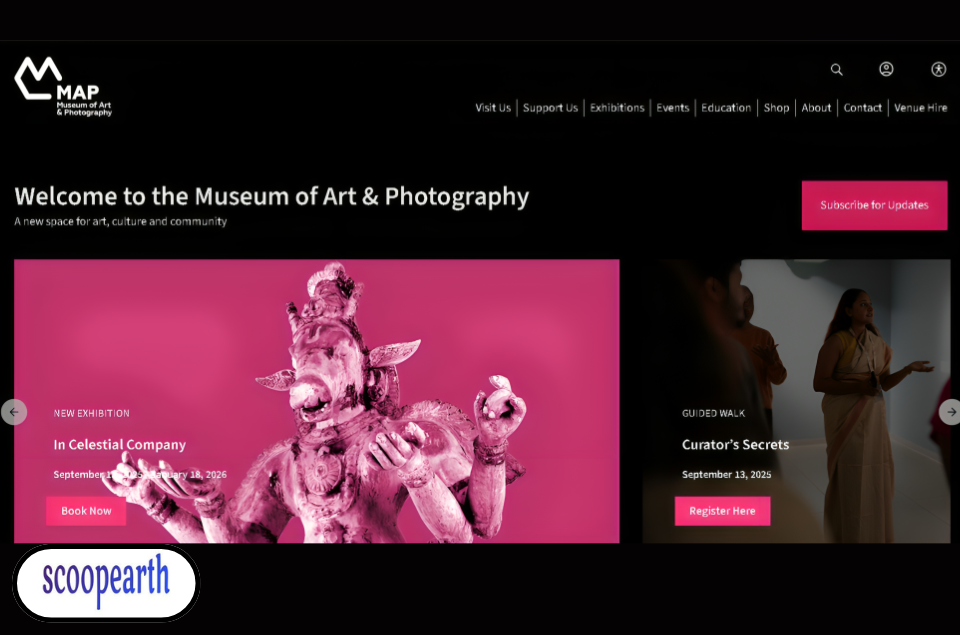
The Museum of Art and Photography (MAP) in Bengaluru has disrupted the usual narratives with its recent exhibition, “Celestial Companions.” The show, which has a keen sense of detail and cultural introspection, redefines the role of women in visual storytelling not as the passive subject but as an active participant, facilitator, and supporter. By doing this, it challenges the classical gaze that has dominated photography and art history.
Inclusion of correspondence and diaries
Throughout history, women in photography have been frequently viewed through the prism of male desire or domesticity, or idealized beauty. This trope is flipped in Celestial Companions. The exhibition foregrounds the agency of women, as opposed to being subjects of observation, emphasizing the ways women have influenced, enabled, and even co-authored the invention of creative paths of male photographers.
The exhibition is based on the rich archival collections of MAP, and it presents unique photographs, letters, and personal items that indicate that women have been able to offer invisible labor and emotional infrastructure. They are either muses, partners, or logistical enablers, but their contributions are finally receiving the praise they deserve.
An incisive photographer and a visual culture writer, Rahaab Allana has managed to create a deeply personal and political narrative. The display does not just show pictures, it recounts some stories. With a well-chosen selection, the viewer will find women who were not necessarily existing in the background but rather played a great role in setting the foreground.
The use of correspondence and diaries that record the emotional and intellectual experiences of the photographers and their friends is one of the highlights, as well. These texts provide an opposition to the visual form, and there are additional layers of meaning and context that can make the viewer question authorship and influence.
In addition to its curatorial genius, the exhibition provides a platform for thought and discourse. It invites visitors to interact with the works on the levels not only visual but also on the intellectual and emotional levels. Guided tours and interactive installations generate dialogue on gender, power, and representation.
The programming surrounding the exhibition by MAP also consists of panel discussions, workshops, as well as community outreach activities, which have an effect on the gallery walls even after the exhibition has been completed. Such interactions guarantee that the subject matters in the book Celestial Companions truly appeal to a wider audience, and the cultural discourse is more inclusive and critical.
Commitment and challenges
The focus of MAP on archival research can be found all over the exhibition. Celestial Companies is not merely an exhibition of photographs, but an archaeological dig in memory. Through digging into personal archives, the stories that were being pushed aside or forgotten have been discovered by the museum.
Perhaps the most striking element of the work is its criticism of the male canon in photography. The exhibition, by mentioning the work done by women behind the scenes, to organize shoots, logistics, provide emotional support, and even shape aesthetic decisions, breaks the myth of the lonely male genius.
Such a reframing not only has symbolic implications, but it also has practical implications for our conception of creative labor. It calls upon institutions, critics, and audiences to enlarge their conceptions of authorship and acknowledge the cooperative aspect of the artistic process.
Conclusion
Celestial Companions is less of an exhibition and more of a cultural intervention. The MAP makes us reconsider the way in which we narrate stories and who narrates them by playing with the conventional gaze and predetermining the role of women as companions, facilitators, and supporters. It is a reminder that there is a complex of relations, influences, and invisible work behind every iconic image. With Celestial Companion, MAP is still at the forefront in redefining the Indian visual culture frame by frame.