Introduction
The United States is home to the world’s largest and most influential information technology (IT) companies. These organizations have transformed how people communicate, shop, work, learn, and do business. From cloud computing and artificial intelligence to enterprise software, cybersecurity, semiconductors, and digital services, American IT companies continue to drive global innovation.
Over the past few years, rapid advances in artificial intelligence, cloud infrastructure, automation, and enterprise software have accelerated the growth of the technology industry. Many U.S.-based IT companies now serve billions of users and millions of businesses across the world while generating hundreds of billions of dollars in annual revenue.
Technology hubs such as Silicon Valley, Seattle, Austin, New York, Boston, and San Jose remain at the center of global innovation, supported by leading universities, world-class talent, venture capital investment, and a thriving startup ecosystem.
This article highlights the Top 10 IT Companies in the USA based on their market value, annual revenue, technological innovation, global presence, financial performance, and industry influence.
Microsoft
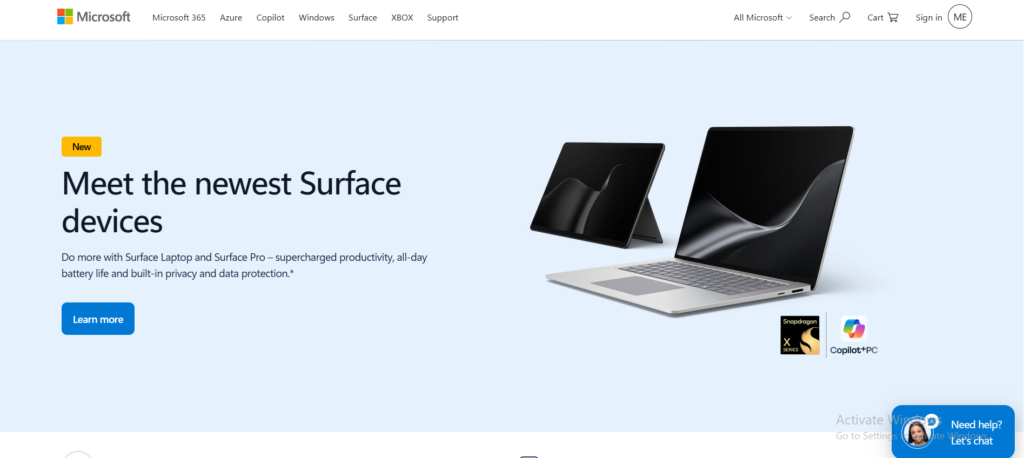
Image Courtesy: Microsoft Official Website
| Founded | 1975 |
| Headquarters | Redmond, Washington |
| Market Capitalization (2026) | Approximately US$2.8 trillion |
| Annual Revenue (Latest TTM) | Approximately US$318 billion |
| Employees | More than 230,000 |
| CEO | Satya Nadella |
Microsoft remains one of the world’s largest technology companies and continues to dominate enterprise software, cloud computing, and artificial intelligence. The company’s product portfolio includes Windows, Microsoft 365, Azure, GitHub, LinkedIn, Dynamics 365, and Xbox.
Azure has become one of the fastest-growing cloud platforms globally, serving businesses ranging from startups to Fortune 500 companies. Microsoft’s partnership with OpenAI has also strengthened its leadership in generative AI by integrating advanced AI capabilities into products like Microsoft Copilot, Azure AI, and Microsoft 365.
The company invests tens of billions of dollars annually in AI infrastructure, cloud data centers, cybersecurity, and software development. Microsoft continues to be one of the most valuable and profitable technology companies worldwide.
Apple
Image Courtesy: Apple Official Website
| Founded | 1976 |
| Headquarters | Cupertino, California |
| Market Capitalization (2026) | Nearly US$5 trillion |
| Annual Revenue | Approximately US$451 billion |
| Employees | Around 166,000 |
| CEO | Tim Cook |
Apple is the world’s largest consumer technology company and one of the most valuable publicly traded businesses. Its ecosystem includes the iPhone, Mac, iPad, Apple Watch, AirPods, Apple TV, and a growing portfolio of digital services.
In addition to hardware, Apple earns significant revenue from subscriptions, cloud services, digital payments, music, video streaming, and the App Store. The company continues expanding its AI capabilities while maintaining strong customer loyalty across more than one billion active devices.
Apple briefly crossed the US$5 trillion market capitalization milestone in 2026, highlighting its continued financial strength and investor confidence.
Amazon
Image Courtesy: Amazon Official Website
| Founded | 1994 |
| Headquarters | Seattle, Washington |
| Market Capitalization (2026) | More than US$2 trillion |
| Annual Revenue | Approximately US$743 billion |
| Employees | More than 1.5 million |
| CEO | Andy Jassy |
Amazon has evolved from an online bookstore into one of the world’s largest technology companies. Today, it leads in e-commerce, cloud computing, digital advertising, logistics, artificial intelligence, and smart devices.
Amazon Web Services (AWS) remains the global leader in cloud infrastructure, powering millions of businesses, governments, startups, and enterprises. AWS also provides advanced AI, machine learning, analytics, and database services.
The company continues investing heavily in robotics, automation, AI infrastructure, logistics, and next-generation cloud technologies, making it one of the most influential IT companies worldwide.
Alphabet (Google)
Image Courtesy: Alphabet Official Website
| Founded | 1998 |
| Headquarters | Mountain View, California |
| Market Capitalization (2026) | Around US$3.9 trillion |
| Annual Revenue | Approximately US$422 billion |
| Employees | Around 191,000 |
| CEO | Sundar Pichai |
Alphabet is Google’s parent company and operates one of the world’s largest digital ecosystems. Its products include Google Search, YouTube, Android, Chrome, Google Maps, Gmail, Google Cloud, and Gemini AI.
Google Cloud has become one of the fastest-growing cloud providers, while Gemini has strengthened the company’s position in generative AI. Alphabet also invests in autonomous vehicles, healthcare technology, quantum computing, and advanced research through DeepMind and other subsidiaries.
With billions of users worldwide, Alphabet continues to shape the future of internet services and artificial intelligence.
NVIDIA
Image Courtesy: NVIDIA Official Website
| Founded | 1993 |
| Headquarters | Santa Clara, California |
| Market Capitalization (2026) | More than US$5 trillion |
| Annual Revenue | More than US$200 billion (annualized) |
| Employees | Around 40,000 |
| CEO | Jensen Huang |
NVIDIA has become the global leader in AI computing and graphics processing technology. Its GPUs power generative AI platforms, cloud data centers, autonomous vehicles, robotics, scientific computing, and gaming.
The rapid growth of artificial intelligence has significantly increased demand for NVIDIA’s hardware, making it one of the world’s most valuable technology companies. Major cloud providers, AI startups, and enterprises rely on NVIDIA chips to train and deploy advanced AI models.
The company continues investing in AI software, networking solutions, digital twins, and high-performance computing technologies.
Oracle
Image Courtesy: Oracle Official Website
| Founded | 1977 |
| Headquarters | Austin, Texas |
| Market Capitalization (2026) | More than US$330 billion |
| Annual Revenue | Approximately US$67 billion |
| Employees | Around 160,000 |
| CEO | Safra Catz |
Oracle is one of the world’s leading enterprise software and database companies. Its solutions include cloud infrastructure, enterprise applications, database management, ERP, supply chain software, and healthcare technology.
Oracle Cloud Infrastructure (OCI) has experienced rapid growth due to increasing enterprise demand for AI computing and cloud services. The company has secured several large AI infrastructure agreements while expanding its global data center network.
Oracle continues helping organizations modernize business operations through cloud-native technologies and enterprise software.
Salesforce
Image Courtesy: Salesforce Official Website
| Founded | 1999 |
| Headquarters | San Francisco, California |
| Market Capitalization (2026) | More than US$250 billion |
| Annual Revenue | Around US$40 billion |
| Employees | More than 70,000 |
| CEO | Marc Benioff |
Salesforce pioneered cloud-based customer relationship management (CRM) software and remains the global market leader in the sector.
Its platform includes Sales Cloud, Service Cloud, Marketing Cloud, Commerce Cloud, Tableau, Slack, MuleSoft, and Agentforce AI solutions. Organizations use Salesforce to manage customer relationships, automate sales, improve customer support, and analyze business performance.
The company’s continued investment in artificial intelligence and workflow automation has strengthened its position in enterprise software.
IBM
Image Courtesy: IBM Official Website
| Founded | 1911 |
| Headquarters | Armonk, New York |
| Market Capitalization (2026) | Around US$200 billion |
| Annual Revenue | Approximately US$69 billion |
| Employees | More than 270,000 |
| CEO | Arvind Krishna |
IBM has successfully transformed itself into a leader in hybrid cloud computing, enterprise AI, cybersecurity, and consulting services.
Its Watsonx AI platform, Red Hat OpenShift, automation software, and consulting business help enterprises modernize IT infrastructure while accelerating digital transformation.
IBM also remains a leader in quantum computing research and enterprise cybersecurity, serving governments, financial institutions, and multinational corporations worldwide.
Cisco
Image Courtesy: Cisco Official Website
| Founded | 1984 |
| Headquarters | San Jose, California |
| Market Capitalization (2026) | More than US$250 billion |
| Annual Revenue | Approximately US$58 billion |
| Employees | Around 90,000 |
| CEO | Chuck Robbins |
Cisco is one of the world’s largest networking and cybersecurity companies. Its technologies power enterprise networks, internet infrastructure, cloud data centers, collaboration platforms, and secure communications.
The company has expanded beyond networking hardware into software subscriptions, cloud security, AI-enabled networking, and observability solutions. Cisco’s products remain essential for businesses, governments, educational institutions, and telecom providers.
Its growing focus on AI-ready networking and cybersecurity positions Cisco for continued long-term growth.
Adobe
Image Courtesy: Adobe Official Website
| Founded | 1982 |
| Headquarters | San Jose, California |
| Market Capitalization (2026) | More than US$180 billion |
| Annual Revenue | Approximately US$24 billion |
| Employees | Around 30,000 |
| CEO | Shantanu Narayen |
Adobe is the global leader in digital creativity, content creation, and marketing software. Its flagship products include Photoshop, Illustrator, Premiere Pro, Acrobat, Lightroom, and Adobe Express.
The company has expanded rapidly through AI-powered creative tools, enabling users to generate images, edit videos, create marketing campaigns, and automate design workflows.
Adobe also serves millions of enterprises through its Experience Cloud platform, helping businesses deliver personalized digital experiences across websites, mobile apps, and e-commerce platforms.
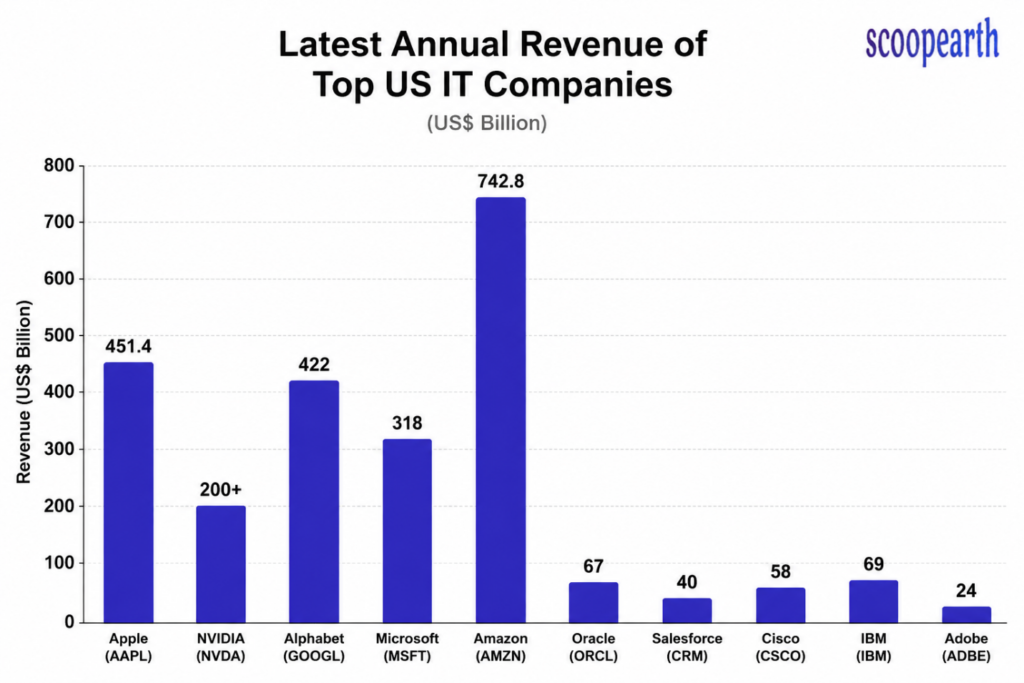
Financial Comparison of the Top IT Companies in the USA
The table below provides a financial comparison of the top 10 IT companies in the USA, highlighting their latest annual revenue, current market valuation, and approximate share price. These figures offer a clear picture of each company’s financial strength, market position, and investor confidence, making it easier to compare their size, growth, and overall influence in the global technology industry.
| Company | Latest Revenue (US$ Billion) | Market Capitalization / Net Valuation | Current Share Price (Approx.) |
| Apple (NASDAQ: AAPL) | 451.4 | US$5.0 Trillion | US$337 |
| NVIDIA (NASDAQ: NVDA) | 200+ (Annualized) | US$4.8 Trillion | US$197 |
| Alphabet (NASDAQ: GOOGL) | 422 | US$4.0 Trillion | US$327 |
| Microsoft (NASDAQ: MSFT) | 318 | US$2.9 Trillion | US$389 |
| Amazon (NASDAQ: AMZN) | 742.8 | US$2.6 Trillion | US$231 |
| Oracle (NYSE: ORCL) | 67 | US$820 Billion | US$295 |
| Salesforce (NYSE: CRM) | 40 | US$270 Billion | US$279 |
| Cisco (NASDAQ: CSCO) | 58 | US$260 Billion | US$65 |
| IBM (NYSE: IBM) | 69 | US$240 Billion | US$254 |
| Adobe (NASDAQ: ADBE) | 24 | US$190 Billion | US$238 |
Why These IT Companies Lead the Industry
These companies remain global technology leaders because they combine innovation, financial strength, and worldwide reach.
Some of the key reasons behind their success include:
- Artificial Intelligence Leadership: Microsoft, Google, NVIDIA, IBM, Adobe, and Oracle are investing heavily in AI platforms, enterprise automation, and next-generation computing.
- Cloud Computing Dominance: AWS, Microsoft Azure, Google Cloud, and Oracle Cloud power millions of businesses worldwide.
- Global Customer Base: Together, these companies serve billions of consumers and millions of organizations across nearly every country.
- Enterprise Software Leadership: Microsoft, Salesforce, Oracle, IBM, Adobe, and Cisco provide mission-critical software for businesses of all sizes.
- Continuous Innovation: Massive investments in research and development help these companies maintain leadership in emerging technologies including AI, cybersecurity, cloud computing, and quantum computing.
Future Outlook
Artificial intelligence is expected to remain the primary driver of growth for the U.S. technology industry. Companies are investing billions of dollars in AI infrastructure, cloud computing, semiconductors, and enterprise software to meet rapidly increasing demand.
Cloud services, cybersecurity, digital transformation, automation, and AI-powered productivity tools are also expected to experience sustained growth over the coming years. As organizations continue modernizing their technology infrastructure, leading IT companies are likely to expand both their revenues and global market influence.
Emerging technologies such as quantum computing, edge computing, autonomous systems, and generative AI will create new opportunities for innovation while strengthening the competitive position of established technology leaders.
Conclusion
The United States continues to lead the global technology industry through companies that have transformed nearly every aspect of modern life. From Microsoft’s enterprise software ecosystem and Amazon’s cloud infrastructure to Apple’s consumer devices, Google’s internet services, and NVIDIA’s AI hardware, these organizations continue to shape the future of technology.
Companies such as Oracle, Salesforce, IBM, Cisco, and Adobe also play a vital role by providing enterprise software, cybersecurity, networking, digital creativity, and cloud solutions that power businesses worldwide.
As artificial intelligence, cloud computing, and digital transformation continue to accelerate, these ten companies are expected to remain at the forefront of innovation. Their continued investment in research, infrastructure, and advanced technologies will ensure that the United States remains the world’s leading hub for information technology and digital innovation.
Frequently Asked Questions (FAQs):
Which is the largest IT company in the USA?
Apple is currently the largest U.S. IT company by market capitalization.
Which U.S. IT company generates the highest annual revenue?
Amazon generates the highest annual revenue among U.S. IT companies.
Which company is the global leader in cloud computing?
Amazon Web Services (AWS) is the world’s leading cloud computing platform.
Which IT company is leading the AI revolution?
Microsoft, NVIDIA, Google, and OpenAI are among the leading companies driving AI innovation.
Which U.S. IT company makes the iPhone?
Apple designs and manufactures the iPhone and other popular consumer devices.
What is Microsoft’s biggest source of revenue?
Microsoft earns most of its revenue from cloud services, software, and enterprise solutions.
Which company owns Google?
Google is owned by its parent company, Alphabet Inc.
Why is NVIDIA one of the fastest-growing IT companies?
NVIDIA’s AI chips and GPUs are in high demand for data centers, cloud computing, and machine learning.
Which company is the market leader in CRM software?
Salesforce is the global leader in customer relationship management (CRM) software.
What is Oracle best known for?
Oracle is best known for its database software, enterprise applications, and cloud infrastructure.
Which IT company specializes in networking equipment?
Cisco is a global leader in networking hardware, cybersecurity, and communication technologies.
What products is Adobe famous for?
Adobe is known for Photoshop, Acrobat, Illustrator, Premiere Pro, and other creative software.
Which U.S. IT companies invest heavily in artificial intelligence?
Microsoft, Google, NVIDIA, Amazon, IBM, Oracle, and Adobe are making major investments in AI.
Why do U.S. IT companies dominate the global technology industry?
They lead through continuous innovation, strong research, global operations, and large investments in emerging technologies.
Which U.S. IT company is considered the most valuable in 2026?
Apple is considered the most valuable publicly traded IT company in the world by market capitalization.