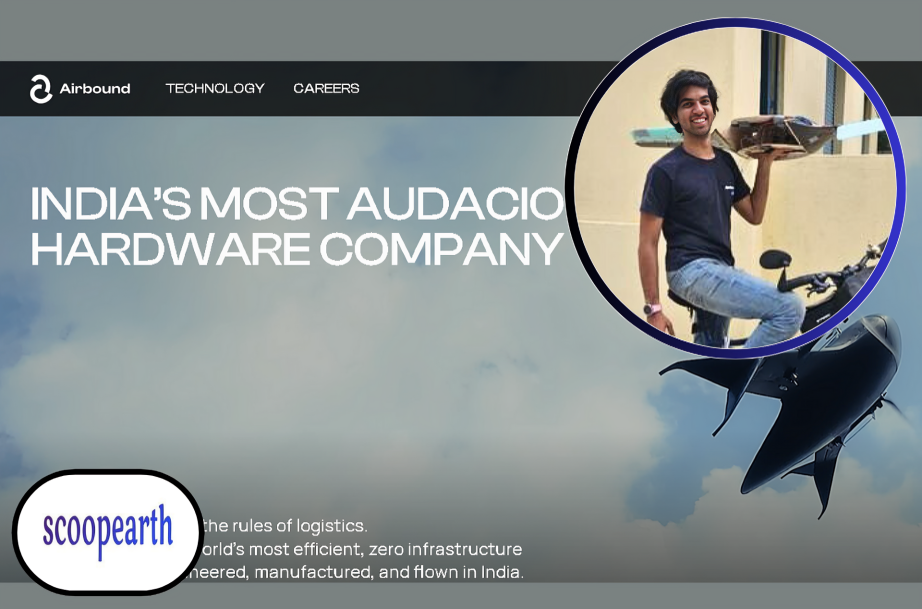
Airbound, India’s autonomous delivery logistics company, headquartered in Bengaluru, has raised $8.65 million seed round that will help it realize its grand vision of one-cent delivery costs per trip at scale. It is a massive capital infusion in order to make the economics of drone delivery shift fundamentally, surpassing the high operating costs that have thus far limited its mainstream use.
Goal and operational efficiency
Airbound aims to ensure that the price of delivery is insignificant and thus drone logistics becomes a useful option not only in high-value deliveries or emergency deliveries, but also in regular goods. The capital will be invested in a strategic manner to ensure that the operations of the firm are scaled swiftly, especially in its own manufacturing capacity. Through the expansion of in-house production, Airbound will lay a platform for developing an extensive and affordable delivery network in India and possibly extend to other countries.
At the core of the disruptive potential of Airbound lies the innovative aircraft design, which solves basic physics and economics issues that conventional drone systems have. Airbound uses an aircraft designed by it that has a blended-wing-body design and a vertical lift tail-sitter design. This distinct design enables the drones to perform vertical takeoff and landing (VTOL), which is necessitated by the need to operate in diverse environments, and at the same time, the aerodynamic efficiency of a fixed-wing flight during transit.
This engineering option is important as it prevents the penalty in performance and efficiency that comes with less optimized designs, including tilt-rotor and quadplane designs. The resultant effect is tremendous operational efficiency as seen with the weight of aircraft ratio to air mass of 1.5 kg to 1 kg. This implies that the drone can carry an almost identical weight as the plane itself. Airbound boasts that its system delivers 20 times less than traditional delivery systems and much less than its competitors’ drone systems, making the delivery-one-cent goal a reality.
Initial development and validation
Lachy Groom, co-founder of Physical Intelligence, led the seed round, indicating a high level of confidence in the technology and business model of Airbound. The investor syndicate, however, extends to an average venture capital, such as the involvement of Humba Ventures and further provision of support by Lightspeed, which is another investor at present.
The round attracted investment by the senior leaders who are experienced in scaling very complex hardware and autonomy systems within some of the most ambitious technology companies in the world, namely Tesla, SpaceX, and Anduril. These industry players can offer a strong level of authentication to Airbound. Their participation implies that professionals who have already developed and implemented advanced hardware and autonomy platforms think that Airbound, with its uncanny blended-wing-body structure and its ability to mass-produce many units, can actually afford the cost-effectiveness required to make drone delivery a viable approach applicable to a wide range of uses. This is the belief of the hardware veterans that Airbound has managed to address the key issue of scalability and economic viability with which the previous efforts in the drone delivery garden have failed.
Since the new capital has been raised, Airbound is now proceeding straight to test its capabilities under the real-life situation with a strategic partnership. In a move that is vital to the company, the company has collaborated with Narayana Health, which is one of the largest hospital chains in India, on an important pilot program based on medical logistics.
This three-month pilot will be aimed at testing the technology to the fullest, with the healthcare segment being the most demanding area and requiring reliability and an unprecedented level of efficiency. The drones will receive ten deliveries in a day, during which they will deliver life-saving supplies, starting with blood samples, medical tests, and other life-threatening needs.
This first implementation demonstrates how Airbound cares about bringing a substantial advancement to the speed and reliability of medical deliveries, especially in situations where the timely arrival of crucial diagnostics and supplies can actually save a life. The healthcare industry is regarded as the ideal environment where the technology should be tested because its requirements are ruthless and strict when it comes to reliability and efficiency before the company can expand its services to other, more general business areas.
Conclusion
The seed round of Airbound of $8.65 million is a significant milestone in the evolution of the autonomous logistics industry in India. The low cost of drone delivery is facing a direct challenge by the Bengaluru-based company through a special blended-wing-body design of drones and a scalable carbon fiber production system that allows the company to produce one aircraft a day. The support of the investors who have profound experience at companies such as SpaceX and Tesla validates the technological feasibility of their objective of having one-cent deliveries per trip.