Most founders create something. Harsh Jain created a habit. “Playing Dream11” became as much a part of watching Indian cricket as the toss of the coin, and one particular legislation threatened to end this budding business ten years later. Not as successful as his net worth indicates, but still recently and realistically.
The co-founder of the world’s largest fantasy sports platform has been through a rollercoaster ride and emerged not just as a billionaire but also as India’s first unicorn in the gaming universe.
From 150 rejections of his funding proposal to being a billionaire and a co-founder of a company valued at 8 billion by the IPL, ICC, and NBA – even as real money gaming got banned in India in 2025 and the revenues dived almost 95% in a month, he has been through it all. This is the success story of Harsh Jain, billionaire and founder of Dream11.
Who Is Harsh Jain?
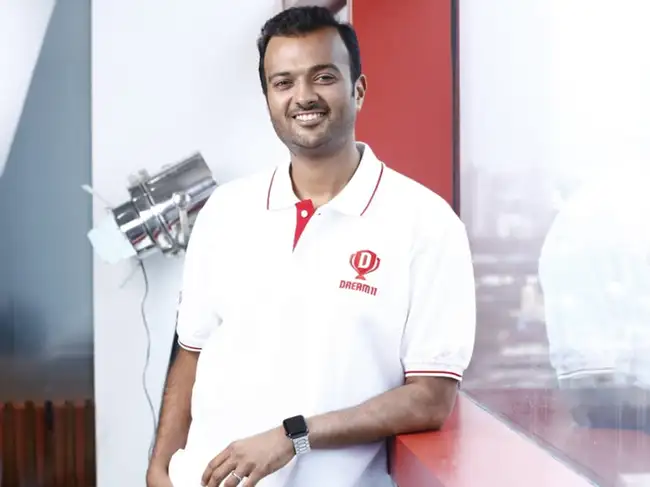
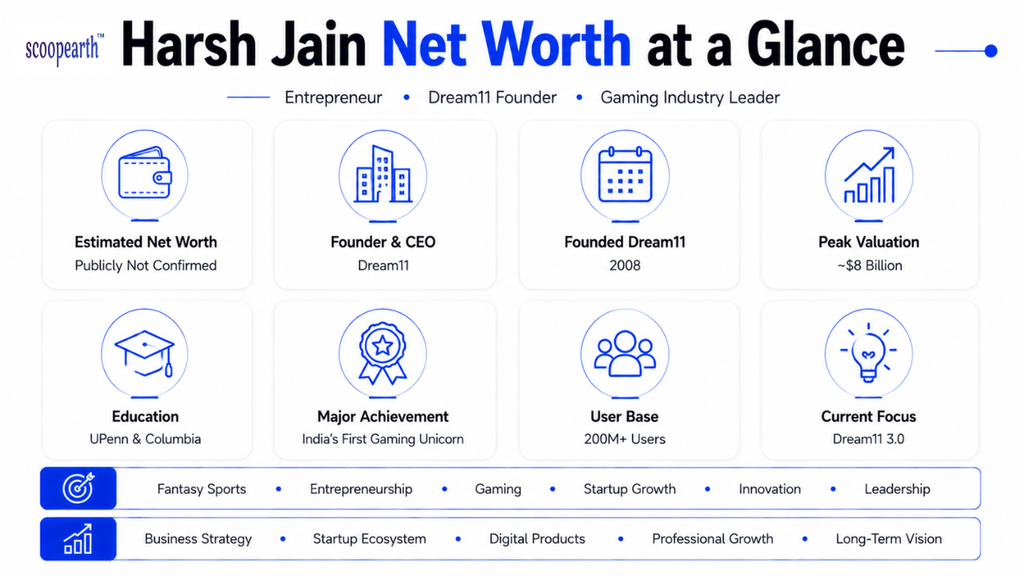
Harsh Jain is a billionaire entrepreneur and the co-founder and CEO of the largest fantasy sports platform, Dream11. He studied at the Sevenoaks School in Kent, England, studied at the University of Pennsylvania’s Wharton School, and did his MBA from Columbia Business School in New York.
There he met his childhood friend Bhavit Sheth, with whom he co-founded Dream11. He came back to India and conceptualized what eventually became Dream11 in 2008, and co-founded the company with Bhavit Sheth.
Today, it is India’s first gaming unicorn valued at around 8 billion dollars. Harsh Jain has been at the forefront of India’s gaming revolution and sold his stake in the company when real money gaming got banned in India in 2025, with the revenues to Dream11 plummeting almost 95% in just a month.
Quick Profile
| Attribute | Details |
| Full Name | Harsh Jain |
| Born | 1986, Mumbai, Maharashtra |
| Education | IB Diploma, Sevenoaks School, UK; B.S. in Electrical Engineering, Mathematics & Economics, University of Pennsylvania; MBA, Columbia Business School |
| Father | Anand Jain, Chairman of Jai Corp Limited; longtime close associate of the Ambani family |
| Wife | Rachana Jain (née Shah), a dentist |
| Son | Krish |
| Known As | Co-founder & CEO, Dream11 (Dream Sports) |
| Earlier Venture | Co-founder, Red Digital (social media & digital marketing firm), founded 2010, later acquired |
| Major Milestone | Dream11 became India’s first gaming unicorn, April 2019 |
| Major Disruption | India’s real-money gaming ban, August 2025 |
Harsh Jain Net Worth
Harsh Jain’s personal net worth is not publicly disclosed, and the discrepancy between a few published estimates is large enough to be confusing, if not misleading. One source cites a specific figure of “around $8 million (₹67 crore), based on his reported salary.
At least one other source separately estimates his wealth at roughly ₹8,000 crore (~$1 billion), based on his founder stake in Dream11’s peak valuation. It’s not every day that you see a difference of an order of magnitude between two net worth figures of the same individual, so take both numbers with a grain of salt.
Why Are The Two Estimates So Different?
| Estimate | Explanation | Why It’s Probably Wrong |
| ~$8 million (₹67 crore) | Based on his reported monthly salary of ₹33 lakh, extrapolated many times over | Doesn’t account for his founder shares in a multi-billion dollar company, which is almost certainly worth more than this sum |
| ~₹8,000 crore (~$1 billion) | Based on his stake in Dream11, which was valued at ~$8 billion as of its last funding in early-August 2025 | Dream11’s real money gaming vertical was banned shortly after this valuation, and the company has since transitioned to a free-to-play business model, so this stake is likely worth significantly less than suggested |
Both numbers are almost certainly wrong. The extrapolated-salary estimate misses out on hundreds of crores in wealth from Dream11’s founder shares, making it a severe underestimate. Meanwhile, the Dream11 stake estimate fails to incorporate the company’s changed business model and subsequent drop in valuation, making it a large overstatement.
Breakdown Of Wealth Sources
| Source | Details |
| Dream11 founder shares | His primary source of wealth, from founding the Indian fantasy sports giant in 2008, which saw its valuation peak at $8 billion before transitioning to a free-to-play business model |
| CEO salary | He earns a monthly salary of approximately ₹33 lakh as the CEO of Dream11, with ₹4 crore annual compensation expected following the latest funding round |
| Lodha Malabar, Mumbai real estate | Owns a 9,546 sq. ft. apartment in the upscale Lodha Malabar residential complex, located close to Bollywood’s famed Antilia, worth approximately ₹138 crore |
| Red Digital (social media/digital marketing) | Founded a social media marketing company, Red Digital, in 2010, sold it at an undisclosed price, and used the proceeds to fund his early career |
Early Life: A Sports-Obsessed Founder in the Making
Harsh Jain was born in 1986 in Mumbai to Anand Jain, the chairman of Jai Corp Limited and a businessman who has been labeled in Indian media as a long-standing confidant of Mukesh Ambani. Jain studied in various schools in India before going to the Sevenoaks School in the UK, where he finished his International A-levels in 2003.
He joined the University of Pennsylvania in Philadelphia to pursue a bachelor’s degree in Electrical Engineering, Mathematics, and Economics, which he completed by 2007.
While there, Jain played cricket and intramural football, discovering his love for sports and setting the stage for his future endeavors. He later pursued an MBA at Columbia Business School in New York, acquiring the necessary skills to lay the foundation for Dream11.
It is noteworthy that Jain’s entrepreneurial career was not an overnight success. After his short career at Microsoft, he co-founded Red Digital, a social media and digital marketing company in 2010, where he gained valuable experience before it was acquired.
Career Journey: From 150 Rejections to a Billion-Dollar Pivot
Phase 1 — Founding Dream11 Against the Odds (2008–2010)
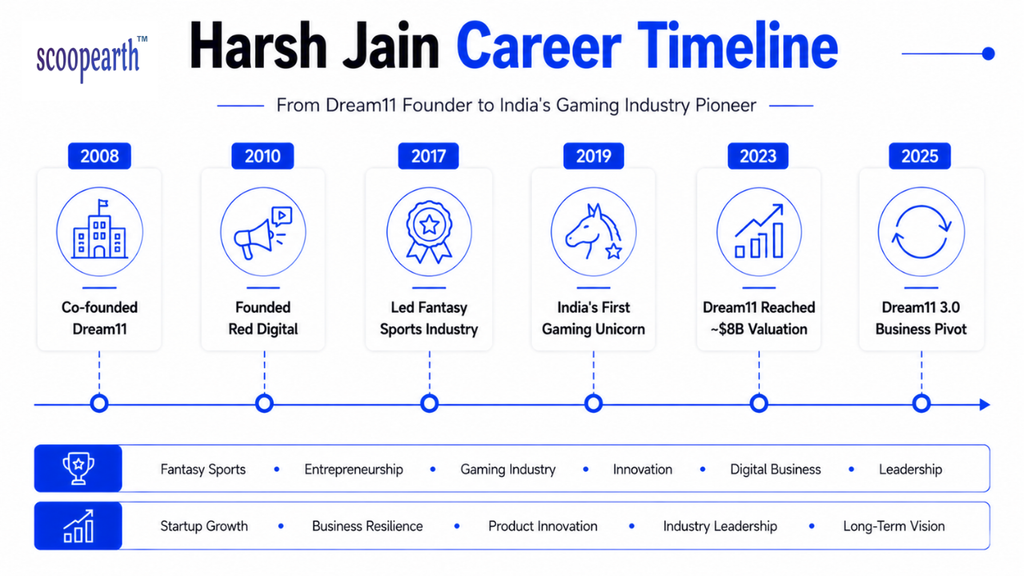
In June 2008, Harsh Jain co-founded Dream11 with childhood friend Bhavit Sheth, inspired by the popularity of English football fantasy leagues and a bet that a cricket-first version would resonate deeply with Indian sports fans.
The idea wasn’t an easy sell. Jain has spoken openly about facing roughly 150 rejections while trying to raise funding and build early credibility — a persistence story that has since become a defining part of how he talks about Dream11’s origins.
Phase 2 — Scaling to Unicorn Status (2010–2019)
Over the following decade, Dream11 grew steadily, eventually reaching 100 million users. In April 2019, it became the first Indian gaming company to enter the “unicorn club,” crossing a $1 billion valuation.
Alongside this growth, Jain served as President of the Federation of Indian Fantasy Sports starting in 2017, playing an active role in securing legal recognition of fantasy sports as a “game of skill” rather than gambling under Indian law — a distinction that would later sit at the center of the industry’s biggest legislative battle.
Phase 3 — Peak Growth, Global Partnerships, and the 2025 Ban (2019–Present)
Dream11’s user base pushed past 200 million, and the platform secured marquee partnerships as the fantasy sports partner or sponsor for the IPL, ICC, NBA, Pro Kabaddi League, the Caribbean Premier League, and New Zealand Cricket’s domestic T20 competition. Its parent company, Dream Sports, became the title sponsor of the Indian men’s cricket team through a reported $44 million (~₹358 crore) BCCI deal.
Revenue climbed from roughly ₹224.6 crore in FY2018 to ₹6,384 crore in FY2023, with the company posting a ₹188 crore profit that year — pushing its overall valuation to approximately $8 billion.
Then, on August 21, 2025, India’s parliament passed the Promotion and Regulation of Online Gaming Bill, banning real-money online gaming nationwide, along with related advertising and financial transactions.
The impact was immediate: by Jain’s own account in an interview with Moneycontrol, paid contests had generated roughly 95% of Dream11’s revenue and nearly 100% of its profits.
Within days, Dream Sports suspended its real-money operations entirely, shut down its newly launched Dream Picks app, and ended its BCCI title sponsorship, citing the severe expected hit to revenue. The company has since pivoted to a free-to-play “Dream11 3.0” model, exploring monetization through advertising, sponsorships, and expansion into content, travel, and fintech.
What Makes Harsh Jain’s Story Unique Essay
While a lot of founders have a ‘clean’ track record of building their startups, Jain is different in many ways. He rejected more than a hundred requests, which shows that his story was not a ‘pretty’ one, made up of some happy-bragging moments at the end.
Jain’s lobbying to declare fantasy sports a game of skill is a sign that he did major things for the industry, making it different from others’. Finally, Jain was transparent about the 2025 ban, saying it had a 95% impact on revenue instead of trying to sugarcoat the issue, and he immediately restructured the company rather than simply walking away from the industry.
Achievements at a Glance
| Achievement | Details |
| Co-founded Dream11 | 2008, with Bhavit Sheth, inspired by English football fantasy leagues |
| Survived 150 funding rejections | Before securing Dream11’s early backing |
| First Indian gaming unicorn | April 2019; valuation crossed $1 billion |
| President, Federation of Indian Fantasy Sports | From 2017; helped secure “game of skill” legal recognition for fantasy sports |
| Scaled to 200 million+ users | Partnerships with IPL, ICC, NBA, Pro Kabaddi League, CPL, New Zealand Cricket |
| Reached ~$8 billion peak valuation | Revenue grew from ₹224.6 crore (FY18) to ₹6,384 crore (FY23) |
| Led BCCI title sponsorship | $44 million (~₹358 crore) deal for the Indian cricket team, 2023–2026 |
| Led Dream11’s post-ban pivot | Launched “Dream11 3.0” free-to-play strategy after India’s August 2025 gaming ban |
FAQs
1. What is Harsh Jain’s net worth?
There is no exact figure for the net worth of Harsh Jain. The number, as of now, ranges between roughly $8 million, based on his disclosed salary, to as high as $1 billion, give or take, depending on the value of his stake in the company at the time of the peak valuation of Dream11, and the damage to the company’s core revenue stream caused by the 2025 gaming ban.
2. How old is Harsh Jain?
Harsh Jain was born in 1986 in Mumbai, Maharashtra.
3. Who is Harsh Jain’s wife?
Harsh Jain’s wife is Rachana Jain (née Shah), a dentist. The couple got married in 2013 and have a son named Krish.
4. Who is Harsh Jain’s father?
Harsh Jain’s father is Anand Jain, the Chairman of Jai Corp Limited, a conglomerate described in the Indian business press as a close associate of the Ambani family.
5. When was Dream11 founded by Harsh Jain?
Harsh Jain and his childhood friend Bhavit Sheth founded Dream11 in June 2008, inspired by the English football fantasy league.
6. What happened to Dream11 in 2025?
In August 2025, the Indian Parliament passed a bill banning real-money online gaming, decimating Dream11’s revenues, which were previously peaking at around 95%. As a result, Dream11 was forced to halt its paid contests and cut its long-standing BCCI sponsorship, shifting its focus toward a free-to-play business model.
7. What is Harsh Jain’s educational background?
Harsh Jain studied at Sevenoaks School in the UK, graduating with his IB Diploma. He then earned his Bachelor’s degree in Electrical Engineering, Mathematics, and Economics from the University of Pennsylvania and completed his MBA at Columbia Business School.
8. How big was Dream11 before the 2025 gaming ban?
At the time of its peak valuation, Dream11 was worth $8 billion or ₹65,000 crore and had over 200 million users. Its revenues grew exponentially, from around ₹224.6 crore in FY2018 to ₹6,384 crore in FY2023.
9. Did Harsh Jain start any other companies apart from Dream11?
Before co-founding Dream11, Harsh Jain started a social media management and digital marketing company called Red Digital in 2010, which was later acquired.
10. What is the current state of Dream11 after the real-money gaming ban?
After the 2025 gaming ban, Dream11 is rebranding itself as a free-to-play platform, or “Dream11 3.0,” focusing on building a presence in advertising, sponsorships, content, travel, and fintech.
Conclusion
The narrative around Harsh Jain serves as one of the most perfect examples of the lessons that founders’ biographies tend to conveniently overlook. After hitting 150 rejections on the road to developing India’s first gaming unicorn, he capitalized on partnerships with the IPL, ICC, and NBA to turn the “game of skill” into a recognized legal entity.
But even then, the man needed nearly two decades of sheer grind before he could finally reach a point where he stopped having to fight for every inch of progress. And with the 2025 real money gaming ban now making its way into the public consciousness, it is this part of Jain’s biography that is set to define his legacy for the years to come. The one that people, up to this point, have not factored in when calculating his net worth.
Even as he had supposedly secured an $ 8 billion peak valuation for Dream11, the company’s stock price has since dropped spectacularly on the news that almost 95% of its revenues would be evaporating overnight.
What happens from here, and whether or not Dream11 3.0 is able to recreate similar success, is what will ultimately rewrite the script of Harsh Jain’s professional life. But until then, the simplest response to the question “What is Harsh Jain’s net worth?” would be to point out just how wrong one is likely to be.