For almost two decades, Dream11 was the favorite success story of every Indian startup founder aspiring to become the next Mark Zuckerberg. It began with a small idea of creating a mobile application for cricket fans and evolved into a global giant, housing the world’s largest fantasy sports platform and becoming India’s first gaming unicorn.
However, it was all short-lived as a single law amendment in the month of August 2025 stripped Dream11 of almost all of its revenues. In order to understand what Dream11 is today, it is essential to analyze the product that helped it attain stardom and the company’s current state as it redevelops the platform.
The given article will provide valuation and revenue data regarding Dream11, along with the information on its founders, business model, and the 2025 law changes. The data will be presented using factual comparisons and addressing the frequently asked questions.
Overview Table: Dream11 at a Glance
| Detail | Information |
| Full Name | Dream11 (operated by Dream Sports, formerly Sporta Technologies) |
| Founded | June 2008 |
| Founders | Harsh Jain and Bhavit Sheth |
| Headquarters | Mumbai, Maharashtra, India |
| Industry | Fantasy sports and online gaming |
| Known For | World’s largest fantasy sports platform; India’s first gaming unicorn |
| Total Funding Raised | Approximately $1.165 billion across 8 rounds |
| Key Investors | Tencent, Steadview Capital, TPG, Falcon Edge Capital, D1 Capital Partners |
| Peak Valuation | Approximately $8 billion (2021–2022) |
| FY25 Reported Revenue | Approximately ₹7,370 crore (~$885 million) |
| Major Disruption | India’s Promotion and Regulation of Online Gaming Bill, passed August 2025, banning real-money gaming nationwide |
| Employees | Approximately 1,300+ (as of mid-2025), up roughly 17% year-over-year |
What is Dream11, and Who Founded It?
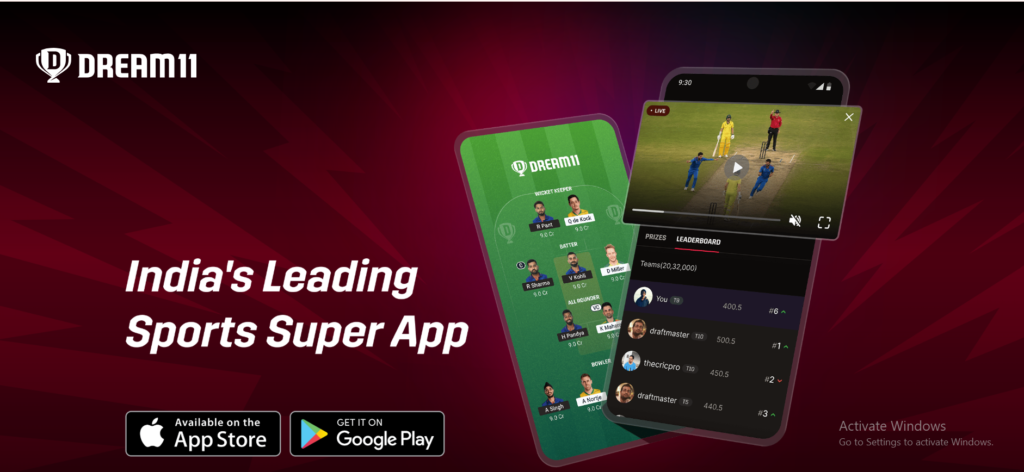
Image Courtesy: Dream11 / Official Website
Dream11 is an Indian fantasy sports website where users create virtual teams of real players and compete based on their on-field outcomes in sports such as football, cricket, and kabaddi.
Founded in June 2008 by Harsh Jain and his childhood friend Bhavit Sheth, the company initially launched as a response to the popularity of English football fantasy leagues and a personal belief that a cricket-centric version would have greater appeal to Indian sport fans.
Developed under the Dream Sports umbrella, the site grew to become the world’s largest fantasy sports platform with over 200 million registered users and partnerships with major leagues such as the IPL, ICC, and NBA before being forced to pivot away from real-money gaming due to India’s August 2025 real-money gaming ban.
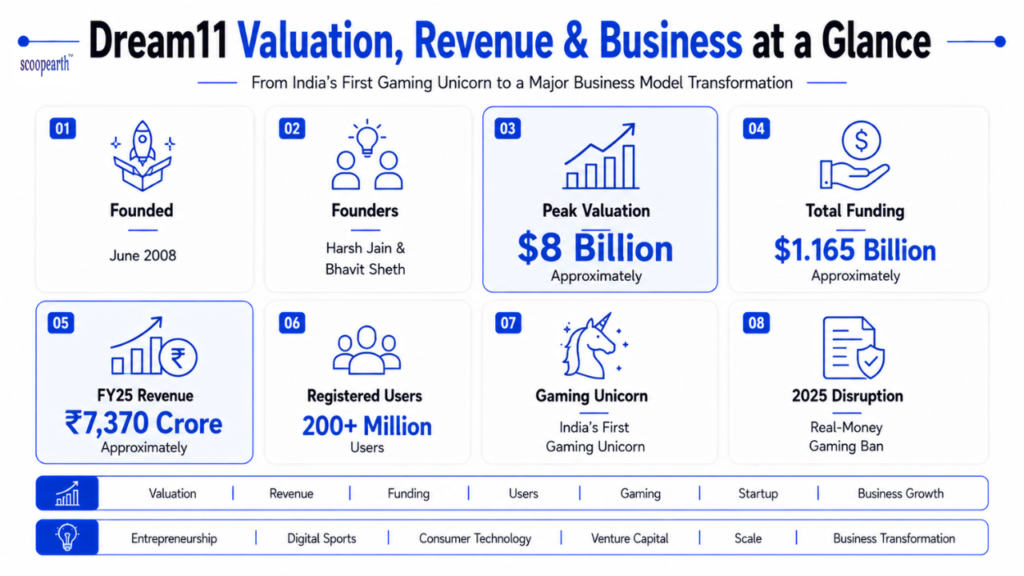
Dream11’s Valuation and Financial Scale
Dream11’s valuation history reflects a fairly dramatic arc: steady early growth, a rapid climb to unicorn status and beyond, a peak multi-billion-dollar valuation, and then a sudden, legislation-driven disruption that has made any current valuation figure genuinely difficult to pin down.
Valuation and Funding Timeline
| Period | Reported Valuation / Funding | Context |
| 2016–2018 | Early growth stage | Company built its core product and user base through Series C and D funding rounds |
| April 2019 | Over $1 billion | Became the first Indian gaming company to reach unicorn status |
| March 2021 | Approximately $5 billion | Valued via a secondary market transaction |
| November 2021 | Approximately $8 billion (Series F) | Raised $840 million in its largest funding round, pushing total funding to roughly $1.165 billion across 8 rounds |
| 2022–2024 | Sustained near peak valuation | Continued global sponsorships and revenue growth |
| August 2025 onward | Not independently re-established | Following the real-money gaming ban, the company’s valuation under its new free-to-play model remains unclear |
Unlike a publicly listed company, Dream11’s valuation isn’t updated in real time; it’s set at the moment of each funding round based on negotiations between the company and its investors. This means the $8 billion figure most commonly cited for Dream11 reflects its November 2021 Series F round specifically, and does not automatically account for the business fundamentals that have changed dramatically since.
Revenue Growth Snapshot
| Fiscal Year | Reported Revenue | Notes |
| FY18 | Approximately ₹224.6 crore | Early growth phase |
| FY23 | Approximately ₹6,384 crore | Company posted a ₹188 crore profit in the same year |
| FY25 | Approximately ₹7,370 crore (~$885 million) | Most recent full-year figure prior to the August 2025 gaming ban |
| Post-ban period | Revenue impact estimated at approximately 95% | Per CEO Harsh Jain’s own account, paid contests generated the vast majority of the company’s revenue and nearly all of its profit before the ban |
The Founders Behind Dream11
Harsh Jain, Dream11’s co-founder and CEO, studied Electrical Engineering, Mathematics, and Economics at the University of Pennsylvania before completing an MBA at Columbia Business School. Bhavit Sheth, his co-founder and childhood friend, has served as Dream11’s Chief Operating Officer, overseeing much of the company’s operational scaling since its founding.
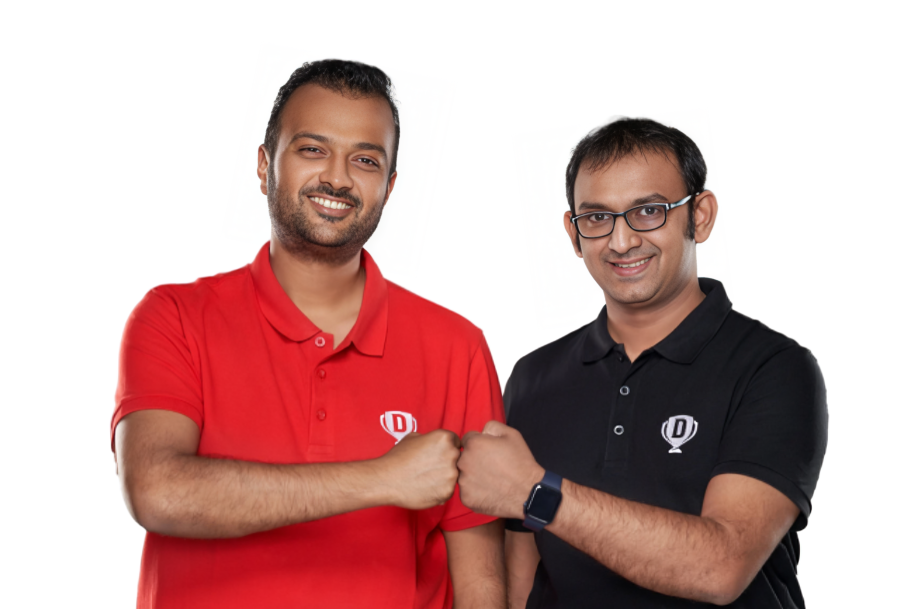
Image Courtesy: Dream11 / Official Website (Left:Harsh Jain Co-Founder & CEO /Right:Bhavit Sheth Co-Founder & COO)
The pair has spoken openly about the difficulty of Dream11’s early years, including facing roughly 150 funding rejections before securing the company’s first backers — a level of early-stage struggle that stands in contrast to the company’s eventual scale as one of India’s most valuable startups.
Business Model: How Dream11 Makes Money
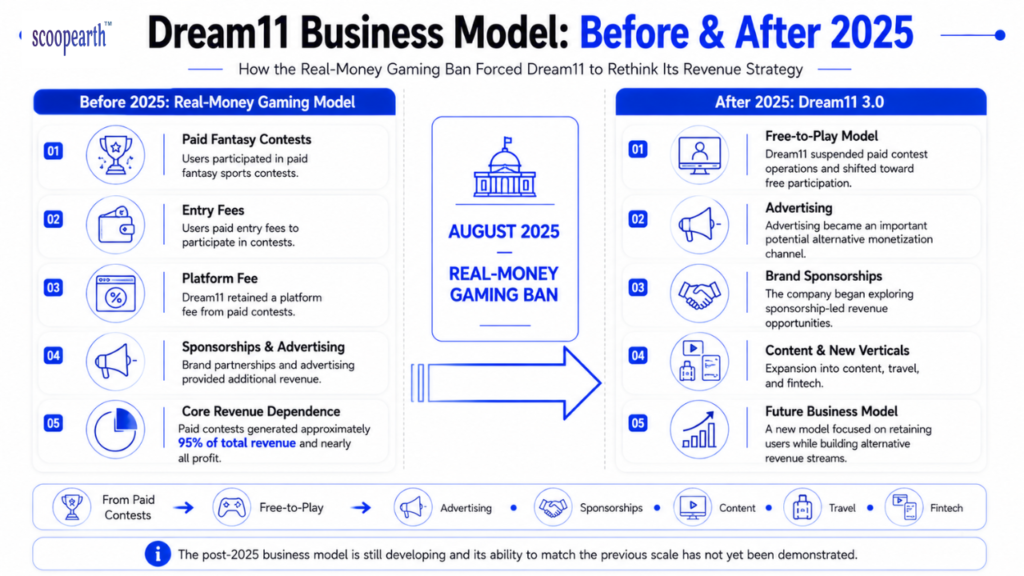
Dream11’s core business model, prior to India’s 2025 gaming ban, centered on paid fantasy sports contests: users paid entry fees to join contests where they competed based on the real-world performance of athletes on their virtual teams, with winners receiving a share of the prize pool and Dream11 retaining a platform fee.
According to CEO Harsh Jain, these paid contests accounted for approximately 95% of the company’s total revenue and nearly 100% of its profit, making the model both highly lucrative and, in hindsight, highly concentrated in a single regulatory-dependent revenue stream. Free-to-play contests, brand sponsorships, and advertising made up a smaller share of overall revenue during this period.
Following the August 2025 ban on real-money online gaming, Dream Sports suspended its paid contest operations entirely and shifted toward a free-to-play model under its “Dream11 3.0” strategy, aiming to generate revenue instead through advertising, brand sponsorships, and expansion into adjacent verticals such as content, travel, and fintech — a business model still in the process of being built out and proven at scale.
Company Timeline: Key Milestones
Founding and Early Growth (2008–2018)
Dream11 was founded in June 2008 by Harsh Jain and Bhavit Sheth, initially operating on a smaller scale as the fantasy sports concept slowly gained traction in India. The company steadily built its user base and product over the following decade, aided by growing smartphone penetration and increasing comfort with digital payments across India.
Unicorn Status and Rapid Scaling (2019–2022)
In April 2019, Dream11 became the first Indian gaming company to cross a $1 billion valuation, officially entering the “unicorn club.” This milestone triggered a period of rapid scaling: the platform’s user base grew past 100 million and then 200 million, and the company secured its largest funding round, an $840 million Series F in November 2021, pushing its valuation to approximately $8 billion.
Peak Growth and Marquee Partnerships (2022–2024)
During this period, Dream11 solidified its position as a dominant force in fantasy sports through partnerships with the IPL, ICC, NBA, and other major sporting organizations, alongside a high-profile BCCI title sponsorship deal for the Indian cricket team. Revenue continued climbing, reaching roughly ₹7,370 crore by FY25, positioning Dream11 as one of the most commercially successful consumer internet companies in India.
The Real-Money Gaming Ban (August 2025)
On August 21, 2025, India’s parliament passed the Promotion and Regulation of Online Gaming Bill, banning real-money online gaming nationwide along with related advertising and financial transactions.
The impact was immediate: within days, Dream Sports suspended its real-money gaming operations entirely, shut down its recently launched Dream Picks app, and ended its BCCI title sponsorship, citing the severe expected hit to revenue.
The broader Indian real-money gaming industry, which had entered 2025 valued at around $3 billion and employing over a lakh professionals, was similarly upended, with competitors including MPL, RummyCircle, PokerBaazi, and Paytm’s First Games all suspending or winding down real-money operations around the same time.
Rebuilding Under Dream11 3.0 (2025–Present)
In the aftermath of the ban, Dream Sports pivoted toward a free-to-play model, exploring new monetization avenues including advertising, sponsorships, and expansion into content, travel, and fintech verticals. The company’s ability to retain meaningful engagement from its massive existing user base, even without real-money incentives, will likely determine how successfully this new chapter plays out relative to its previous, far more lucrative business model.
Frequently Asked Questions (FAQs)
What is Dream11’s current valuation?
Dream11’s most recent formally established valuation was approximately $8 billion, set during its November 2021 Series F funding round. Following India’s August 2025 real-money gaming ban, the company’s valuation under its new free-to-play business model has not been independently re-established, so this figure should be treated as historical rather than current.
Who founded Dream11, and when?
Dream11 was founded in June 2008 by Harsh Jain and Bhavit Sheth, inspired by the popularity of English football fantasy leagues.
How much funding has Dream11 raised?
Dream11 has raised approximately $1.165 billion across 8 funding rounds, with its largest single round being an $840 million Series F in November 2021.
What happened to Dream11 in 2025?
In August 2025, India’s parliament passed the Promotion and Regulation of Online Gaming Bill, banning real-money online gaming nationwide. This eliminated approximately 95% of Dream11’s revenue, forcing the company to suspend its paid contests, end its BCCI sponsorship, and pivot to a free-to-play business model.
How does Dream11 make money?
Historically, Dream11 generated most of its revenue through entry fees for paid fantasy sports contests. Following the 2025 gaming ban, the company shifted toward a free-to-play model, exploring advertising, brand sponsorships, and new verticals like content, travel, and fintech as alternative revenue sources.
How large was Dream11’s user base?
Prior to the 2025 disruption, Dream11 had grown past 200 million registered users, making it one of the largest sports engagement platforms in the world.
What sports partnerships has Dream11 held?
Dream11 has partnered with or sponsored major sporting organizations including the IPL, ICC, NBA, Pro Kabaddi League, the Caribbean Premier League, and New Zealand Cricket, and previously held a $44 million BCCI title sponsorship deal for the Indian men’s cricket team spanning 2023 to 2026.
Who are Dream11’s main competitors?
Dream11’s key competitors include DraftKings and FanDuel internationally, and platforms like MPL and WinZO within the Indian market, several of which were similarly affected by India’s 2025 real-money gaming ban.
What is Dream11’s revenue?
Dream11’s most recently reported annual revenue was approximately ₹7,370 crore (around $885 million) for FY25, though this figure reflects the period before the August 2025 real-money gaming ban significantly disrupted the company’s core revenue stream.
Can Dream11 recover from the 2025 gaming ban?
Dream Sports has pivoted to a free-to-play “Dream11 3.0” strategy focused on advertising, sponsorships, and new verticals, but whether this new model can approach the scale of its previous real-money gaming business remains genuinely uncertain and has not yet been demonstrated at scale.
Conclusion
The rise and fall of Dream11 as a company encapsulates the triumph of Indian consumer-tech startups and the precarious environment in which they must operate. From initial rejections of its funding proposals 150 times over to becoming India’s first-ever gaming unicorn, Dream11 was able to leverage IPL, ICC, NBA, and other partnerships to generate revenue.
It is difficult to overstate the degree to which these factors contributed to its staggering 30x revenue jump on the stock exchanges. On the other hand, the August 2025 real-money gaming ban is an integral part of the discussion of Dream’s current value.
If the company, which had relied on those revenues to operate, will be able to retain its audience and sustain its growth in the long run will be determined by its ability to pivot to other avenues of monetization, such as advertising and sponsorships, as it tries to rebrand itself as “Dream11 3.0.”