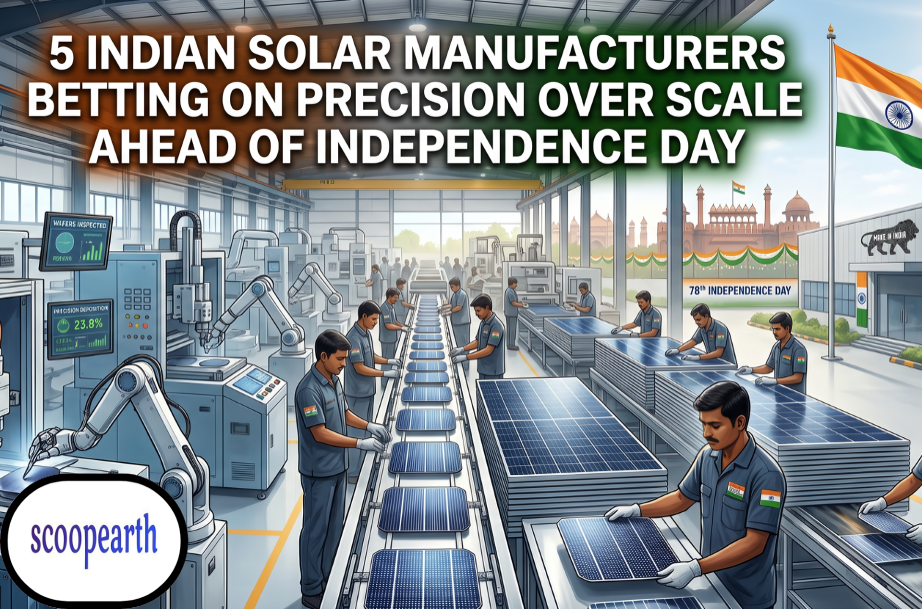
India’s solar module manufacturing capacity crossed 217 GW in August 2026, up from roughly 2 GW a decade ago. Independence Day this year lands in the middle of that growth story, but the more interesting shift is happening somewhere the capacity numbers don’t capture. Module capacity has grown far faster than cell capacity, which sits closer to 30 GW nationally, and that gap has pushed manufacturers to think harder about what happens inside the factory, not just what comes out of it.
A handful of plants are now competing on something harder to put on a press release: whether every module holds up over the decades it is meant to last. Here are five companies making that bet.
Aroma Solar
Aroma Solar’s 1.23 GW module manufacturing plant in Karnal, Haryana, was built around artificial intelligence and robotics from day one, not retrofitted onto an older line later. Its TOPCon modules, rated up to 650Wp, recently received ALMM approval which determines eligibility for government-backed and subsidised projects.
The facility itself runs as a fully robotic, dust-free environment, with AI-driven checks built into every stage of assembly rather than saved for a final inspection point. A defect caught mid-process costs far less to fix than one discovered after a module has already shipped.
RenewSys
RenewSys has taken a different route to the same end. Rather than sourcing encapsulants and backsheets from outside vendors, it manufactures both in-house, giving it direct control over materials most manufacturers treat as commodity inputs bought off the shelf.
Encapsulant quality is one of the more common points of long-term wear in a module, showing up as discoloration or reduced output well after installation. Controlling that layer of the module at the source, rather than depending on a supplier’s own standards, is where RenewSys is placing its bet.
Saatvik
Saatvik has focused its recent expansion almost entirely on N-type TOPCon module lines, moving away from the PERC architecture that defined the first wave of Indian manufacturing. TOPCon cells typically run at 22 to 24% efficiency against PERC’s 20.5 to 22%, and they degrade more slowly over a module’s working life, closer to 0.35% a year rather than PERC’s 0.45 to 0.5%.
Over a 25-year asset life, that difference compounds into a meaningful gap in total energy delivered. Saatvik’s shift reflects a broader move across the industry toward technology built to perform over decades, not just at the point of sale.
Premier Energies
Premier Energies has scaled quickly in recent years and built a specific reputation for build quality in the residential rooftop segment, where customers feel the difference between a well-built module and a mediocre one for years after installation.
Rooftop systems are harder to service than utility-scale plants, since each one sits on a different roof with its own access constraints, which makes getting the manufacturing right the first time more important. Holding that reputation through a fast scale-up is its own kind of discipline.
Websol Energy System
At its Falta SEZ facility, Websol runs fully automated cell and module lines, with automated optical inspection and electroluminescence testing built into the process, and human involvement largely limited to supervision and maintenance.
The plant carries a stack of certifications, ISO 9001, IEC 61215, and TUV Rheinland among them, which matter most for an export order or a large utility tender rather than a single rooftop. Expansion is already approved, with 5.2 GW of cell capacity and 4.55 GW of module capacity planned by 2028, the new phases built on TOPCon technology.
India’s solar industry will keep adding gigawatts either way. The harder number to chase, and the one that matters more over time, is how many of those modules are still performing exactly as promised a decade after installation. These five companies are where that shift is already visible.