In a global technology landscape heavily dominated by media-trained tech founders and high-profile IPOs, the narrative of modern wealth usually involves venture capital backing and relentless public relations. However, one of the most successful technology stories coming out of India deliberately rejects this playbook.
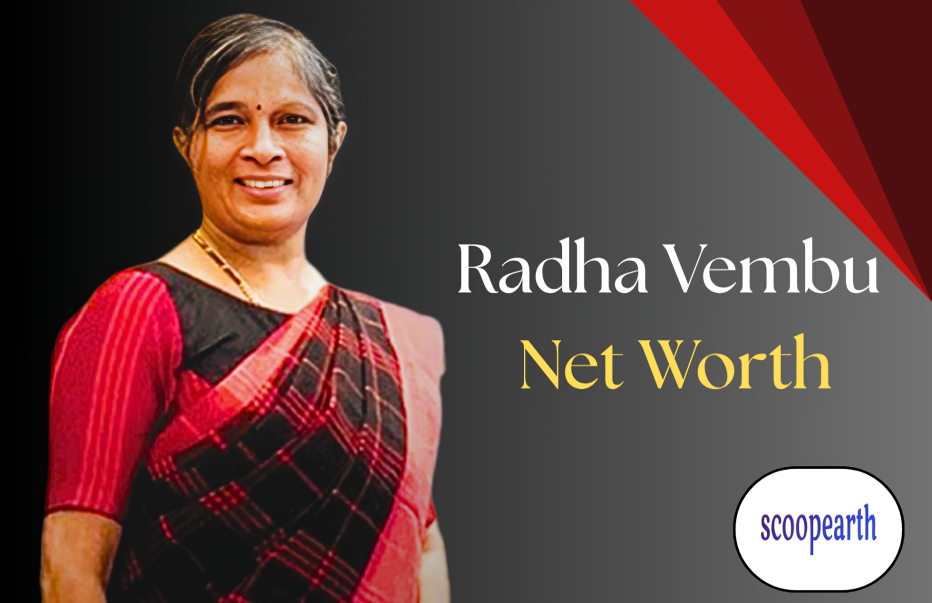
Radha Vembu, the Product Head and largest shareholder of Zoho Corporation, represents a rare breed of business leader: the “silent billionaire.” While her name rarely dominates morning business headlines, her strategic blueprint has shaped one of the most resilient, entirely bootstrapped Software-as-a-Service (SaaS) empires in the world.
To understand the scope of her influence is to look beyond typical financial metrics and analyze her structural contribution to Indian technology, rural decentralization, and the global cloud ecosystem.
The Architecture of an Empire
Early Life & Foundational Grounding
Born in Chennai, Tamil Nadu, in 1972, Radha Vembu grew up in a family that prioritized logic, problem-solving, and education. She completed her schooling at the National Higher Secondary School before earning a degree in Industrial Management from the prestigious Indian Institute of Technology Madras (IIT Madras) in 1997.
Unlike many of her contemporaries in the late 1990s who viewed an elite technical degree as a direct ticket to Silicon Valley, Vembu chose to remain in India. She held a firm conviction that world-class technology infrastructure could be designed, scaled, and distributed globally right from domestic soil.
The Genesis of Zoho Corporation
Radha Vembu joined AdventNet Inc., founded by her brother Sridhar Vembu and Tony Thomas in 1996, and played a key role in building the company’s product ecosystem. The company would later evolve into the global technology powerhouse known as Zoho Corporation. From day one, the company took a fiercely independent path.
Rejecting external venture capital pressure allowed the founders to prioritize sustainable product design over short-term investor demands. While her brother Sridhar became the forward-facing strategic scientist of the firm, Radha took on the deeply technical, granular role of managing the product architecture.
Zoho’s Bootstrapped Business Model
Unlike many modern software companies that rely on multiple rounds of venture capital funding before reaching profitability, Zoho Corporation followed a fundamentally different path. The company has remained entirely bootstrapped since its inception, financing its expansion through customer revenue rather than outside investment. This approach has allowed Zoho to retain complete control over its strategic direction, product roadmap, and long-term vision without the pressure of quarterly investor expectations.
For Radha Vembu, this independence has translated into the freedom to focus on building products with long-term value instead of chasing rapid growth at any cost. Zoho has steadily expanded its
portfolio to include more than 55 business applications covering customer relationship management, finance, collaboration, human resources, and productivity. Serving businesses across more than 180 countries, the company has built a reputation for offering integrated software solutions while maintaining strong commitments to user privacy and data ownership.
Income, Assets, and Financial Footprint
• Net Worth: Estimated at roughly ₹55,300 crore to ₹56,440 crore ($6.7 billion to $6.8 billion USD), making her one of the world’s wealthiest self-made women entrepreneurs according to the Hurun Global Rich List.
• Asset Breakdown: Unlike billionaires whose wealth is distributed across volatile stock portfolios and speculative real estate, Vembu’s financial footprint is concentrated largely within her 47.8% stake in Zoho Corporation.
• The Corporate Valuation: Because Zoho remains entirely private and bootstrapped, its financial health relies completely on real, incoming cash flow from over 100 million global users rather than speculative market valuations.
• Additional Holdings: Beyond her primary tech holdings, she serves as the director of the Corpus Foundation and holds strategic agricultural and real estate interests focused heavily on sustainable rural development.
The Product Engine: The Quiet Manager of Zoho Mail
While her net worth commands attention, inside the corporate structure of Zoho, Radha Vembu famously retains a highly focused, understated title: Product Manager for Zoho Mail. She has led this specific division since 2007.
“The quality of the product matters, not the people behind it. Most of the senior management does not want any limelight.” — Radha Vembu
Managing an enterprise email service is widely considered one of the most technically demanding tasks in the software ecosystem due to severe privacy requirements, high security parameters, and data redundancy demands. Under her leadership, Zoho Mail was systematically scaled to compete
directly with global technology giants like Microsoft and Google, expanding into a broader workspace suite that anchors Zoho’s global competitiveness across more than 180 countries.
Family & Strategic Decentralization
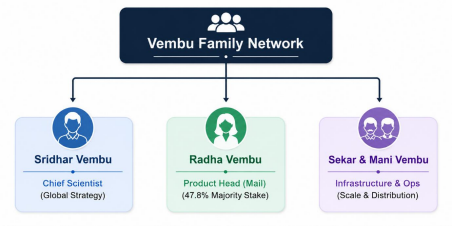
The Vembu family structure operates less like a traditional corporate board and more like a closely coordinated leadership network. While Radha handles product development and her brother Sridhar drives high-level research and development as Chief Scientist, their other siblings, Sekar and Mani Vembu, lead vital infrastructure arms within the parent company.
This alignment allowed the family to pioneer a radical thesis: decentralizing technology innovation from metropolitan hubs into rural India.
Instead of forcing talent into crowded technology corridors like Bengaluru or Gurgaon, Radha and her family established major R&D hubs in small towns and villages such as Tenkasi and Kumbakonam in Tamil Nadu. Through the Zoho Schools of Learning, they bypass traditional degree requirements entirely by hiring local youth, training them internally in advanced engineering, and integrating them directly into global product teams.

The decentralization strategy also reflects the family’s broader philosophy that innovation should not be limited to metropolitan cities. By creating engineering centers in smaller towns, Zoho has demonstrated that high-quality software development can thrive outside traditional technology hubs. The model has generated employment opportunities for local communities while reducing the operational costs and urban pressures associated with large cities. Over the years, this approach has attracted global attention as an alternative blueprint for sustainable technology growth, proving that talent can be nurtured wherever the right training and opportunities exist.
The Takeaway
The success story of Radha Vembu challenges the core assumptions of modern startup culture. It proves that massive global scale does not require giving up equity to external investors, and that true market authority does not require public visibility. By focusing entirely on product execution, data security, and rural empowerment, she has established a multi-billion-dollar legacy built on substance, silence, and self-reliance.
Her journey also reflects a broader shift in the Indian technology ecosystem, where sustainable innovation is increasingly valued alongside rapid expansion. Through disciplined leadership, long term thinking, and an unwavering commitment to building quality products, Radha Vembu has helped establish Zoho as one of India’s most respected global software companies. Her story demonstrates that lasting success can be achieved through consistency, independence, and a clear vision rather than publicity alone.