Introduction
India is in the mid of the most exciting phase of economic transformation in its history. With a young population, increasing digital adoption, growing disposable income and strong government initiatives, the country is fast becoming one of the world’s biggest economies.
There’s been a sea change in the way India does business and how consumers engage with technology over the last decade. New industries are hitting the scene at a breakneck speed. Think digital payments that are becoming part of daily life, electric vehicles replacing traditional cars.
Government initiatives like Make in India, Digital India, Startup India, Production Linked Incentive (PLI) schemes and infrastructure development have opened opportunities in many sectors.
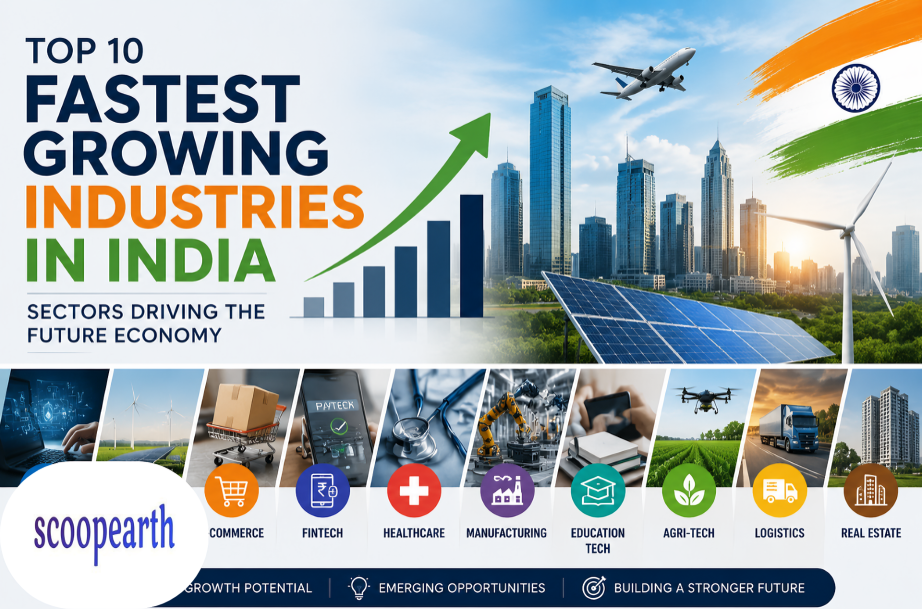
The following are the top 10 fastest-growing industries in India that are expected to shape the country’s economic future.
Electric Vehicles (EVs) s Auto Components
The industry of Electric Vehicles (EV) is one of the most rapidly growing industries in India. The transition to electric mobility from traditional fuel-based vehicles is being accelerated by increasing fuel costs, environmental concerns and government support.
India is investing heavily in charging infrastructure, battery technology and local manufacturing of EV components. This growth is not only for cars but also for electric two wheelers, buses and commercial vehicles.
Government schemes like FAME (Faster Adoption and Manufacturing of Hybrid and Electric Vehicles) have urged manufacturers and consumers to adapt to EV technology.
Leading Companies:
- Tata Motors – One of India’s largest EV manufacturers, offering electric cars such as Nexon EV and Tiago EV.
- Ola Electric – A major electric two-wheeler company focused on large-scale EV production.
The EV ecosystem is also creating growth opportunities for battery manufacturers, charging companies, and auto-component suppliers.
FinTech s Digital Payments
India’s FinTech sector has changed the way people handle their money. Platforms such as UPI have made it possible to make instant payments across cities and villages. Digital lending, online banking, insurance tech and investment platforms are on a rapid growth path.
The increase in smartphone users and cheap internet access has enabled FinTech firms to reach customers who had limited access to financial services.
Leading Companies:
- PhonePe – A leading digital payments platform with millions of users.
- Razorpay – Helps businesses manage online payments and financial operations.
- CRED – Offers credit management and premium financial services.
Information Technology’s (IT) Artificial Intelligence (AI)
India has long been one of the world’s IT superpowers and the industry still has a lot to offer. Traditional IT services are still strong but new opportunities are emerging in Artificial Intelligence, cloud computing, cybersecurity and automation.
With a skilled workforce and expertise in technology, India is witnessing a growing number of global companies establishing Global Capability Centers (GCCs) in the country.
AI is emerging as a major growth driver, aiding industries in automating processes, analysing data, and building smart solutions.
Leading Companies:
- Tata Consultancy Services (TCS) – One of the world’s largest IT service providers.
- Infosys – Provides digital transformation and AI-driven solutions globally.
Renewable Energy’s Green Technology
India is rapidly increasing its renewable energy capacity as the world turns to cleaner
energy sources. Solar, wind, green hydrogen and energy storage technologies are becoming key areas of focus. India has set itself ambitious targets for renewable energy adoption, to
lower its dependence on fossil fuels. Large-scale solar parks, rooftop solar installations and clean energy investments are opening up new opportunities.
Leading Companies:
- Adani Green Energy – One of India’s largest renewable energy companies.
- Tata Power Renewable Energy – Developing solar and clean energy projects.
Healthcare’s Pharmaceuticals
India is globally recognized as the “Pharmacy of the World” because of its large pharmaceutical manufacturing capabilities. The healthcare industry is growing due to increasing health awareness, rising middle-class income, medical technology
advancements, and improved healthcare infrastructure.
Biotechnology, medical devices, telemedicine, and digital healthcare are also expanding rapidly.
Leading Companies:
- Sun Pharmaceutical Industries – India’s largest pharmaceutical company.
- Dr. Reddy’s Laboratories – A global pharmaceutical manufacturer.
The healthcare sector will continue to grow as India focuses on affordable and accessible medical services.
E-Commerce’s Retail
India’s e-commerce industry has grown significantly due to cheap internet access,
increasing smartphone usage, and changing consumer behavior. Online shopping is no longer limited to major cities. E-commerce companies are expanding into smaller towns and rural areas, bringing millions of new consumers online.
The growth of digital payments and faster delivery networks has further strengthened this sector.
Leading Companies:
- Flipkart – One of India’s largest e-commerce marketplaces.
- Meesho – Focuses on social commerce and small sellers.
The future of retail in India is expected to be a combination of physical stores and digital platforms.
Infrastructure’s Construction
One of the biggest drivers of Indian economic growth is development of infrastructure.
The government is spending big on highways, railways, airports, smart cities, housing C urban development. These projects are generating demand for construction companies, engineering firms, material suppliers.
Leading Companies:
- Larsen s Toubro (LsT) – A major engineering and construction company.
- Adani Infrastructure – Develops airports, roads, and energy infrastructure. Infrastructure growth is expected to remain a key pillar of India’s economic expansion.
Electronics Manufacturing
With companies shifting supply chains and government support through PLI schemes, domestic production is increasing rapidly. Mobile phones, semiconductor components, consumer electronics, and advanced technology products are being manufactured locally.
The goal is to reduce import dependency and make India a major electronics exporter.
Leading Companies:
- Dixon Technologies – Manufactures electronics and consumer products.
- Foxconn India – Produces electronics for global brands.
Defense Manufacturing
India is focusing on becoming self-reliant in defense production. The government is
encouraging private companies to participate in aerospace and defense manufacturing.
Policies supporting domestic production and reduced imports have opened opportunities for Indian companies.
The sector includes aircraft manufacturing, military equipment, drones, and defense technology.
Leading Companies:
- Hindustan Aeronautics Limited (HAL) – A major aerospace and defense manufacturer.
- Bharat Electronics Limited (BEL) – Develops defense electronics systems.
Agritech’s Food Processing
Agriculture remains an important part of India’s economy, and technology is transforming the sector. Agritech companies are helping farmers with better supply chains, market
access, weather insights, and digital farming solutions.
At the same time, food processing is growing due to changing lifestyles and increasing demand for packaged and ready-to-eat products.
Leading Companies:
- DeHaat – Provides technology-driven agricultural services.
- Ninjacart – Improves farm-to-market supply chains.
Growth Outlook of Key Industries
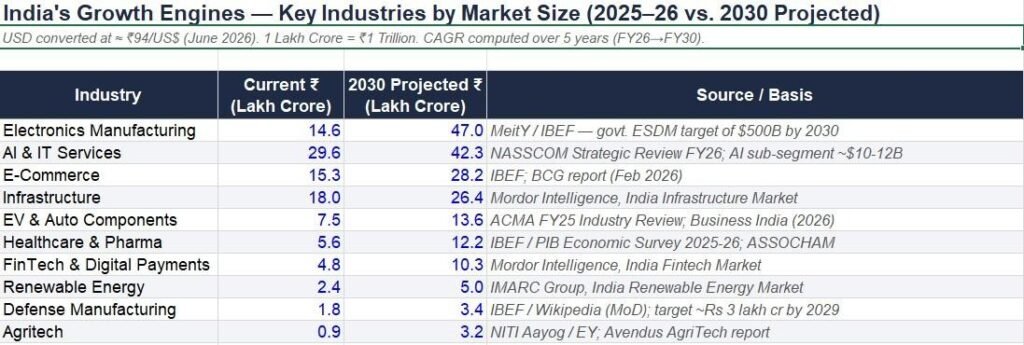
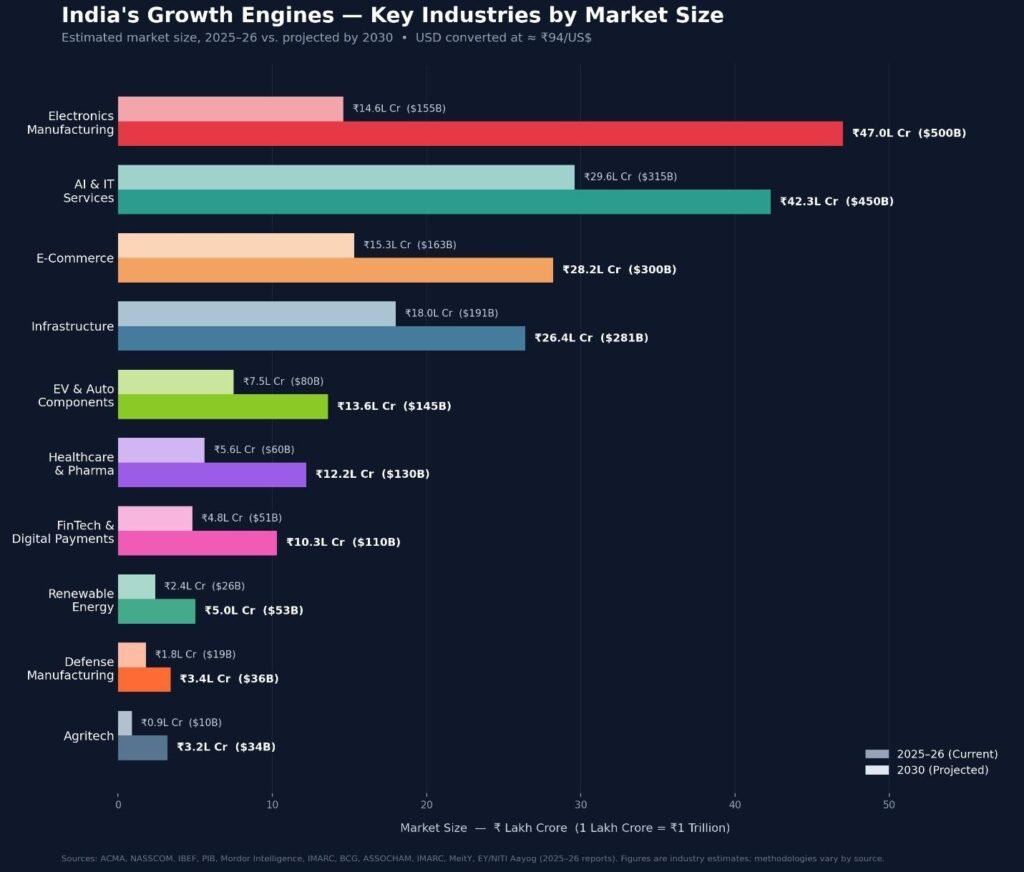
To better visualize this growth story, the graph below maps out India’s fastest-growing industries and their projected expansion by 2030. Electronics manufacturing and IT services emerge as the largest and most mature sectors, while e-commerce,
infrastructure, EVs, healthcare, and fintech follow closely behind, each riding strong domestic demand and policy support. Renewable energy, defense, and agritech remain smaller in scale today but are growing the fastest, underscoring where India’s next big opportunities lie.
Note: Figures are industry estimates compiled from ACMA, NASSCOM, IBEF, PIB, Mordor Intelligence, IMARC,
BCG, ASSOCHAM, MeitY, and NITI Aayog/EY reports (2025–26). Methodologies vary by source; treat as directional estimates, not audited figures.
Conclusion
India’s economic future is being shaped by innovation, technology, and a rapidly growing consumer base. The fastest-growing industries — from electric vehicles and artificial intelligence to renewable energy and healthcare — represent the changing needs of a modern economy.
Companies operating in these sectors are not just building businesses; they are transforming how Indians travel, pay, work, shop, and live.
With continued government support, increasing investments, and a talented workforce, India is positioned to become one of the world’s most dynamic economies. The next decade is expected to bring even greater opportunities across these industries, making them some of the most important sectors to watch.
FAQs
Which are the fastest-growing industries in India?
The fastest-growing industries in India include Electric Vehicles (EVs), FinTech, Artificial Intelligence (AI), Information Technology, Renewable Energy, Healthcare, E-Commerce, Infrastructure, Electronics Manufacturing, Defense Manufacturing, and Agritech.
Which companies are leading the EV industry in India?
Major companies driving India’s EV industry include Tata Motors, Ola Electric, Ather Energy, and Mahindra Electric, along with battery and charging infrastructure companies.
Which are the leading FinTech companies in India?
Some leading FinTech companies in India include PhonePe, Paytm, Razorpay, and CRED, which provide digital payments, financial services, and business solutions.
Which renewable energy sectors are growing in India?
Solar energy, wind power, green hydrogen, and energy storage are among the fastest-growing renewable energy sectors in India.
Which EV segment is growing fastest in India?
Electric two-wheelers are currently one of the fastest-growing EV segments in India because of lower running costs and affordable pricing.
Why is India called the “Pharmacy of the World?
India is called the “Pharmacy of the World” because it is one of the largest producers of affordable generic medicines and supplies pharmaceutical products globally.
Which companies are leading India’s e-commerce sector?
Major e-commerce companies include Flipkart, Amazon India, Meesho, and Reliance Retail, which are expanding online shopping across India.
Is India becoming a defense manufacturing hub?
Yes, India is focusing on defense self-reliance by encouraging domestic production of aircraft, military equipment, drones, and defense technologies.
Which industries will create the most jobs in India?
Industries such as IT, AI, healthcare, manufacturing, renewable energy, EVs, infrastructure, and e-commerce are expected to create significant employment opportunities.
Which industries will dominate India’s economy by 2030?
Industries expected to dominate India’s economy by 2030 include AI C IT, EVs and renewable energy.