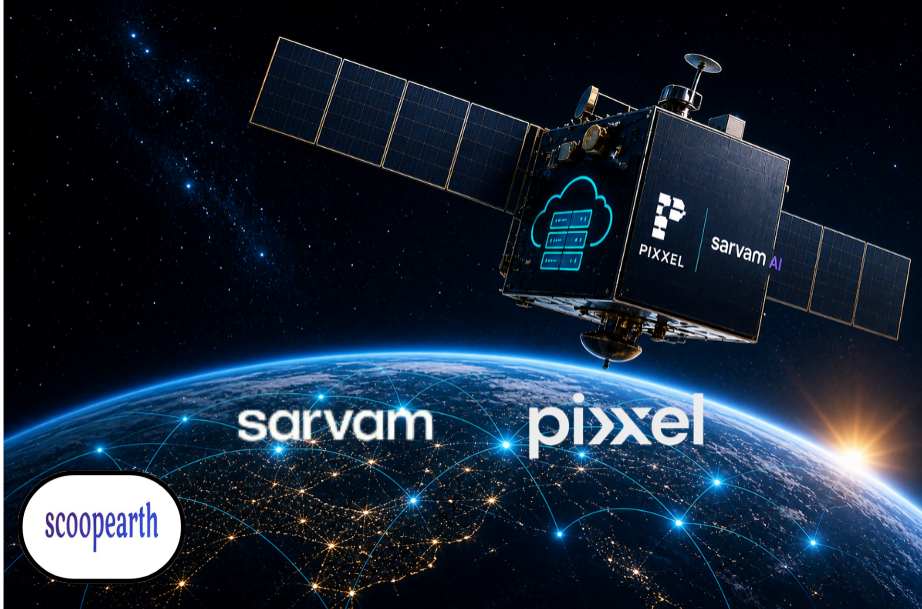
Planetary intelligence company Pixxel and artificial intelligence firm Sarvam AI have announced a strategic partnership to create and launch the first satellite orbital data centre in India, known as Pathfinder. This project is one of the significant steps that are being made to transfer high-performance computing power out of the planet and into space, effectively transforming a satellite into not a passive sensor but rather an intelligent compute node. The Pathfinder, a 200 kg-class satellite, is currently planned to enter orbit as early as the fourth quarter of 2026.
Mission of Pathfinder
The Pathfinder mission is created to respond to the swelling constraints of Earth-based information centres that are increasingly constrained by energy needs, land space, and regulation. By shifting the computing power to the orbit, the companies will be tapping the plentiful solar energy available in space while working there, being closer to the source of the data.
The project is about technology as much as it is about sovereignty. The onboard intelligence of the satellite will be powered by Sarvam AI’s full-stack artificial intelligence platform, which will be developed and governed in India. This guarantees that the entire process, such as the data capture and actionable insight. It is managed in an India-built sovereign stack, eliminating reliance on a foreign cloud infrastructure.
Technological objective and computation in orbit
Pathfinder will host data centre-quality GPUs, unlike conventional satellites that only have low-power edge processors designed to survive in extreme conditions. They share the same generation as the hardware deployed in terrestrial data centres to execute the frontier AI models. The developed hardware will enable the satellite to support foundation models that are free to engage in complex thought processes and process real-time information.
The data from the hyperspectral imaging information is observed on the board itself, instead of sending the raw images back to Earth; therefore, the system factorially reduces the latency and bandwidth demands. The capability allows near-real-time decisions, which is important in the high-stakes application of climate monitoring, infrastructure tracking, disaster response, and resource management.
The Pathfinder mission is a major demonstrator of technology. It will be subjected to tight testing to confirm AI inference, performance, power, and thermal limits in the vacuum of space. The satellite will be assembled at Pixxel subsidiary Gigapixxel, a plant designed to raise satellite production to up to 100 units.
Should it be successful, the mission will provide the technical and commercial base to a scaling network of orbital data centres. This shock toward orbital compute is not the only global and national trend playing out, as space-tech companies are hastening to bundle compute-related options with satellite systems to unlock fresh applications in defence and telecommunications.
Conclusion
The partnership between Pixxel and Sarvam AI demonstrates the shift of satellites from mere data collectors to full-scale autonomous systems led by intelligence. The collaboration aims to position India as the lead player in this new infrastructure frontier by exploiting the satellite engineering experience of Pixxel with the sovereign software stack of Sarvam AI.
Although the cost of launches of rockets and the maintenance of the hardware in space are still challenges, a successful launch of the Pathfinder would put India among the first movers in a new era where intelligence is accessible everywhere, not only on the surface of the earth but also in faraway places in orbit.