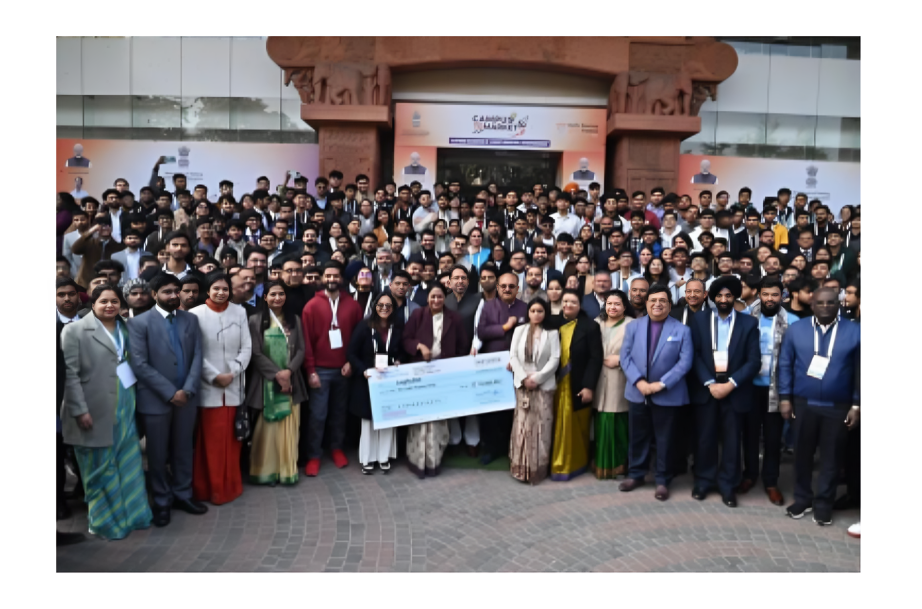
By introducing a complete Startup Policy with an investment of ₹325 crore over the next five years, the Delhi National Capital Territory (NCT) government has made a major step toward bolstering the city’s startup environment. The news was made during the Campus to Market:
Delhi Startup Yuva Festival 2026, a premier program designed to support youth-led entrepreneurship and hasten the transfer of student inventions from classrooms to actual markets.
The festival was designed as a high-impact forum to strengthen the campus-to-market pipeline and was organized by the Department of Training and Technical Education, Government of the National Capital Territory of Delhi. Student innovators, early-stage entrepreneurs, investors, incubators, academic institutions, business executives, and senior legislators were all together in one location for the event. The Government of Delhi and TiE Delhi-NCR’s partnership demonstrates a shared dedication to creating a strong, diverse, and future-ready startup ecosystem powered by young talent.
Leadership and policy vision in government
Shri Ashish Sood, Hon’ble Minister for Education, Higher Education, Home, Power, Urban Development and Training & Technical Education; Smt. Rekha Gupta, Hon’ble Chief Minister, Government of the National Capital Territory of Delhi; and Shri Jayant Chaudhary, Hon’ble Minister of State (Independent Charge) for Skill Development and Entrepreneurship, Government of India, all graced the festival. Their presence highlighted entrepreneurship and the government’s strategic development as important foundations of economic progress.
Speaking at the occasion, Shri Jayant Chaudhary emphasized the need to provide young
people with appropriate skills and India’s demographic advantage. He emphasized that only by providing young people with skills, chances for practical learning, and exposure outside of formal schooling will the entire potential of India’s demographic dividend be realized. highlighted the National Education Policy’s shift in emphasis from competency-based learning to credentials.
Delhi’s youth-led entrepreneurship
Smt. Rekha Gupta emphasized the importance of students and young innovators, saying that Delhi’s youth have the passion and inventiveness needed to create internationally competitive businesses. She pointed out that programs like the Delhi Startup Yuva Festival are intended to assist students transition from ideas to scalable enterprises by offering resources, mentorship, and advice. She highlighted the expansion of startups in India, pointing out that there are now over 2,10,000 firms and more than 120 unicorns, compared to just 500 in 2014.
Following a customary lamp-lighting ceremony, key authorities gave speeches during the ceremonial inauguration. The Secretary of the Department of Training and Technical Education, Shri Pandurang K. Pole, IAS, emphasized the need of institutional support and efficient policy implementation.
Startup showcase and influence on the ecosystem
A dynamic startup expo showcasing student-led innovations in fields including technology, sustainability, healthcare, education, skill development, social impact, and ITI-driven solutions was part of the event. Leading industry figures gave motivational talks throughout the day, covering topics including artificial intelligence, brand development, and entrepreneurial leadership.
Speaking to the audience, Shri Ashish Sood revealed the Top 100 student companies that were chosen from more than 750 submissions from Delhi’s colleges, universities, and ITIs. He described the government’s comprehensive campus-to-market strategy, emphasizing that more than 470 businesses are presently undergoing incubation, with a combined turnover of ₹500–600 crore and several job prospects. Up to ₹10 lakh in equity-free seed money will be given to chosen firms, and early-stage businesses will also receive extra assistance.
Conclusion
The new Delhi Startup Policy, which is in line with Prime Minister Shri Narendra Modi’s Vision 2047, is to provide structured finance, incubation, and mentorship to 5,000 businesses by 2035. A significant step in establishing Delhi as a premier center for student entrepreneurship, innovation, and sustainable economic growth in India is the Campus to Market: Delhi Startup Yuva Festival 2026.