The Government of Kerala has resolved, in reaffirmation of its obligation to play a leading role in the national campaign on climate change in India, to take a multi-pronged approach to speed up saturation-based energy efficiency and vigorously develop renewable energy in the state. This programme is one of the key milestones on the way to achieving the long-term goal of the state to become a national leader in environmental sustainability. It is a strategy that entails the integrated involvement of all the major governmental departments and stakeholders, and it majorly entails the use of advanced energy efficiency technologies and the amplified implementation of renewable energy.
Overall goal and long-term vision
The overall goal of collaborations is to make Kerala a leader in combating climate change. In this manner, the state tries to keep on providing high-quality and cost-effective services to its consumers and at the same time safeguard the interests of future generations and maintain the sustainability of the overall economy and the environment.
The Government of Kerala, as a major part of this long-term vision, has set itself clear targets and objectives concerning its environmental aspirations. The state has established an ambition of being carbon neutral in the year 2050 and to be 100% powered by renewable energy by the year 2040. These targets will also help in environmental benefits, but also decrease the financial cost of the state exchequer by removing dependence on traditional high-cost sources of energy and facilitating self-sufficiency with green options.
Sectoral implementation and infrastructure
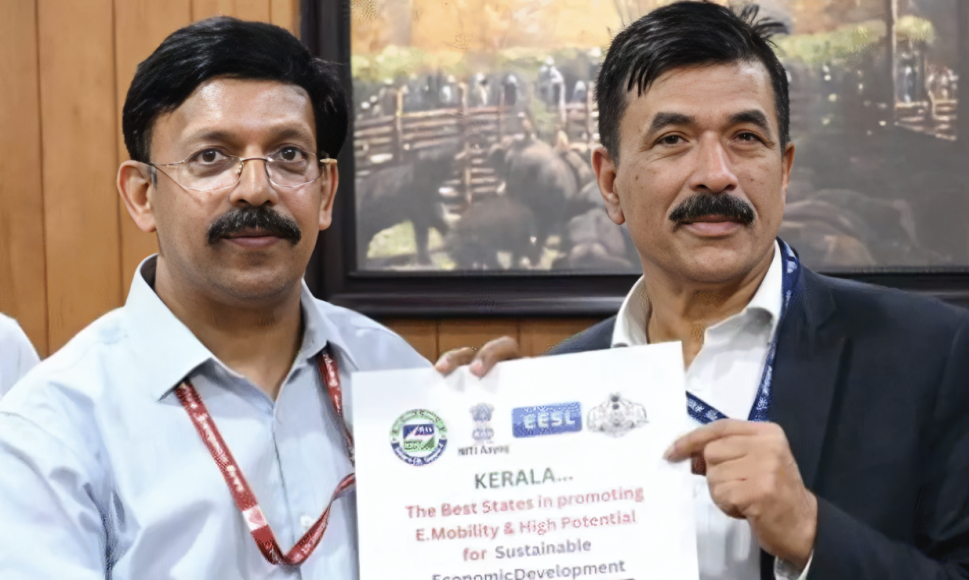
A top-level meeting was recently conducted with a delegation of EESL based in Delhi, headed by Akhilesh Kumar Dixit, the CEO of EESL, to further these goals. The officials of the state involved in this meeting included Minhaj Alam, CMD of KSEB; Patil Ajit, Kumar Keshvendra, Secretaries of the Finance Department; Harshil R. Meena, CEO of ANERT; Hari Kumar, Director of EMC and KN Mathew, State Head of Energy Efficiency.
The talks were focused on the actual implementation of energy efficiency high technology in various sectors. Amongst the flagship proposals is the transformation of about 25,000 government buildings as prosumers through solarisation and the incorporation of Battery Energy Storage Systems (BESS). This change is projected to reduce the yearly power bill of the state by almost 300 crore, and also, the excess power can be sold back to the grid during peak hours.
In addition to the development of efficiency, the roadmap includes statewide conversion to LED street lighting and a massive expansion in publicly accessible electric vehicle (EV) charging systems. The state also intends to electrify 12,000 government vehicles and is looking to adopt Vehicle-to-Grid (V2G) technology. The programme has examined the PM E-DRIVE programme, which seeks to roll out 10,900 electric buses around the country in order to enhance good air quality in cities. These group activities have already gained Kerala a national identity, such as the National Energy Conservation Award, which already indicates that it can be a model in clean energy transition.
Conclusion
The multi-pronged approach to climate change in Kerala is a pioneering step and a concerted effort to respond to the global climate crisis at a subnational scale. The state is also establishing itself as a sustainable innovation laboratory by combining the high-tech approach with high-ambition policy objectives, including the 2040 renewable energy target and the carbon neutrality target by 2050.
The emphasis on achieving self-sufficiency in government infrastructure and the encouragement of the overall EV ecosystem show an interest in financial accountability and environmental accountability. As these plans proceed to the ground-level implementation of high-level plans, Kerala will be a critical example to other states in India who are pursuing a way to a greener and more reliable future.