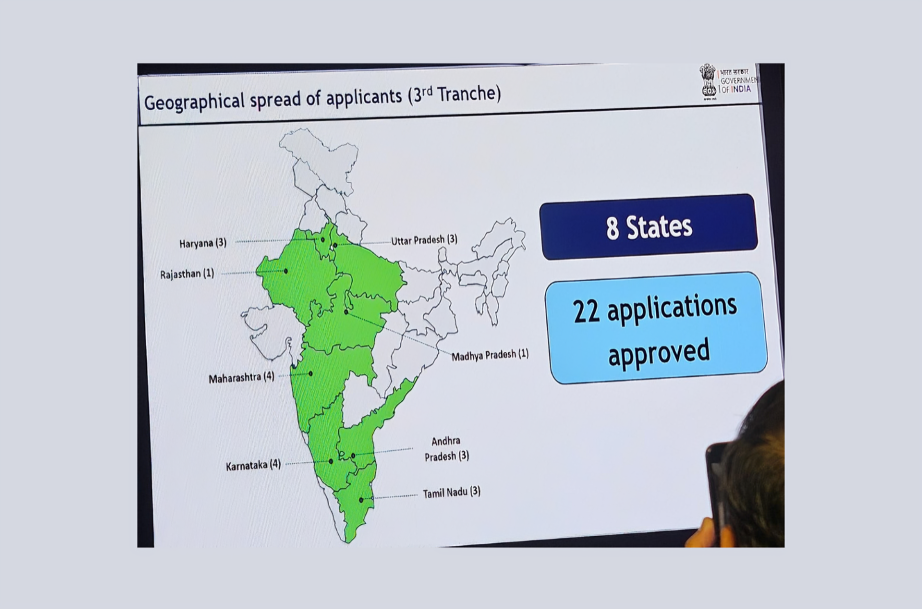
The approval of the third tranche of projects through the Electronics Component Manufacturing Scheme (ECMS) has been a milestone in the Government of India becoming a global electronics manufacturing hub. The Ministry of Electronics and Information Technology (MeitY) announced that 22 new applications have been cleared, and this is a historic cumulative investment intention of ₹41,863 crore. This declaration, at a high-profile event in New Delhi, is a significant upgrading of the extent of the scheme, toward a much more comprehensive integration of Indian companies into global value chains, and strengthening the domestic electronic ecosystem.
Approval and geographical growth
The adoption of these 22 new proposals is a breakthrough move to the ECMS, which initially had been announced in April 2025 with an overall fiscal commitment of ₹22,919 crore. Through this new tranche, the scheme has broken the mark of 46 approved projects. It is projected that the production value of these 22 applications will be an astonishing ₹2,58,152 crore, which exceeds the production value of the first and second tranches by a significant margin.
Union Minister of Electronics and Information Technology Ashwini Vaishnaw, as he handed the approval letters to the industry players, pointed out that the scheme is opening the second stage of value chain integration, where the final piece devices are assembled to the more important stage of component and sub-assembly production.
The ECMS third tranche deals with the manufacturing of eleven different and essential product segments. These are the building blocks of several high-growth markets such as mobile phones, telecommunications equipment, consumer electronics, automotive electronics, and industrial applications. The project is concentrated on five categories of bare components that are: printed circuit boards (PCBs), capacitors, connectors, enclosures, and lithium-ion cells. It includes three key sub-assemblies, including camera modules, display modules, and optical transceivers, and three items of the supply chain, such as aluminium extrusion, anode material, and laminates.
These projects are going to be set up in eight states, namely Andhra Pradesh, Haryana, Karnataka, Madhya Pradesh, Maharashtra, Tamil Nadu, Uttar Pradesh, and Rajasthan, in order to achieve geographically balanced industrial growth. This prolific dispersion highlights the government’s determination to increase the presence of high-tech manufacturing beyond the conventional clusters. The involvement of key players of the industry, including Dixon Technologies, Samsung Display Noida, Hindalco Industries, and a unit of Foxconn, Yuzhan Technology India, can also be pointed out as additional evidence of the confidence in the manufacturing abilities of India, both globally and domestically.
Vision and employment
Among the major consequences of the third tranche is the anticipated creation of 33,791 direct jobs in the participating states. Smaller, but technically important facilities are also being set up, including the multi-layer PCB plant of Vital Electronics in Maharashtra and the battery material plant of NPSPL Anode Material in Andhra Pradesh.
These plants are necessary to decrease the reliance on imports of important electronic parts. Through encouraging the manufacturing of more specialised products, such as camera modules by Kunshan Q Tech and connectors by Amphenol High Speed Interconnect India, the government is making the domestic value chain more independent and resilient to events in the global supply chain.
The Electronics Component Manufacturing Scheme is one of the foundations of India in achieving a total electronics manufacturing worth of $500 billion by the fiscal year 2030-31. The success of this scheme has been so tremendous that it has already been applied to 249 schemes offering total investments of ₹1.15 lakh crore, which is far more than what it had set out initially.
The ECMS will help India to have an inbuilt and natural competitiveness because its strategic approach to establishing the manufacture of deep-tier components instead of merely final assembly will make India competitive. This is meant to ensure that the industry does not shift to other places despite the future increases in labor costs, since the industry will have a sustainable competitive edge due to the deep industrial roots developed by producing components.
Conclusion
The sanctioning of the third tranche of the ECMS with an outlay of ₹41,863 crore is a conclusive move to turn India into an “Atmanirbhar” or self-reliant country in the electronic supply chain. The government is not just increasing domestic production and reducing the dependency on imports; by the government sponsoring 22 applications across a variety of states and product segments, the government is also employing tens of thousands of high-quality jobs. The swift implementation and good reception of both the global and domestic investors are a good indication of a brighter future for the high-tech manufacturing industry in India.