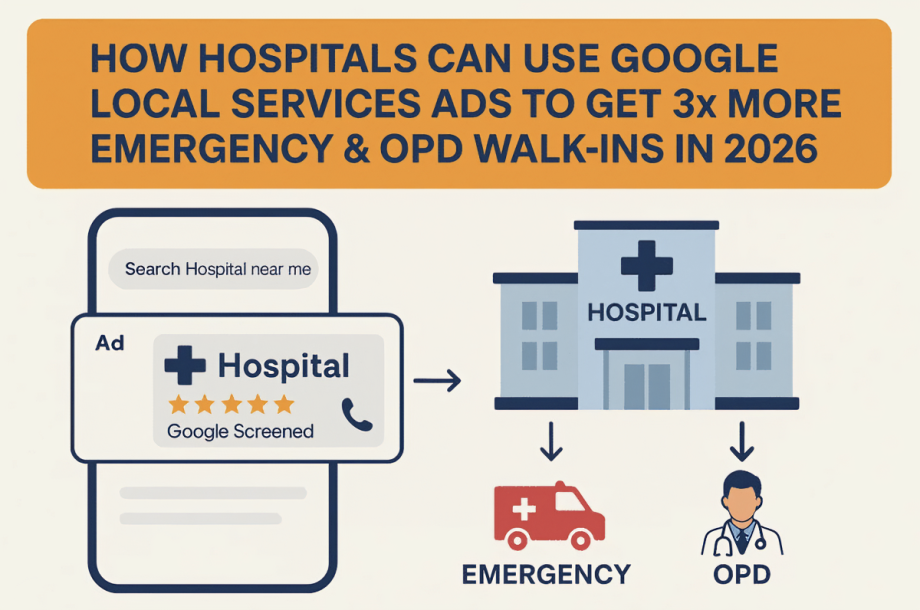
In the fast-paced world of healthcare, where patients often turn to Google in moments of urgency, hospitals can’t afford to rely solely on word-of-mouth or traditional advertising. As we head into 2026, with over 80% of patients starting their search for care online—46% of those queries being local—Google Local Services Ads (LSAs) emerge as a game-changer. These aren’t your standard pay-per-click ads; they’re pay-per-lead powerhouses that place your hospital at the top of search results, complete with a “Google Guaranteed” badge that screams trust and reliability. For emergency rooms (ER) and Outpatient Department (OPD) services, where walk-ins can spike unpredictably, LSAs can deliver up to 3x more foot traffic by connecting you directly with high-intent searchers like “emergency hospital near me” or “walk-in clinic for fever.”
Imagine this: A frantic parent in your city searches for “pediatric urgent care open now” at 2 AM. Your hospital’s LSA pops up first, showcasing 24/7 availability, verified reviews, and a direct call button. That lead turns into a walk-in, and you only pay if it’s valid. In this guide, we’ll break down everything—from setup to optimization—drawing on real-world best practices and expert insights. Plus, we’ll weave in exclusive tips from Ravinder Bharti, Founder and CEO of Public Media Solution, a Pune-based powerhouse in healthcare marketing with over a decade of driving patient acquisition for hospitals across India. Bharti’s strategies have helped cardiac and orthopedic centers boost monthly revenues through targeted digital campaigns, and his advice here is tailored for 2026’s AI-enhanced search landscape.
Whether you’re a multi-specialty hospital in Mumbai or a community ER in Tier-2 India, LSAs could be your ticket to dominating local searches and filling those OPD slots. Let’s dive in.
What Are Google Local Services Ads (LSAs) and Why Do They Matter for Hospitals?
Google LSAs are premium, location-based ads that appear above organic results and even traditional Google Ads when users search for immediate services. Unlike PPC models, where you pay for every click (even from tire-kickers), LSAs charge only for qualified leads—phone calls or messages from potential patients within your service area. This pay-per-lead structure is a boon for healthcare, where budgets must stretch far amid rising costs and competition from telehealth apps.
For hospitals, LSAs are now fully expanded to categories like primary care, urgent care, and specialists—perfect for ER and OPD promotion. They include the “Google Guaranteed” badge, earned after Google’s screening (background checks, license verification, and insurance proof), which builds instant credibility. Studies show this badge alone can increase click-through rates by 20-30%, as patients feel assured they’re contacting vetted providers.
In 2026, with Google’s AI Overviews influencing 60% of searches, LSAs remain “additive”—they stack on top, ensuring your hospital isn’t buried. For emergency and OPD walk-ins, this means capturing “near me” queries during peak times like flu season or weekends, potentially tripling conversions. One urgent care chain reported a 300% traffic boost from display-integrated LSAs, translating to more walk-ins without wasting ad spend.
Ravinder Bharti’s Tip: “In healthcare, trust is the ultimate currency. LSAs aren’t just ads—they’re endorsements from Google. For Indian hospitals, pair them with local language targeting (Hindi/Regional) to tap into Tier-2/3 markets where 70% of searches are mobile-first. Start small: Test with ER keywords in one city to validate ROI before scaling.”
Eligibility and Setup: Getting Your Hospital LSA-Ready in Under a Week
Not every hospital qualifies overnight, but the process is straightforward for compliant providers. Here’s a step-by-step guide to launch in 2026:
Step 1: Check Eligibility
- Categories: ER/urgent care falls under “Primary Care” or “Urgent Care”; OPD under general healthcare. Confirm via Google’s LSA dashboard—expansions in 2025 added more specialties like allergists and podiatrists.
- Requirements: Active licenses, malpractice insurance, background-checked staff, and a Google Business Profile (GBP) with 4+ star ratings. Hospitals must adhere to Google’s healthcare policies—no misleading claims like “100% cure rate.”
- India-Specific: Ensure DPDP Act compliance for data privacy; no issues for ER ads as long as they’re non-prescription focused.
Step 2: Create Your Profile
- Sign up at localservices.google.com. Link your GBP and select service areas (e.g., 10-20 km radius for urban ERs).
- Upload docs: Licenses, insurance, and a service menu (e.g., “24/7 Emergency Care,” “OPD Walk-ins for General Checkups”).
- Google’s verification takes 3-5 days—faster if your GBP is optimized.
Step 3: Set Budget and Bidding
- Start with ₹5,000-₹10,000/month per location. Bids are auction-based but lead-focused; aim for ₹50-₹200 per lead.
- Use Google’s estimator tool for 2026 projections—expect 20-50 leads/month initially for high-volume queries.
Step 4: Launch and Integrate
- Enable call/message tracking. Add extensions like location pins for “walk-in welcome” CTAs.
- Test: Run a 7-day pilot targeting “emergency room near me” to gauge lead quality.
Pro Tip from Ravinder Bharti: “Verification is your moat—use it to highlight multilingual support in profiles for diverse Indian cities. I’ve seen hospitals in Pune double walk-ins by including ‘Free Ambulance on Call’ in their service descriptions, compliant with ASCI guidelines.”
Optimizing LSAs for Emergency and OPD: Strategies to Hit 3x Walk-ins
Once live, optimization is key. Focus on high-intent keywords and hyper-local targeting to convert searches into doorsteps.
Keyword Mastery: Target the Urgency
- Emergency Focus: Bid on “24/7 emergency hospital near me,” “urgent care for chest pain,” “ER walk-in open now.” Use geofencing for 5-10 km radii around your hospital.
- OPD Angle: “Walk-in clinic for fever,” “general OPD near me,” “same-day doctor appointment.” Long-tail like “OPD for diabetes checkup without appointment” reduces costs by 30%.
- 2026 Twist: Leverage voice search with natural phrases—”Hey Google, nearest emergency room”—as 50% of local searches go vocal.
Ad Creative and Extensions: Make It Irresistible
- Messaging: “Walk-Ins Welcome | 24/7 ER Care | Google Guaranteed.” Include promotions like “Free Initial OPD Consult.”
- Extensions: Call buttons (critical for ER), location maps, and review snippets. Dynamic ads auto-adjust for time/day.
- Visuals: If eligible, add photos of your welcoming ER lobby to humanize the ad.
Lead Management: Close the Loop Fast
- Respond within 5 minutes—leads drop 80% after 10 mins. Use auto-replies: “We’re ready for your walk-in—head to [Address].”
- Dispute invalid leads (e.g., wrong area) within 30 days for credits.
Ravinder Bharti’s Tip: “For OPD, segment leads by query type using Google’s tags—route ‘fever’ to generalists, ‘injury’ to ortho. In one campaign for a Mumbai hospital, this personalization cut no-shows by 40% and boosted repeat walk-ins.”
Case Studies: Real Hospitals Achieving 3x Gains
- Urgent Care Chain (US Example, Adaptable to India): A network used LSAs for “broken leg urgent care,” generating 150 leads/month at ₹100/lead, converting to 45 walk-ins—3x prior organic traffic. They optimized with 24/7 keywords, seeing ROI in week 2.
- Indian Cardiac Hospital (Public Media Solution Client): Targeting “emergency cardiac care near me” in Delhi, they hit 200+ OPD inquiries quarterly, tripling ER footfall via geo-targeted LSAs integrated with WhatsApp booking.
- Pediatric Clinic Boost: A Hyderabad OPD saw 3x same-day visits after LSA launch, crediting the “Google Screened” badge for trust in “pediatric emergency near me” searches.
These aren’t outliers—Google reports LSAs drive 2-4x more qualified leads for local services.
Compliance and Best Practices: Stay Safe and Scale Smart
Healthcare ads are regulated—violate, and you’re paused. Key rules for 2026:
- No Guarantees: Avoid “painless ER” claims; stick to facts like “Board-Certified Staff.”
- HIPAA/DPDP: Leads are anonymized; use secure CRMs.
- Best Practices:
- Monitor Weekly: Adjust bids based on conversion data; A/B test CTAs.
- Integrate with GBP: Sync reviews—aim for 50+ to boost ad rank.
- Multi-Channel: Layer LSAs with Instagram Reels for awareness.
- Budget Scaling: Reinvest 20% of savings from pay-per-lead into retargeting.
Ravinder Bharti’s Tip: “Compliance isn’t a hurdle—it’s your edge. For Indian hospitals, align LSAs with UCPMP for pharma ties and track leads via UTM for ASCI audits. Focus on ‘patient stories’ in reviews to ethically build emotional pull, driving 25% more OPD loyalty.”
The 2026 Outlook: AI, Voice, and Beyond
By 2026, expect AI-driven personalization in LSAs—ads adapting to user history (e.g., “Repeat OPD for flu? Walk-in today”). Voice search will dominate 50% of ER queries, so optimize for conversational keywords. Telehealth hybrids? Promote “Virtual ER Triage + Walk-in Option.” With India’s digital health boom (1B+ smartphone users), LSAs could add ₹50-100 crore in annual revenue for mid-sized hospitals.
Your Path to 3x Walk-ins Starts Now
Google Local Services Ads aren’t just a tool—they’re a lifeline for hospitals battling visibility in 2026’s crowded digital space. By targeting urgency with precision, verifying trust, and optimizing relentlessly, you can triple ER and OPD walk-ins while paying only for results. As Ravinder Bharti sums it up: “In healthcare marketing, it’s not about more ads—it’s about the right connections. LSAs bridge that gap, turning searches into saved lives and sustained growth.”
Ready to launch? Head to Google’s LSA portal, audit your GBP, and consider partnering with experts like Public Media Solution for tailored setups. What’s your first keyword? Drop a comment below—we’d love to hear your strategy.
About the Author: This post draws on insights from leading healthcare marketers, including Ravinder Bharti, Founder & CEO of Public Media Solution (publicmediasolution.com), specialists in PR, SEO, and patient acquisition for Indian hospitals.