Swish deals with ultra-fast food delivery. Swish has raised $38 million in a new funding round. Hara Global and Bain Capital Ventures led this huge capital injection. It was also attended by Accel, an existing investor, and venture debt funding provided by Alteria Capital and Stride Ventures.
This new capital injection highlights the increasing investor confidence in the specialized business model of Swish, despite the major player competitors struggling to compete in the instant food delivery sector.
Strategic expansion and foundation of Swish
This round of funding, according to the current estimates, has taken Swish to approximately ₹1,267 crore (approximately $140 million) post-money. This is a huge increase of more than 2.4 times its last valuation, which is evidence of the high rate of growth the company has developed over a fairly short period.
Swish raised $14 million in a Series A round that was led by Hara Global and Accel, with a previous seed round of $2 million raised in late 2024. The repetitive attention by major venture capital firms implies that Swish has established a niche that is viable and distinct in the Indian startup ecosystem.
The new capital of this round of $38 million will be directed to achieve two main purposes: facilitating the geographic growth of the business and enhancing the specialized delivery system of the company. Swish will utilize the capital to leave behind its existing strongholds and create a presence in the new areas of demand.
The investment will also go a long way in improving its technical and logistic capability so that the 10-minute delivery promise will not be compromised as the number of orders keeps rising. Swish wants to continue its competitive advantage in a market where speed and reliability are the final differentiators by strengthening its quick delivery infrastructure.
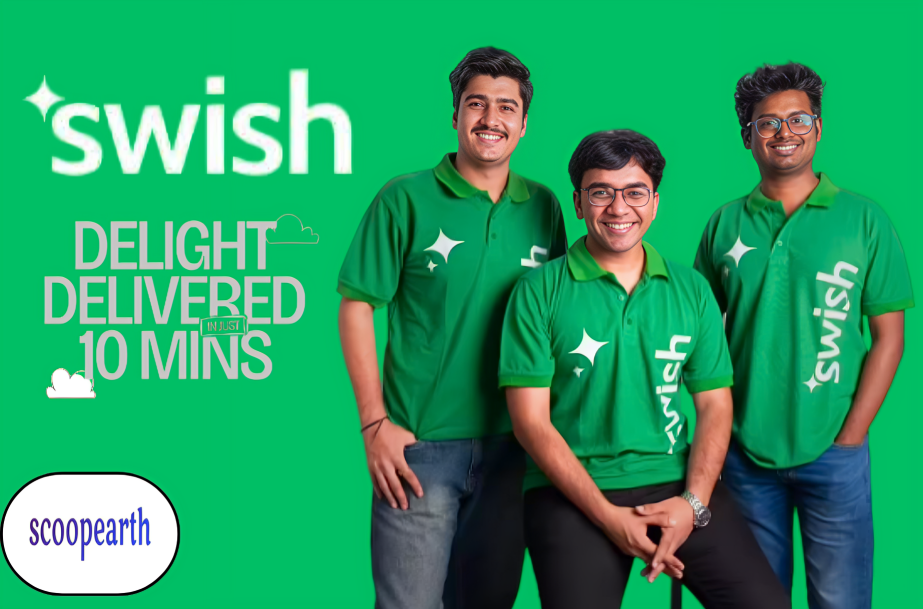
Aniket Shah, Sureshkumar Saran, and Ujjwal Sukheja established Swish in 2024. Swish is based on a hyper-local concept that works to achieve maximum effectiveness. The company employs a system of cloud kitchens, which it calls delight centres, which are strategically located near high-demand residential and commercial properties.
Unlike the conventional food delivery service, which can span a large radius, Swish is limited to a small delivery area, usually between 1.5 and 2 kilometres of a distribution centre. This limited radius is the key to their ability to deliver ultra-fast turnaround times and have fresh meals delivered to consumers almost immediately after being cooked.
Challenges and financial performance
The achievement of Swish is achieved at a time when the ultra-fast food delivery market in India has been extremely volatile and even had several strategic withdrawals by the larger incumbents in the industry. The largest competitors, such as Zomato and Swiggy, have recently chosen to close their own quick delivery apps. Snacc, a Swiggy quick delivery app, was closed after one year of its release.
Quick, launched by Zomato, has discontinued its 15-minute delivery service, soon after it was first launched. Even Zepto, a leader in the larger quick commerce market, has been reported to reduce its vertical, the Zepto Café, and close about 200 of its 600 outlets as part of an internal restructuring initiative. Ola too has shelved its plans of delivering food after a failed attempt at re-launching it.
Swish does seem to be going against the trend despite these industry-wide setbacks. The emphasis it has on its full-stack approach, in which it controls all the aspects of the user experience, including food preparation in its own cloud kitchens, final delivery, and so on, will enable the company to have more control over the entire user experience.
Although the Zomato-owned Blinkit still delivers its instant food delivery service, Bistro, Swish is establishing itself as a 10-minute specialist. This exclusive approach has enabled the start-up to expand its order volumes per day, which have increased by about 5,000 orders to about 20,000 orders in the past four months.
The growth rates of the company help give an insight into the magnitude of its aspirations and the expenditure on bringing up a new retail category. Swish started its operations officially in the 2025 fiscal year and recorded a revenue of ₹4 crores in the period between July 8, 2024, and March 31, 2025.
The company had also experienced a net loss of ₹19 crore in the same period, which can be attributed to the massive initial investments needed to develop its delight centres and marketing presence. The target will be to capitalize on economies of scale as the company spreads its footprint and increases the number of orders in order to get itself into a more sustainable financial position.
The existing shareholder composition has a high complement between the founders and their institutional investors. Accel India is still the largest shareholder with 26.2%, and Hara Global has a share of 20.43% after the allotment of the new round.
The current proportion of new investor Bain Capital Ventures stands at 7.19%, with the three co-founders holding about 12.72% each. This balanced cap table will offer the company the governance and financial expertise to manage the complexity of the Indian food-tech market.
Conclusion
The Swish raise of $38 million is an important milestone in the history of the 10-minute food delivery model in India. Swish is one of the few companies that have been able to demonstrate the viability of ultra-fast delivery of food as it continues to roll out this capital to increase its network of delight centres and streamline its logistical operations. The road to profitability in such an operationally complex and capital-intensive segment is long and difficult. With the high volume growth and focused infrastructure, Swish is better than most of its competitors to undertake the task.