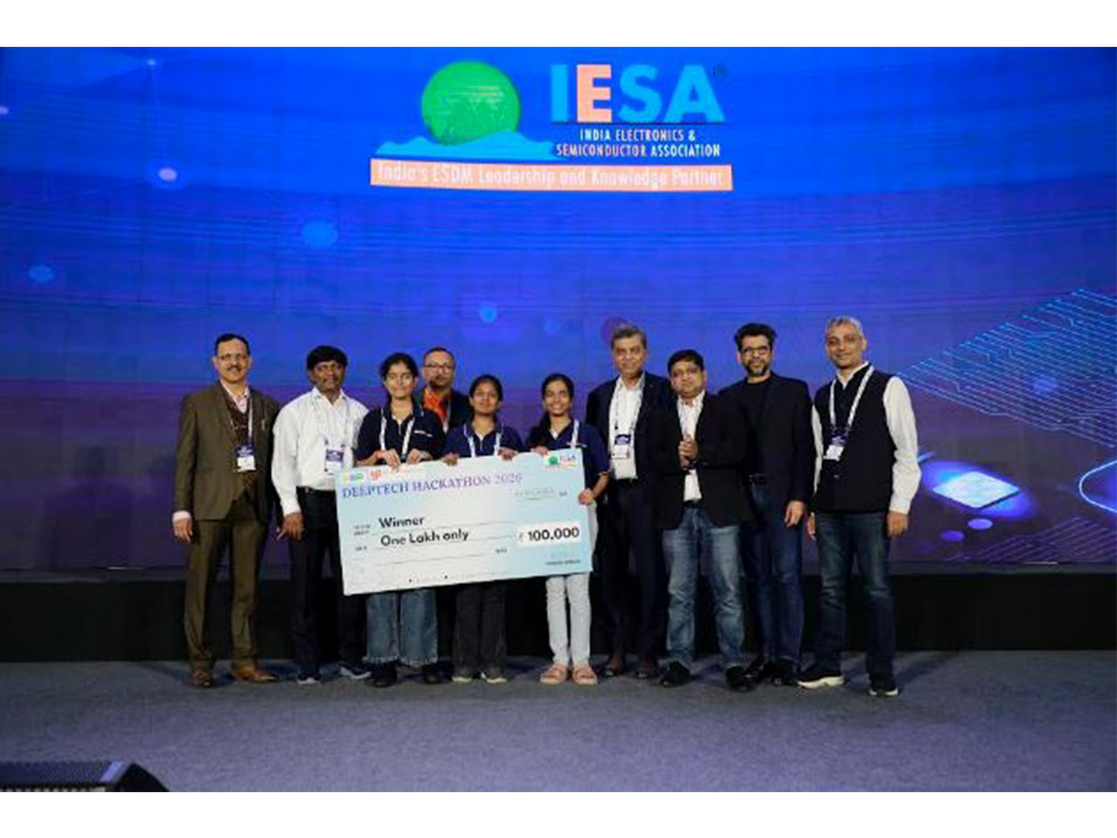
In a historic collaboration between India Electronics and Semiconductor Association (IESA), GlobalFoundries (GF) India, and NXP Semiconductors, the DeepTech Hackathon Grand Finale has been successfully accomplished. It was a high-impact event that was hosted at IESA Vision Summit 2026, in Bengaluru, as a driver towards turning India into a full-fledged and self-sustaining semiconductor fabricating ecosystem on a design-based platform instead of the talent pool.
Expansion and reliability
India has a long-standing reputation for rich semiconductor design capability. With the country gaining pace in the realization of its self-chip production facilities, the forerunners in the industry are insisting on the necessity to increase proficiencies throughout the whole chain of value. DeepTech Hackathon was specially designed to fulfill this urgency to identify, develop, and accelerate breakthrough innovations as well as breed a talent pipeline capable of responding to future demands.
The hackathon, held in collaboration with the Inter-Institutional Inclusive Innovations Center (i4C), put the best brains of engineering in the country to the challenge of solving real-world problems in industries. The participants were required to come up with state-of-the-art solutions based on AI-based Electronic Design Automation (EDA) workflows. The research problem statement involved developing an Edge AI-based Defect Classification System on Semiconductor Images, which is an imperative element in achieving high yields and reliability in contemporary semiconductor fabrication.
Journey and focus
The competition attracted outstanding participation from the Indian engineering community, which shows that the sphere of deep-tech continues to gain more and more interest. The hackathon received 911 teams in 359 colleges around the country. This enormous interest yielded 532 quality submissions of ideas, and the evaluation procedure was carried out in a strict, multi-phase process involving industry mavens and academic veterans.
The trip of the participants consisted of multiple qualification rounds, deep dives into technologies, and special mentorship. This interaction enabled students and professionals in the early stages of their careers to perfect their prototypes and bring their solutions to the real needs of the industry. The 10 finalist groups were then chosen to perform their work in the Grand Finale, which was held in the IESA Vision Summit 2026, the most powerful meeting of the electronics and semiconductor leaders in India.
The fact that the hackathon is centered on Edge AI and defect classification reflects a critical tendency within the industry, which is the incorporation of artificial intelligence to streamline manufacturing processes. The initiative has allowed the development of high-demand skills, such as creating systems that can be used to classify microscopic defects in wafer and die images by posing challenges to the students. These are necessary solutions regarding the time-to-market and cost-effectiveness of producing the chips.
The support of the event by industry sponsors, such as GlobalFoundries India and NXP Semiconductors, was crucial to the technical scope of the event. Having them involved made sure that the participants were not only solving hypothetical problems in theory, but they were also working on prototypes that could possibly be implemented into the current fabrication lines. This academic-industrial synergy is regarded as an essential move towards closing the skill gap and making India a culture of design-led manufacturing.
Conclusion
DeepTech Hackathon Grand Finale at IESA Vision Summit 2026 is a landmark in the history of what India hopes to accomplish in terms of its semiconductor and AI industry. Through offering a national medium to the talent to demonstrate breakthrough innovations, the event has successfully sparked the next generation of deep-tech leadership in the country.
The effective presentation of AI-based solutions by the finalist teams confirms that India is now willing to play a more important role in the global semiconductor value chain. Once these young innovators enter the workforce, they will be bringing with them the practical experience and technical skills, making them a self-reliant and innovative electronics ecosystem in the future.