Hyderabad-based space technology startup TakeMe2Space has successfully raised $5 million in a seed funding round, led by Chiratae Ventures. This round also attracted investments from Unicorn India Ventures, Artha Venture Fund, and Seafund. This funding represents a significant step forward in the company’s ambition to create India’s inaugural orbital data centre infrastructure and enhance AI computing capabilities directly in space.
The funds will be allocated towards expanding TakeMe2Space’s satellite constellation, bolstering in-orbit AI computing capabilities, and accelerating research into high-power compute satellites that can manage advanced workloads beyond our planet.
Launch of MOI-1 Satellite Marks the Beginning of OrbitLab Vision
Founder and CEO Ronak Kumar Samantray expressed optimism as 2026 kicks off with the anticipated launch of the company’s first major satellite, MOI-1, which will power its OrbitLab platform. He mentioned that the company is transitioning from a single satellite-based solution to a comprehensive, interconnected satellite infrastructure.
The 14-kg MOI-1 satellite is set to launch on January 12 aboard ISRO’s PSLV C-62 mission. Equipped with the MIRA space telescope, this satellite is designed to operate as an ‘AI lab in space,’ enabling around 15 customers to conduct experiments and run AI workloads in orbit.
Future Plans Include Satellite Replication and New Missions Looking ahead, TakeMe2Space aims to launch MOI-2, which will replicate the capabilities of MOI-1 and boost the company’s total in-orbit compute capacity to nearly
200 watts. Additionally, the upcoming AaduSat mission will focus on demonstrating propulsion systems for orbit maintenance and validating optical satellite communication links.
The AaduSat mission will also explore the use of silicon-based solar cells in orbit, presenting an alternative to the traditional triple-junction gallium arsenide cells typically employed in space applications.
Creating a Distributed Data Centre in Space
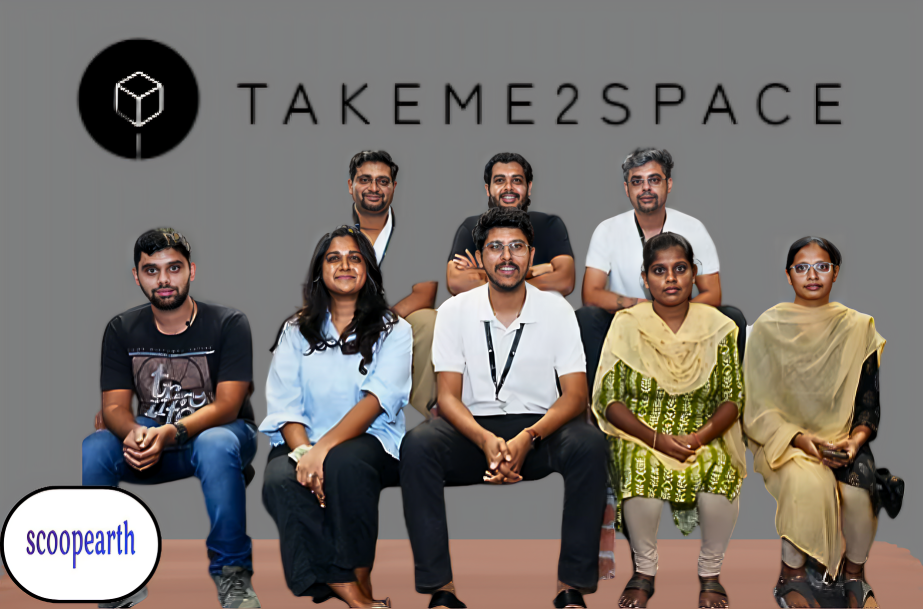
Founded in 2024, TakeMe2Space is dedicated to developing high-compute satellites and an orbital platform that enables customers to deploy and operate AI models directly in space. The company’s goal is to democratise access to space-based experimentation, allowing users from various backgrounds to conduct satellite missions without institutional barriers.
As part of its long-term vision, the startup plans to deploy six satellites to support the OrbitLab platform. Collectively, these satellites will provide nearly 5 kilowatts of in-orbit compute capacity and will be interconnected through optical inter-satellite links, laying the groundwork for a distributed space-based data centre.
Team Expansion and Global Market Strategy
Samantray highlighted that expanding the team will be a top priority in the coming months, with plans to increase the workforce from 17 to approximately 50–60 employees across engineering and sales roles. The funding will also facilitate TakeMe2Space’s growth in India, the United States, and Australia.
The company intends to strengthen partnerships with ground station operators and satellite assembly providers while enhancing customer support to promote the adoption of its orbital computing services.
Investor Confidence and Technological Validation\
Commenting on the investment, Ranjith Menon, managing director at Chiratae Ventures, noted that TakeMe2Space is redefining access to orbit by transforming satellites into shared infrastructure. He emphasized that the founding team’s strong execution capabilities were pivotal in securing the investment.
Previously, the startup successfully tested its MOI-TD (My Orbital Infrastructure – Technology Demonstrator) aboard ISRO’s SpaDeX mission in December 2024. This test validated encrypted AI model uploads, in-orbit code execution, secure data downlinking, and radiation shielding technology designed to extend satellite lifespan using standard electronic components.